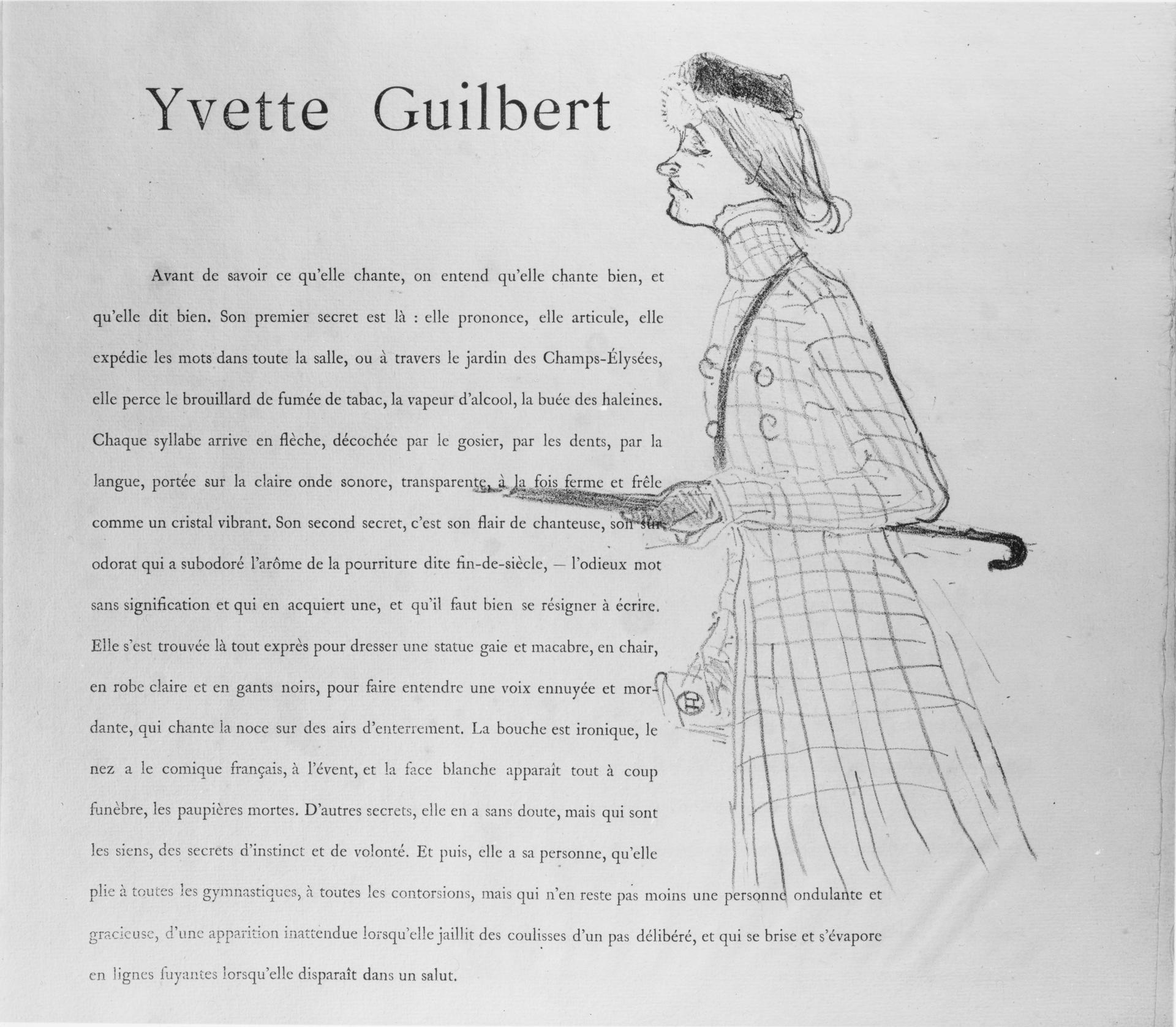
Yvette Guilbert (1894, Met-Objekt 967)
Original title: Yvette Guilbert
kurzbeschreibung
In 1894, Henri de Toulouse-Lautrec portrayed the French singer and actress Yvette Guilbert. Unlike many of his stage portraits, this lithograph shows her in profile, wearing a checkered top and carrying an umbrella. Her hair is tied in a knot. The print is in black and white; the image measures 27 × 21.5 cm, the sheet 42 × 32.5 cm.
Description
Guilbert appears here from the side, her body turned slightly to the left. She wears a checkered top and holds an umbrella; her hair is gathered into a knot, with a head covering on top. The background remains empty and understated, so the figure stands out clearly. The absence of color sharpens the contours and makes visible the structures of her clothing and face.
Context
This print was made in 1894, when Toulouse-Lautrec was deeply engaged with Parisian nightlife. Yvette Guilbert was a well-known cabaret singer whose performances were both elegant and ironic. The portrait belongs to a series of likenesses Lautrec made of stage artists. The lithograph circulated as a single sheet or in connection with posters, which explains its presence in public spaces.
Impact
Because all extraneous detail is missing, the eye goes immediately to the figure and her posture; this gives the image a calm but distinct presence. The clear lines and open background make the portrait seem timelessly elegant and bring Guilbert's artistic personality to the fore.
Technique
The work was made using lithography, in which a drawing is applied with greasy chalk to a limestone. The black-and-white print exploits the contrasts of this process to create fine gradations and textures. The technique allowed Toulouse-Lautrec spontaneous, lively lines, as are typical of his style.
AI-generated description text
Source: Metropolitan Museum of Art · Public Domain (CC0 1.0)