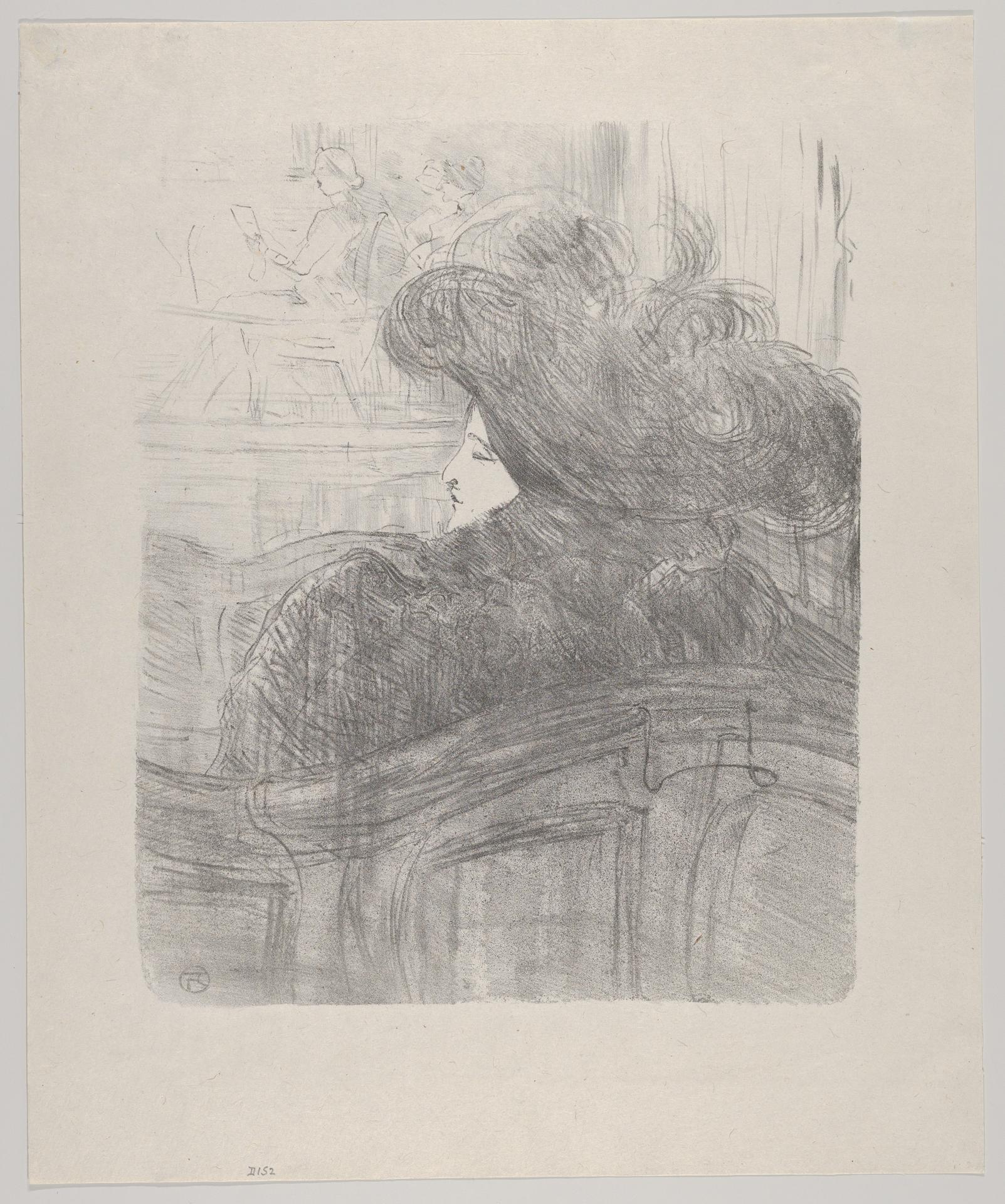
Cléo de Mérode
Original title: Cléo de Mérode
kurzbeschreibung
Henri de Toulouse-Lautrec drew the celebrated dancer Cléo de Mérode in 1898 using a crayon lithograph with scraper on china paper. The print presents her from behind inside a room.
Description
A woman sits on a sofa with her back to us, her wavy hair spilling over one shoulder. Behind her, other figures converse at a table. The view takes place indoors, likely in a café, and remains in shades of gray. Light falling from the front picks out the contours of the figures.
Context
Cléo de Mérode was a well-known dancer and social figure in Belle Époque Paris. Toulouse-Lautrec made the portrait as a lithograph, a medium he used often in the 1890s. The work dates from a period when the artist frequently captured nightlife and its participants in prints.
Impact
The rear view feels intimate, almost voyeuristic, while the everyday situation gives off a relaxed mood. The gray tones and delicate lines lend the sheet a calm, elegant presence.
Technique
For the lithograph, Toulouse-Lautrec used crayon on china paper and then worked it with a scraper to bring out fine highlights and textures. The china paper provides a smooth surface and detailed reproduction.
AI-generated description text
Source: Metropolitan Museum of Art · Public Domain (CC0 1.0)