IV. A Menilmontant de Bruant
Original title: IV. A Menilmontant de Bruant
kurzbeschreibung
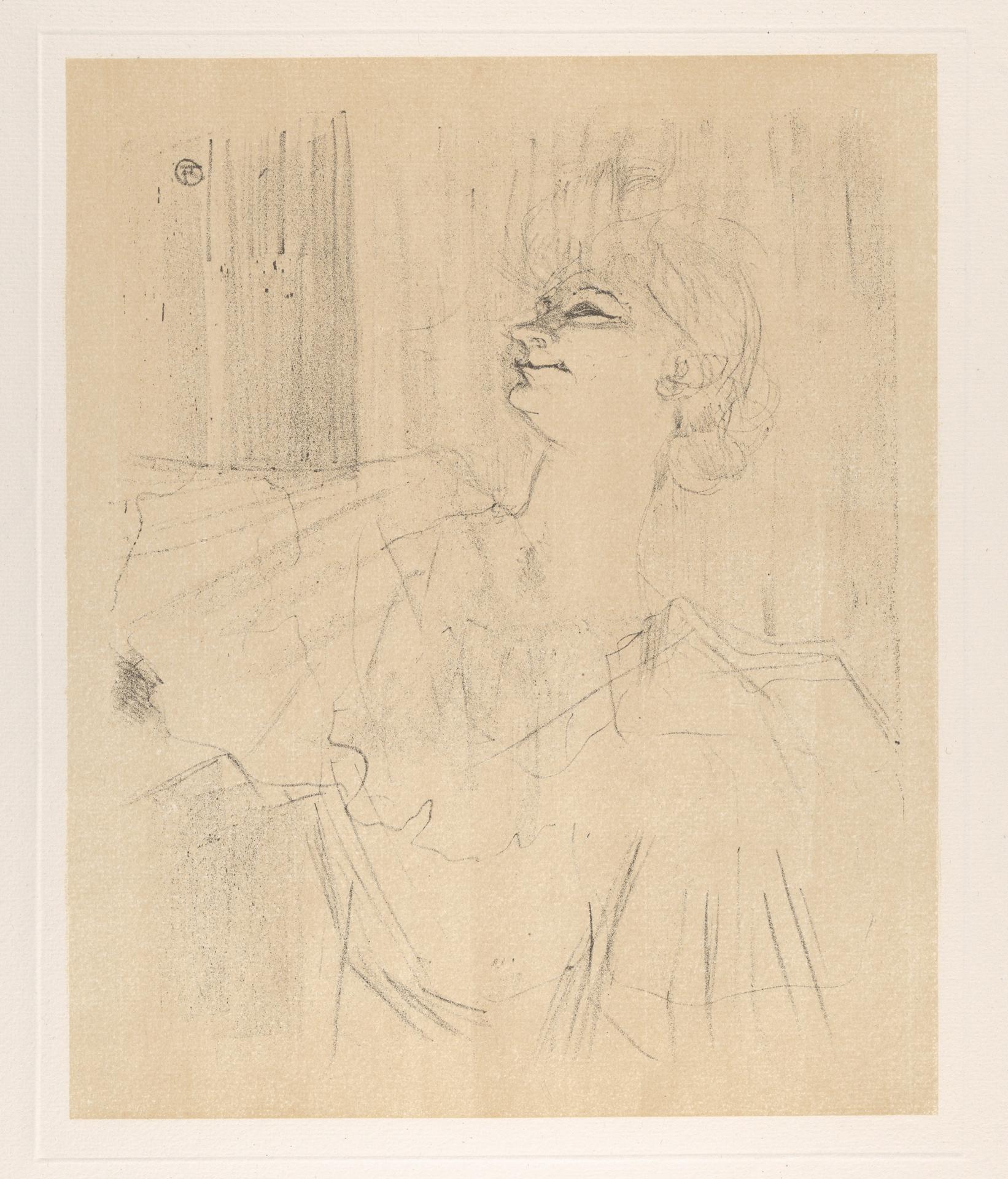
Henri de Toulouse-Lautrec made this lithograph, "IV. Ein Menilmontant von Bruant," in 1898. It shows a woman in profile and belongs to a series devoted to the cabaret singer Aristide Bruant and his circle. The print was pulled on laid paper with a beige tint stone.
Description
The woman appears in profile, her gaze turned upward. She wears a dress with a striking neckline, and her hair is pinned up in a curly knot. Coarse yet precise strokes shape her features. Vertical stripes suggest a window or door behind her. Gray dominates the palette, with a light beige background and darker gray tones in the foreground.
Context
Toulouse-Lautrec created his "Menilmontant" series in 1898 as a tribute to Aristide Bruant, the popular cabaret singer and owner of the Mirliton in Montmartre. Bruant, who often performed in working-class clothes with a red scarf, sang about the Parisian working-class district of Ménilmontant. These lithographs came at a time when Toulouse-Lautrec was known primarily for his posters and prints. The series was issued as a portfolio of several sheets.
Impact
The rough lines and the upward gaze give the figure an expressive, almost monumental presence. The restriction to gray tones and the hinted architecture behind her focus attention entirely on the woman's posture and expression. The image feels immediate and spontaneous—evidence of Lautrec's gift for capturing characters with just a few strokes.
Technique
This is a lithograph printed with a beige tint stone on laid paper. The lithographic process allows for subtle gradations of gray, controlled by the varying fat content of the ink and the pressure of the press. The tint stone provides an even, warm base tone from which the darker lines of the motif stand out.
AI-generated description text
Source: Metropolitan Museum of Art · Public Domain (CC0 1.0)