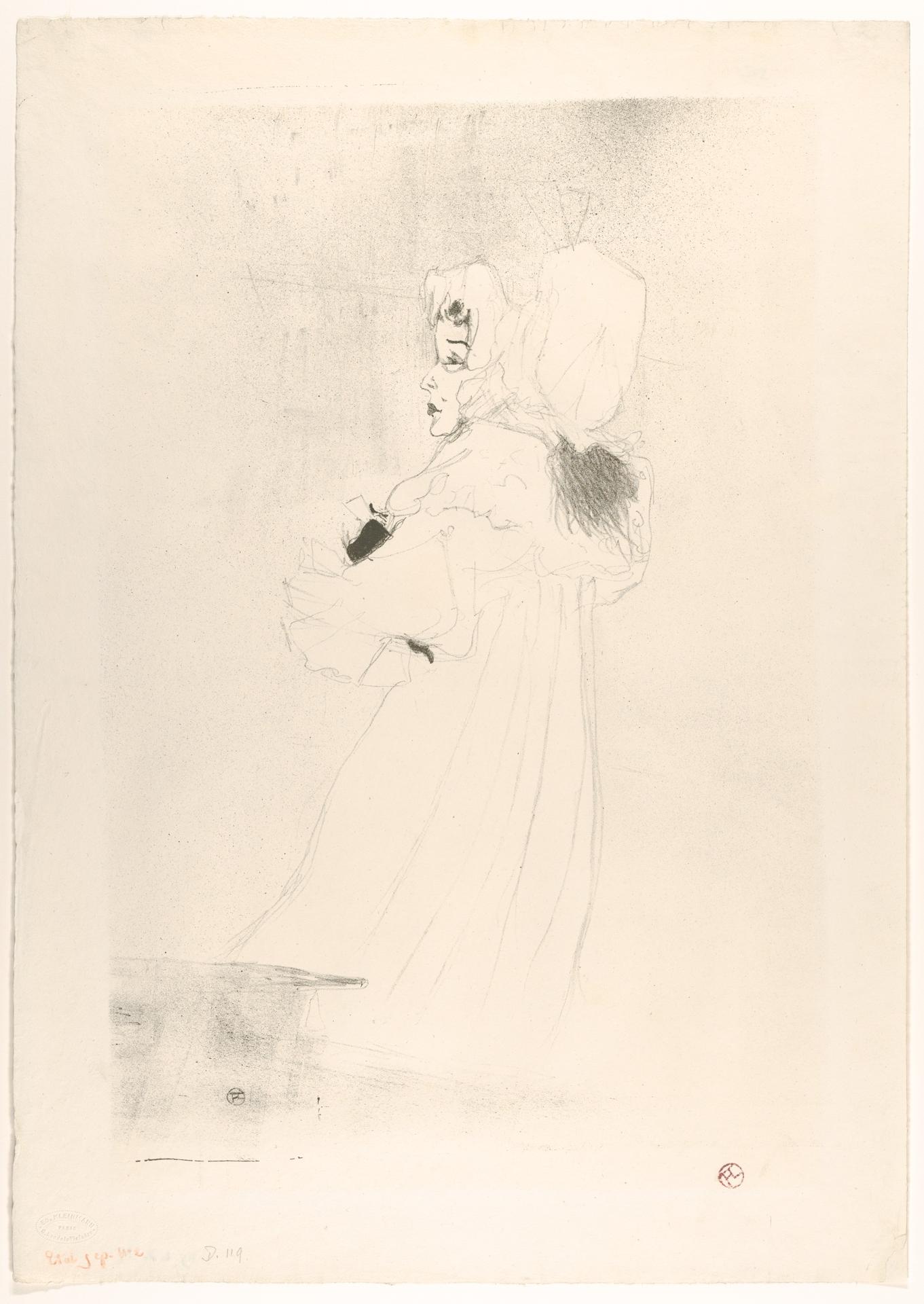
Miss May Belfort (Large Plate)
Original title: Miss May Belfort (Large Plate)
kurzbeschreibung
Henri de Toulouse-Lautrec made this crayon and spatter lithograph in 1895 on wove paper. It shows the Irish singer May Belfort in a long, flowing dress with a broad collar and a cap that partly covers her face. Belfort looks to the left and holds a prop that resembles a hat or an umbrella. The print is the first state in black ink.
Description
The woman stands upright in the center of the sheet, her gaze turned to the left. A wide collar and a cap frame her face, which lies partly in shadow. Her right hand holds an elongated object that looks like a hat or an umbrella. In the foreground, part of a piece of furniture is suggested, perhaps a table or a podium. Light falls from the front and emphasizes the contours of the figure.
Context
May Belfort was a well-known singer in the Parisian cabarets of the 1890s, often appearing in childlike or eccentric costumes. Toulouse-Lautrec portrayed her several times, including on posters for her performances. The lithograph was made when the artist regularly portrayed stage performers and captured their stage presence. The work was printed as a first state in black ink on wove paper.
Impact
The restriction to black and white and the sparing use of line draw attention to the figure and her posture. That the face remains partly hidden creates a detached, almost mysterious effect. Crayon and spatter technique give the surface a lively texture that makes the sheet appear dynamic despite its simplicity.
Technique
The lithograph was printed using crayon and spatter technique in black ink on wove paper. The crayon allows soft transitions and fine shading, while the spatter technique (spraying ink) brings a granular structure to the areas. The impression was taken in a first state, that is, before later revisions.
AI-generated description text
Source: Metropolitan Museum of Art · Public Domain (CC0 1.0)