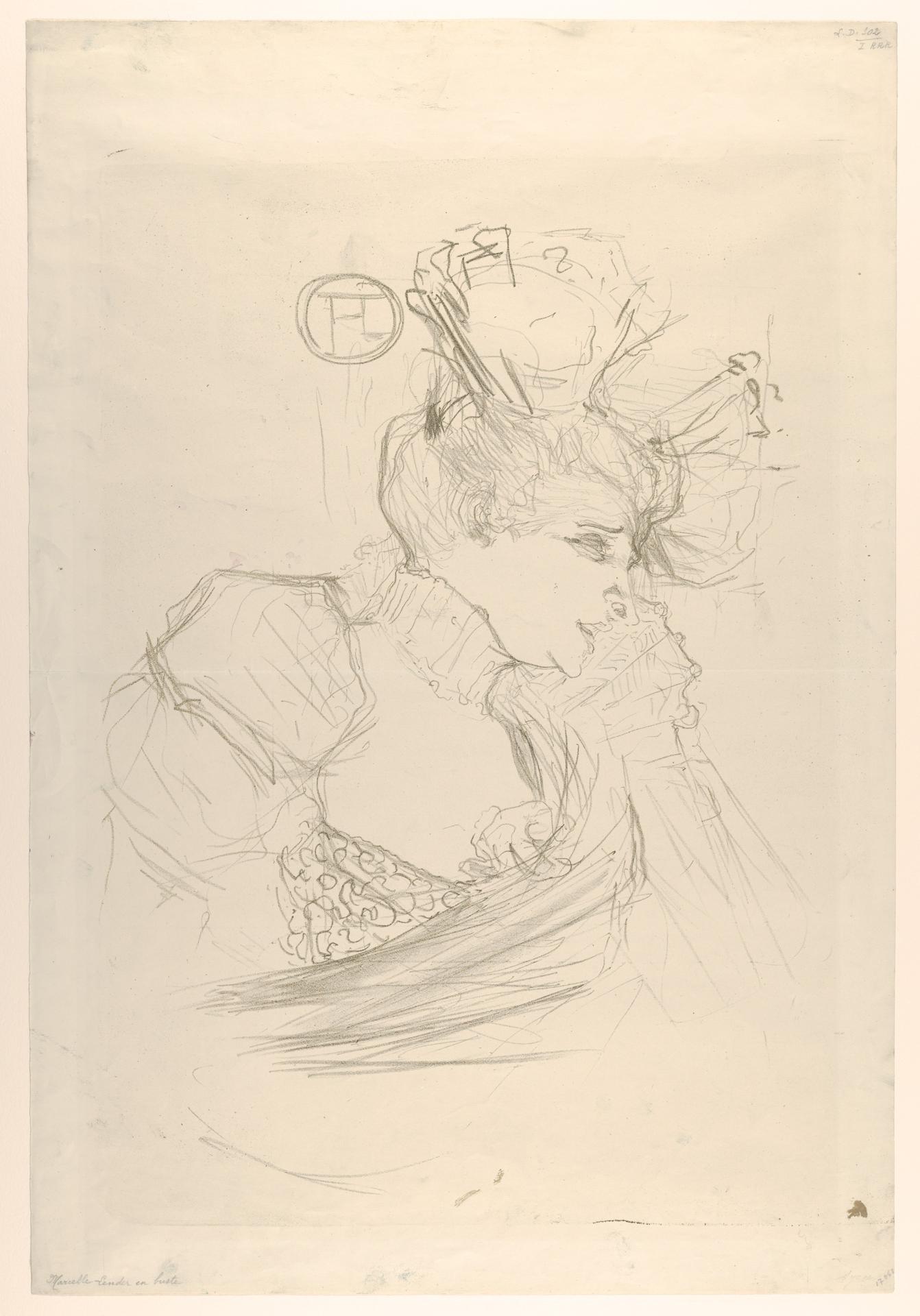
Portrait Bust of Mademoiselle Marcelle Lender (1895, Met-Objekt 900)
Original title: Portrait Bust of Mademoiselle Marcelle Lender
kurzbeschreibung
Henri de Toulouse-Lautrec made this lithograph in 1895, using crayon, brush, and spatter techniques. Printed in eight colors with letterpress text on wove paper, it shows the dancer and singer Marcelle Lender seated. This is the fourth and final state, from the Pan edition of 1895.
Description
Marcelle Lender sits half-reclining, her elaborately styled hair cascading down. Across her chest, she wears a dress with a striking pattern. Behind her, indistinct strokes hint at a window or architectural elements. The image is mostly black and white, with a mix of sketchy and detailed lines. Light falls evenly, without harsh shadows or highlights.
Context
Marcelle Lender was a well-known dancer and singer in 1890s Paris, often performing in cabarets. Toulouse-Lautrec portrayed her several times, including in lithographs that appeared in the magazine Pan. The 1895 Pan edition promoted contemporary graphic art. During this period, the artist experimented intensively with printmaking techniques.
Impact
The interplay of sketchy and precise strokes gives the portrait a lively, spontaneous quality. The restrained color and even lighting create a calm, intimate mood. Without going into detail, the image captures the sitter's personality.
Technique
For this lithograph, Toulouse-Lautrec drew on the stone with crayon, brush, and spatter methods, then printed in eight colors. The letterpress text was added separately, indicating a complex printing process. The paper used was wove, as was typical for high-quality art prints.
AI-generated description text
Source: Metropolitan Museum of Art · Public Domain (CC0 1.0)