The Motograph Moving Picture Book
Original title: The Motograph Moving Picture Book
kurzbeschreibung
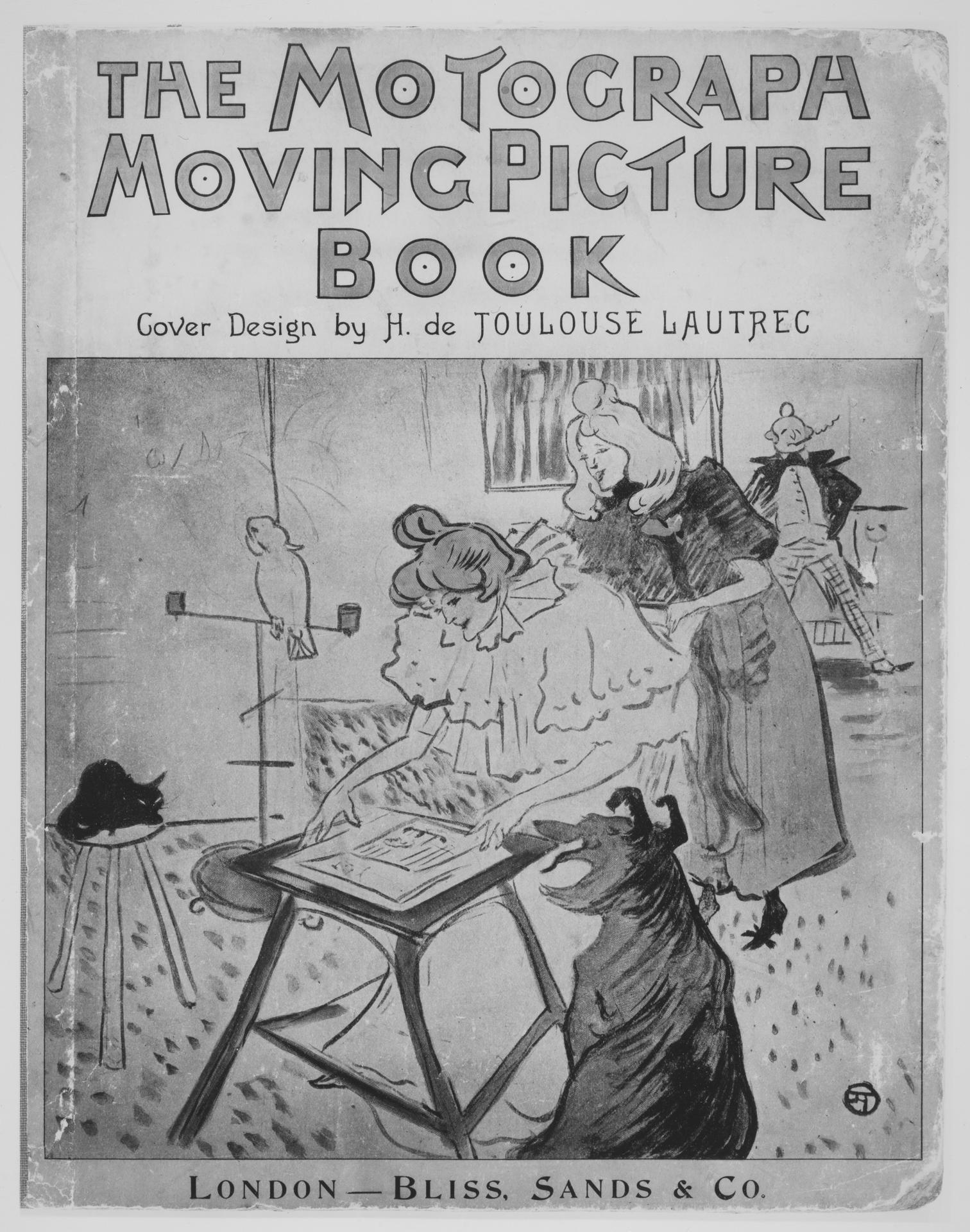
An illustrated book titled Das Motograph-Bewegtbilderbuch appeared in 1898 with Henri de Toulouse-Lautrec. It brings together wood engravings and color lithographs. On the title page, several people turn toward a picture. The book links art with an early form of moving-image technology.
Description
On the title page, the title is set in a typeface that recalls the cinematograph. In the foreground, a woman sits at a table and looks at a drawing. A second woman stands beside her and explains something with a gesture. A dog kneels on the floor and gazes at the picture, while a cat sits on a stool and also looks in that direction. Further back, a person wearing a hat turns away. Curtains and furniture suggest the interior. The color stays monochrome, as is typical of wood engraving and lithography.
Context
When the book came out in 1898, cinematography and related techniques such as the mutoscope were becoming popular. Toulouse-Lautrec was known for posters and lithographs, but he also devoted himself to book illustration. Das Motograph-Bewegtbilderbuch was an early example of bringing moving images into book form: by turning pages or using mechanical devices, movement was suggested. It reveals his interest in modern entertainment media.
Impact
The monochrome rendering and the dynamic layout bring the interplay of the figures with the picture to the fore. The scene feels lively and conveys the fascination with the new medium of moving images. The stylized typography emphasizes the technical aspect.
Technique
For the illustrations, Toulouse-Lautrec used wood engravings and color lithographs, common printing methods of the late 19th century. Wood engraving provided clear contours, while lithography allowed fine gradations and tones. The book format of about 29.6 x 23.9 cm was standard for illustrated works of the period.
AI-generated description text
Source: Metropolitan Museum of Art · Public Domain (CC0 1.0)