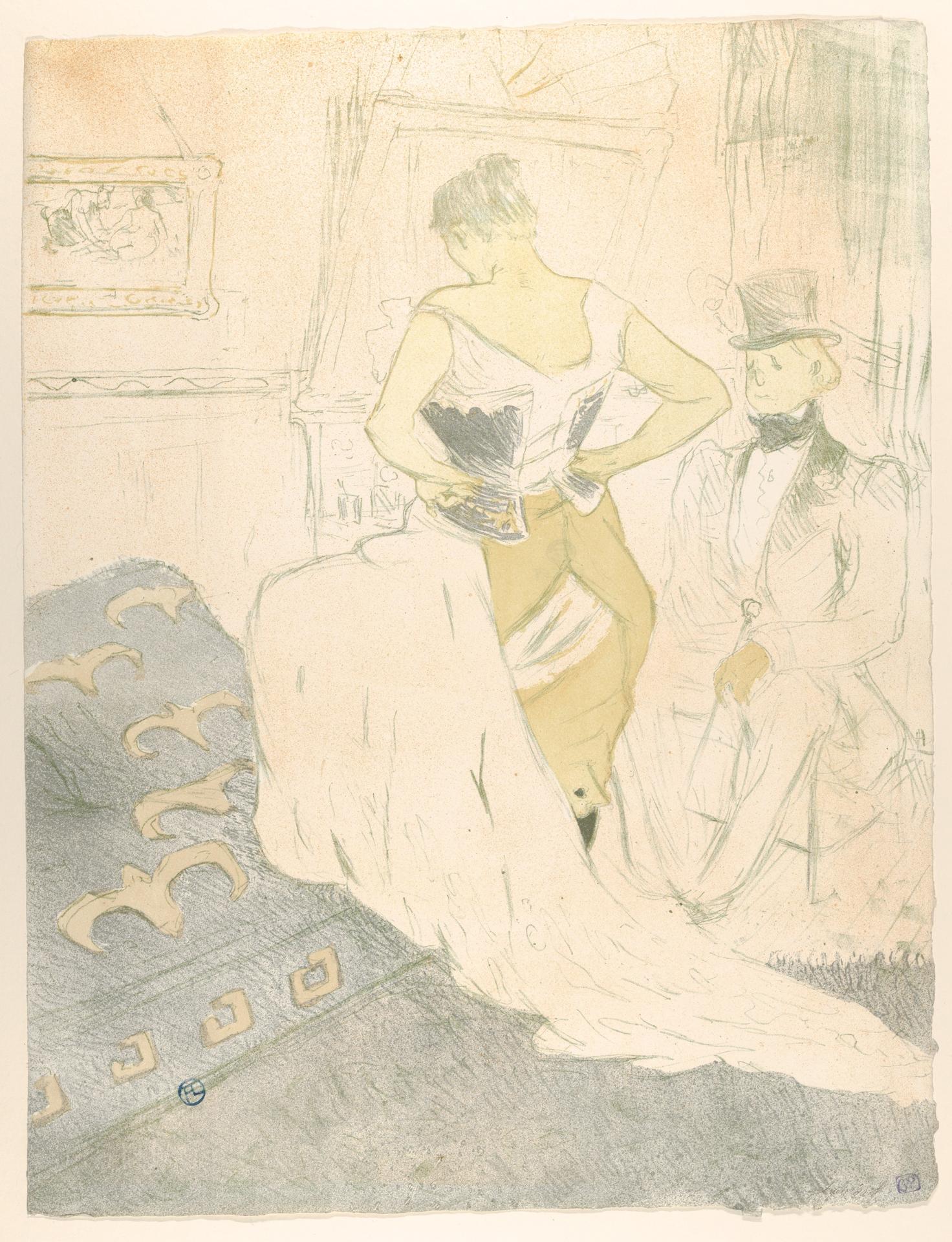
Fastening a Corset – A Passing Conquest, from "Elles"
Original title: Fastening a Corset – A Passing Conquest, from "Elles"
kurzbeschreibung
In 1896, Henri de Toulouse-Lautrec created "Das Korsett schnüren – Eine flüchtige Eroberung" as part of his "Elles" series. The print depicts a woman putting on a corset while a man in a suit stands beside her, watching. The work is a lithograph executed with crayon, brush, and spatter techniques in five colors on wove paper.
Description
A woman in a white top and yellow trousers is busy lacing her corset. A gentleman in a suit and top hat observes her. On the wall hangs a painting of a woman in a similar pose. The room feels sparse: an armchair, a table with a book on it. Pastel tones dominate, with green and blue accents in the background. Frontal light brings the figures forward.
Context
This subject belongs to Toulouse-Lautrec's 1896 "Elles" series, in which he chronicled the lives of women in brothels. It grew out of the artist's close observations in the Parisian demimonde. The print presents an everyday, familiar situation that nonetheless reveals the social gap between the woman and her visitor. The title "A Fleeting Conquest" hints at the brevity of the encounter without passing judgment.
Impact
Pastel hues and loose, sketchy lines give the print an immediate, casual quality. The relaxed postures of the figures and the room's scant furnishings create an atmosphere that is both intimate and detached. Spatter technique and bold contours heighten the liveliness without letting the scene tip into the merely anecdotal.
Technique
For this print, Toulouse-Lautrec used crayon, brush, and spatter, along with a scraper. It was printed in five colors on wove paper, allowing for graduated color effects. The spatter technique leaves fine dots that give the image its own texture; the scraper served to add highlights and make corrections.
AI-generated description text
Source: Metropolitan Museum of Art · Public Domain (CC0 1.0)