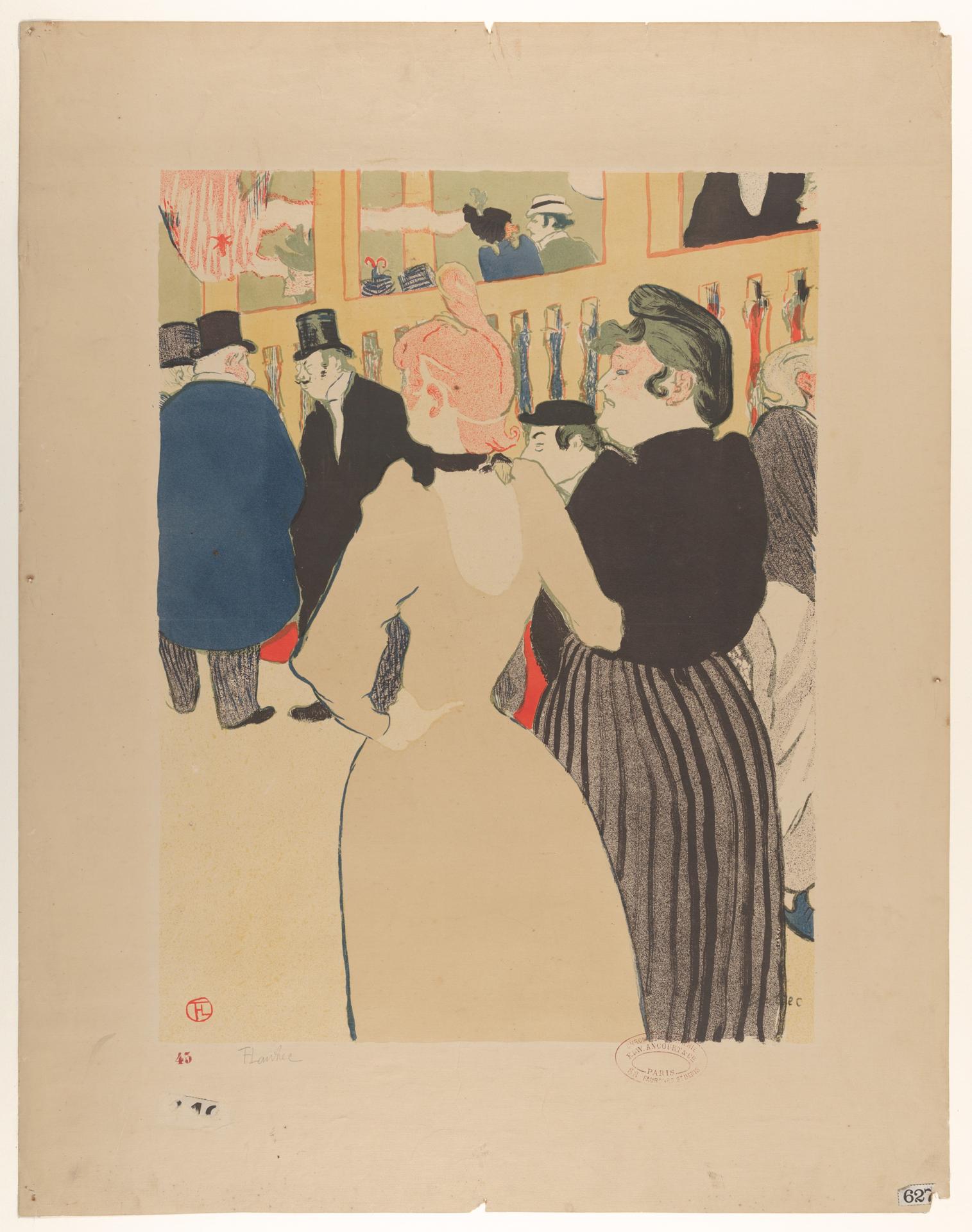
At the Moulin Rouge: La Goulue and Her Sister
Original title: At the Moulin Rouge: La Goulue and Her Sister
kurzbeschreibung
Henri de Toulouse-Lautrec made this 1892 lithograph, capturing two dancers at the Moulin Rouge in a lively dance pose. Printed in six colors on wove paper, the sheet is the second of two states. The scene conveys something of the atmosphere of Parisian nightlife.
Description
In the foreground, two women dance, their faces left blank. One wears a red top and black striped trousers, the other a black top and striped trousers; both have hats. Behind them, several figures stand in a hall-like room with decorated walls. Dark tones dominate the color scheme, broken by accents of red and white. Light falling from above highlights the outlines of the figures.
Context
The lithograph was made in 1892, when Toulouse-Lautrec often frequented the Moulin Rouge in Paris. It shows the famous dancer La Goulue with her sister, who performed together in the variété. The motif belongs to a series of posters and prints that advertised nightlife. The print was issued in an edition and attests to the artist's interest in entertainment culture.
Impact
The dancers' animated pose and the strong color contrasts give the sheet a lively, almost theatrical presence. Because the faces in the foreground remain hidden, the eye is drawn to movement and silhouettes, which makes the view appear abstract and stylized. In this way, the energy and allure of the Parisian entertainment district are communicated.
Technique
The lithograph was printed in six colors on wove paper. Contours and color areas interlock, as is characteristic of this process. The second state of two shows minor deviations from the first, suggesting revision by the artist.
AI-generated description text
Source: Metropolitan Museum of Art · Public Domain (CC0 1.0)