The Photographer Sescau (Le Photographe Sescau)
Original title: The Photographer Sescau (Le Photographe Sescau)
kurzbeschreibung
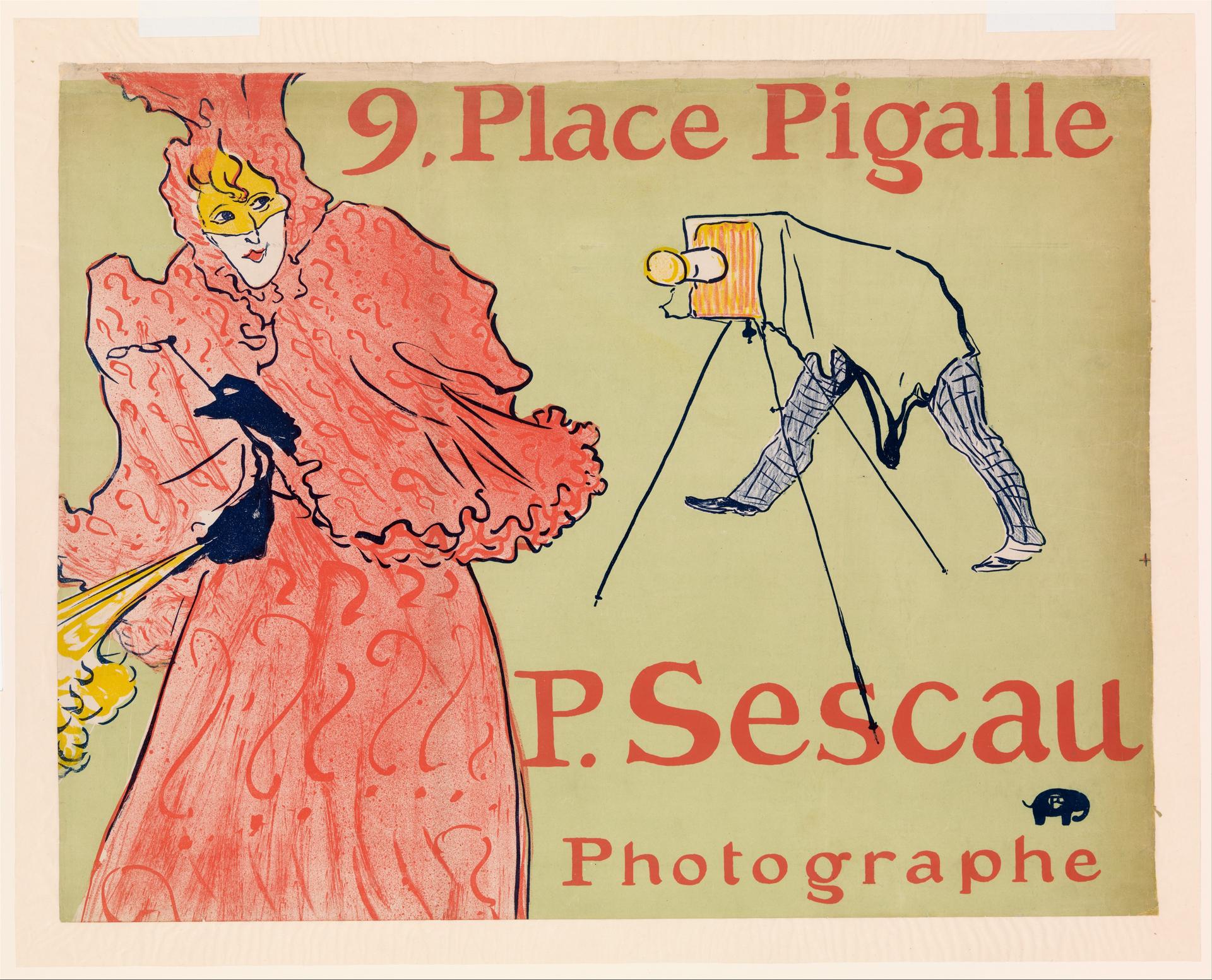
In 1894 Henri de Toulouse-Lautrec designed the lithograph "Der Fotograf Sescau," which served as an advertisement for Paul Sescau's photography studio on Rue Pigalle in Paris. It features a woman in a red-striped dress wearing a mask and holding a pipe, alongside a photographer with a camera on a tripod. The print was made in four colors on machine-woven paper.
Description
On the left, in the foreground, stands a woman in a striking red-striped dress; she wears a mask and holds a pipe. To the right, a photographer in a blue-and-white checkered shirt and trousers operates a camera on a tripod. The address "9, Place Pigalle" appears in red lettering at the top. Below, the name "P. Sescau" is given with the profession "Photographe" and a small elephant. Against a pale green ground, red, blue, and yellow dominate.
Context
This 1894 poster promoted Paul Sescau's photography studio at Place Pigalle, in the Montmartre entertainment district. Toulouse-Lautrec, who often portrayed artists and performers from that area, created the print as lithography was emerging as a medium for poster art. The masked woman alludes to the link between photography and theater cultivated in Sescau's studio.
Impact
Strong color contrasts and a clear, poster-like layout define the print. The woman with mask and pipe appears enigmatic, lending the whole a playful, almost ironic touch. The result is a lively, fashionable atmosphere characteristic of Parisian entertainment culture in the 1890s.
Technique
The lithograph was printed in four colors on machine-woven paper. Red, blue, yellow, and green appear in flat areas, while contours remain clear and simplified. Toulouse-Lautrec used lithography to achieve a strong graphic impact with few colors—a hallmark of his poster art.
AI-generated description text
Source: Metropolitan Museum of Art · Public Domain (CC0 1.0)