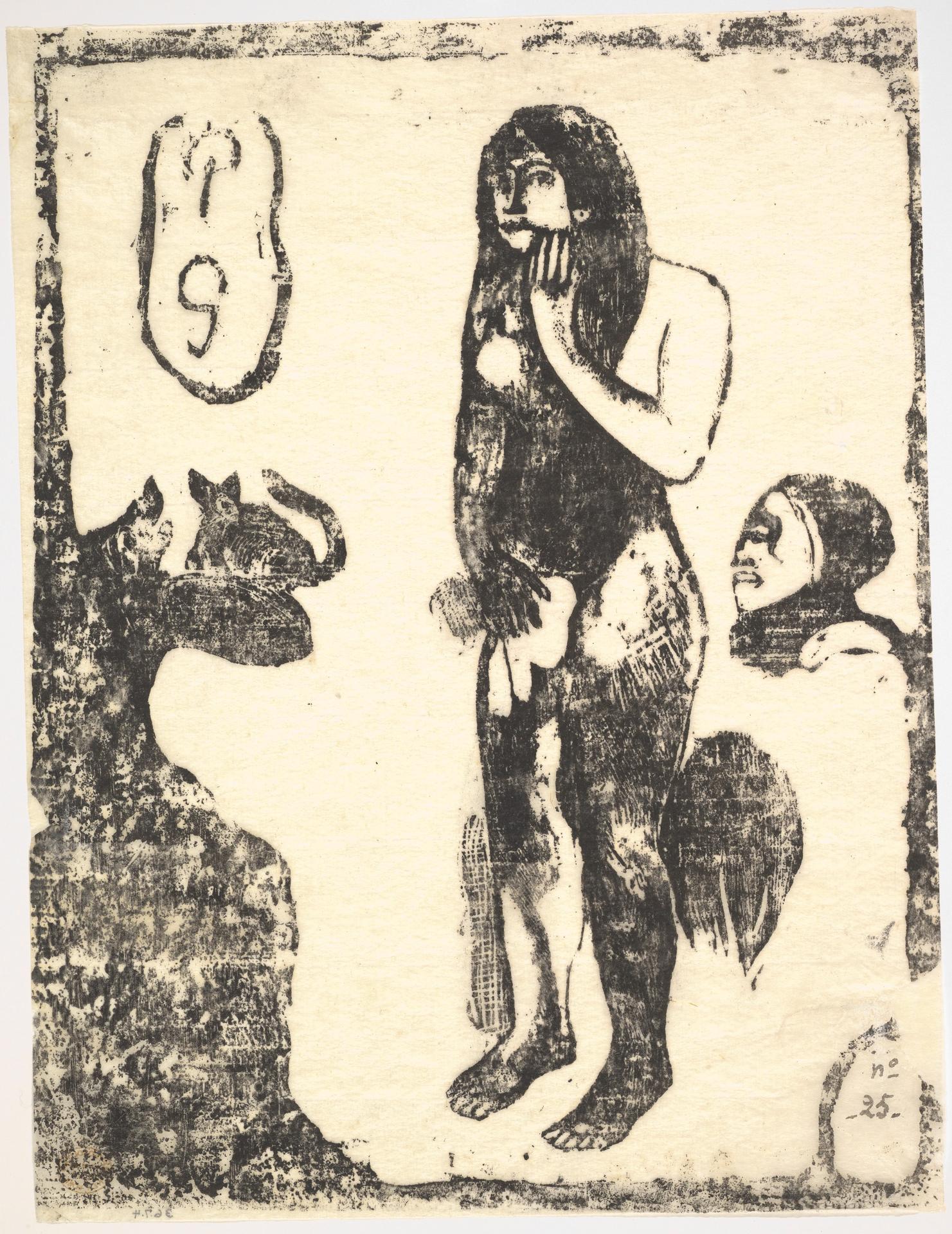
Eve (1898–99, Met-Objekt 767)
Original title: Eve
kurzbeschreibung
Unlike many depictions of Eve from his time, Paul Gauguin's woodcut of 1898–99 shows not a seductive woman but a withdrawn one: one hand at her mouth, the other on her belly. Printed in black ink, this work belongs to Gauguin's engagement with existential questions and mythological subjects.
Description
A female figure dominates the sheet; one hand covers her mouth, the other rests on her belly, and her posture seems pensive and slightly uneasy. Below her to the right, a smaller figure looks up at her. In the upper left appear signs or letters reminiscent of 'P' and '9', next to them a wolf-like animal. The layout is asymmetrical; the visible grain of the wood gives the print a rough, handcrafted quality.
Context
Gauguin made this woodcut during his stay in Tahiti, when he was deeply engaged with the relationship between humans, nature, and myth. The Eve motif comes from the Bible but is reinterpreted here through the South Seas experience. The sheet belongs to a series of woodcuts Gauguin created for his later book 'Noa Noa'. The smaller figure and the animal might allude to temptation or the connection between human and beast.
Impact
The restriction to black and white and the coarse wood texture give the sheet an immediate, archaic presence. The woman's thoughtful pose and the enigmatic pictorial elements invite quiet, contemplative viewing. The expressionist linework heightens the emotional density of the motif.
Technique
The woodcut was printed in black ink on paper, with the wood's grain remaining visible as part of the image structure. Gauguin cut the block in bold, simplified lines typical of his late graphic work. The relief printing process allowed only a limited edition, giving each impression a handcrafted, individual character.
AI-generated description text
Source: Metropolitan Museum of Art · Public Domain (CC0 1.0)