Te Po (1893–94, Met-Objekt 758)
Original title: Te Po
kurzbeschreibung
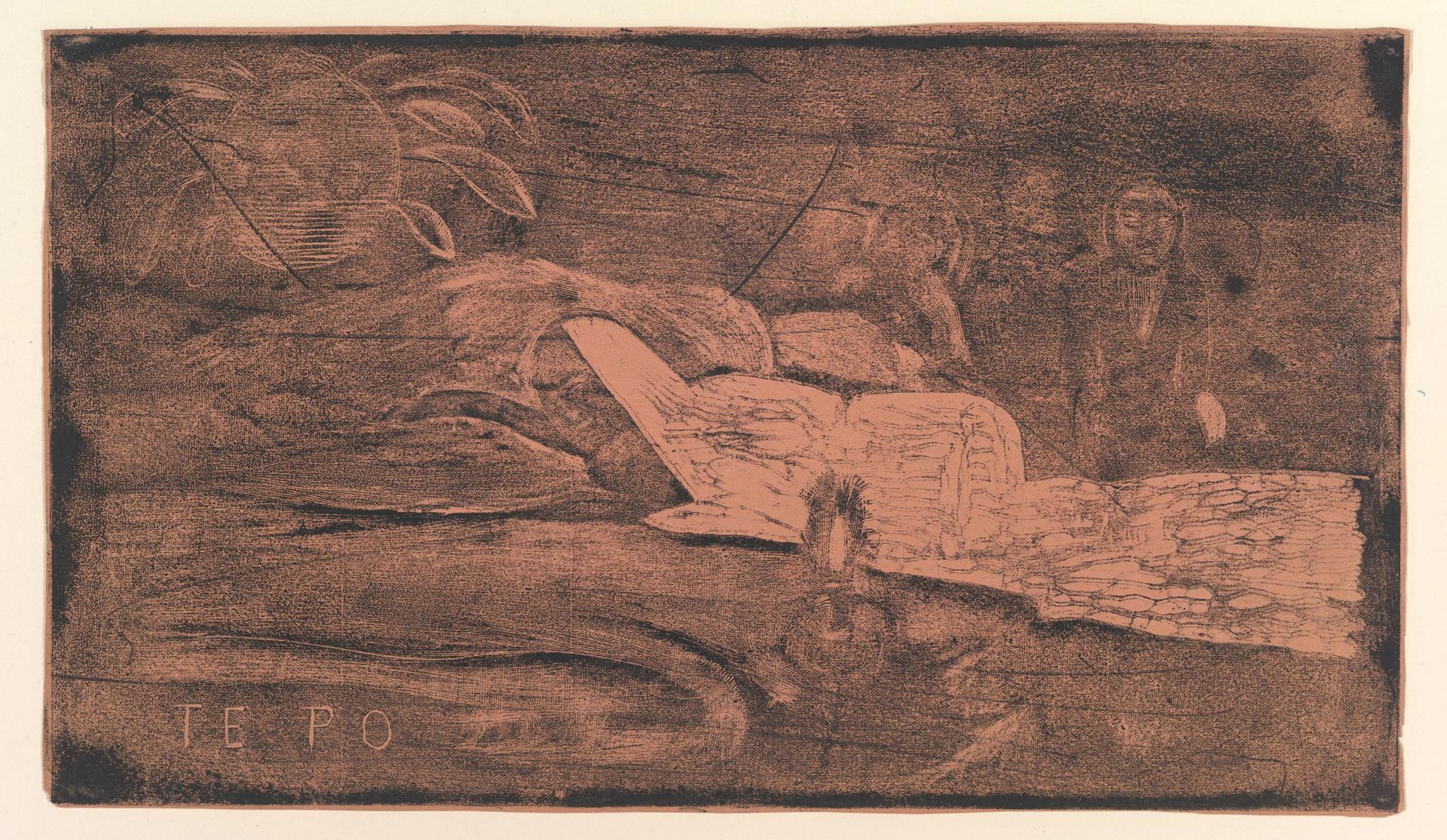
Maori creation story tells of the night before the world took shape, and Paul Gauguin's woodcut Te Po from 1893–94 draws on that myth. A seated figure holds a book or scroll. Gauguin made the print during and after his first Tahitian stay, and it belongs to his early efforts in this medium. The impression is the second state (state II).
Description
A figure sits frontally on a rock or cliff, a book or parchment roll in hand. Traditional clothing wraps the body, while trees and shrubs give only a hint of the natural setting. Everything in the arrangement points toward the central figure; no distracting details intrude. Light falls evenly and softly, with no hard shadows.
Context
Gauguin cut the block during his first Tahitian stay (1891–1893) and continued working on it after returning to France in 1893–94. In Tahitian, Te Po means 'the night,' and the title refers to the Maori myth of creation. During these years Gauguin increasingly explored woodcut as an independent artistic means. The print is connected to his illustrated manuscript Noa Noa, in which he recorded his experiences in Tahiti.
Impact
A reduced, graphic language and a quiet, meditative presence define this woodcut. Monochrome grey tones and diffuse light create a timeless, almost archaic atmosphere. The subject feels exotic and symbolic at once, yet never merely decorative.
Technique
Gauguin cut the printing block from wood and transferred it to paper with printer's ink. The second state (state II) may include additional tonal values or reworking compared to the first impression. The method allows only coarse lines and flat areas, which produces the characteristic, expressive reduction.
AI-generated description text
Source: Metropolitan Museum of Art · Public Domain (CC0 1.0)