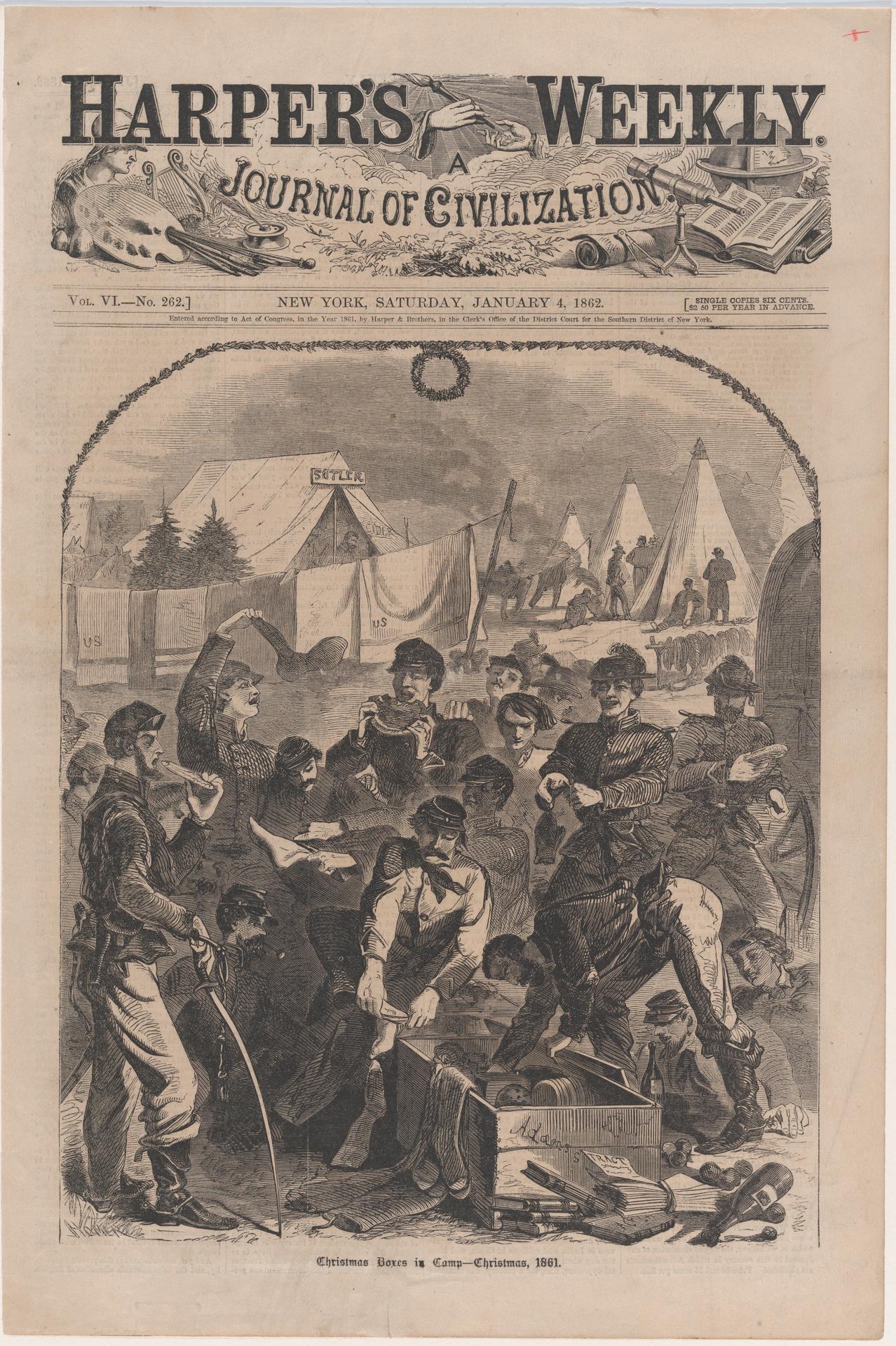
Christmas Boxes in Camp – Christmas, 1861
Original title: Christmas Boxes in Camp – Christmas, 1861 (from "Harper's Weekly," Vol. VI)
kurzbeschreibung
Winslow Homer made this wood engraving in early 1862 for Harper's Weekly, and it appeared in the January 4 issue. The black-and-white print shows soldiers in a winter camp during the American Civil War, just as they unpack their Christmas boxes. Homer, then working regularly as an illustrator for the magazine, drew the scene from the previous holiday season.
Description
Several soldiers fill the foreground, busy with crates: lifting lids, passing items along, or simply watching. Behind them, tents stand among bare trees, hinting at the wintry setting. The arrangement feels animated, with many figures absorbed in different tasks. Finely graduated lines and even tonal values give the detailed view its characteristic nineteenth-century engraving look. Harsh shadows are absent; the lighting stays flat and uniform.
Context
The illustration ran in Harper's Weekly on January 4, 1862, and looked back to the Christmas just past. During the Civil War, packages from home were considered an important morale boost for the troops. Homer drew for the paper regularly at this time before turning to painting. The subject picks up on the widespread practice of supplying soldiers in the field with shipments from home.
Impact
A quiet, almost contemplative mood emanates from the print; the war recedes for a moment. The tightly packed group of figures spins a lively narrative and draws the viewer into camp life. The clear black-and-white graphic sharpens the contours and gives the view a documentary quality typical of the period.
Technique
For the wood engraving, the design is cut into a woodblock; the relief process allows fine lines and precise details, making it suitable for mass production in magazines like Harper's Weekly. The reproduction stays black and white; varying line weights create depth and texture.
AI-generated description text
Source: Metropolitan Museum of Art · Public Domain (CC0 1.0)