St. Valentine's Day – The Old Story in All Lands (from "Harper's Weekly," Vol. XII)
Original title: St. Valentine's Day – The Old Story in All Lands (from "Harper's Weekly," Vol. XII)
kurzbeschreibung
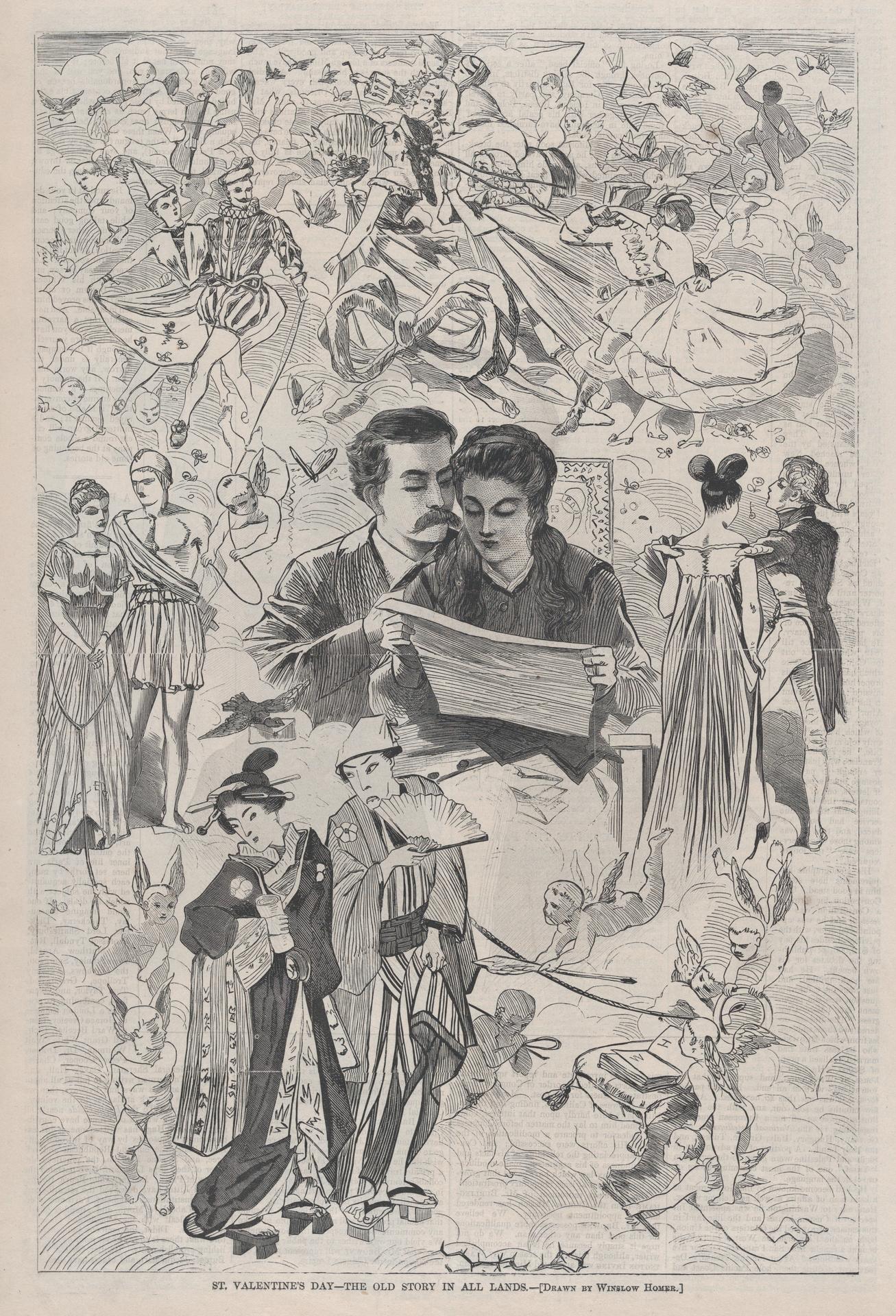
On February 22, 1868, Harper's Weekly published Winslow Homer's wood engraving 'St. Valentine's Day – The Old Story in All Lands.' In it, a couple sits closely together, surrounded by numerous figures from history and custom. The print is executed as a monochrome wood engraving with detailed line work.
Description
A man and a woman occupy the center of the image, drawn close together; he holds a sheet of paper in his hand, and she listens. Around them, many figures in various costumes and poses are scattered, including people in historical dress that suggest a dance or festive event. Above the scene, cherub-like angels hover, giving the layout a layered and lively quality. Everything is held in shades of gray, with sharp contours and delicate shading.
Context
The illustration was drawn for Harper's Weekly, a widely circulated magazine of the time known for its wood-engraved illustrations. Winslow Homer contributed regularly to the publication during the 1860s. Valentine's Day was hugely popular in the nineteenth century in both the United States and Europe and was often pictured with romantic motifs and historical allusions. The date of February 22, 1868, falls in the years after the American Civil War, when print culture and the magazine market were expanding rapidly.
Impact
Intimate closeness and a broad, almost allegorical panorama come together in this print, making it feel at once personal and universal. The dense arrangement of figures and precise line work create a lively, festive atmosphere that draws the viewer into the scene. At the same time, the monochrome style preserves a historical distance, like that radiated by old prints.
Technique
Wood engraving was used for the reproduction: the design was cut into a woodblock and then printed. This method allowed for fine lines and details that stand out clearly in the graphic. The shading is created by line patterns of varying density, typical of nineteenth-century printmaking.
AI-generated description text
Source: Metropolitan Museum of Art · Public Domain (CC0 1.0)