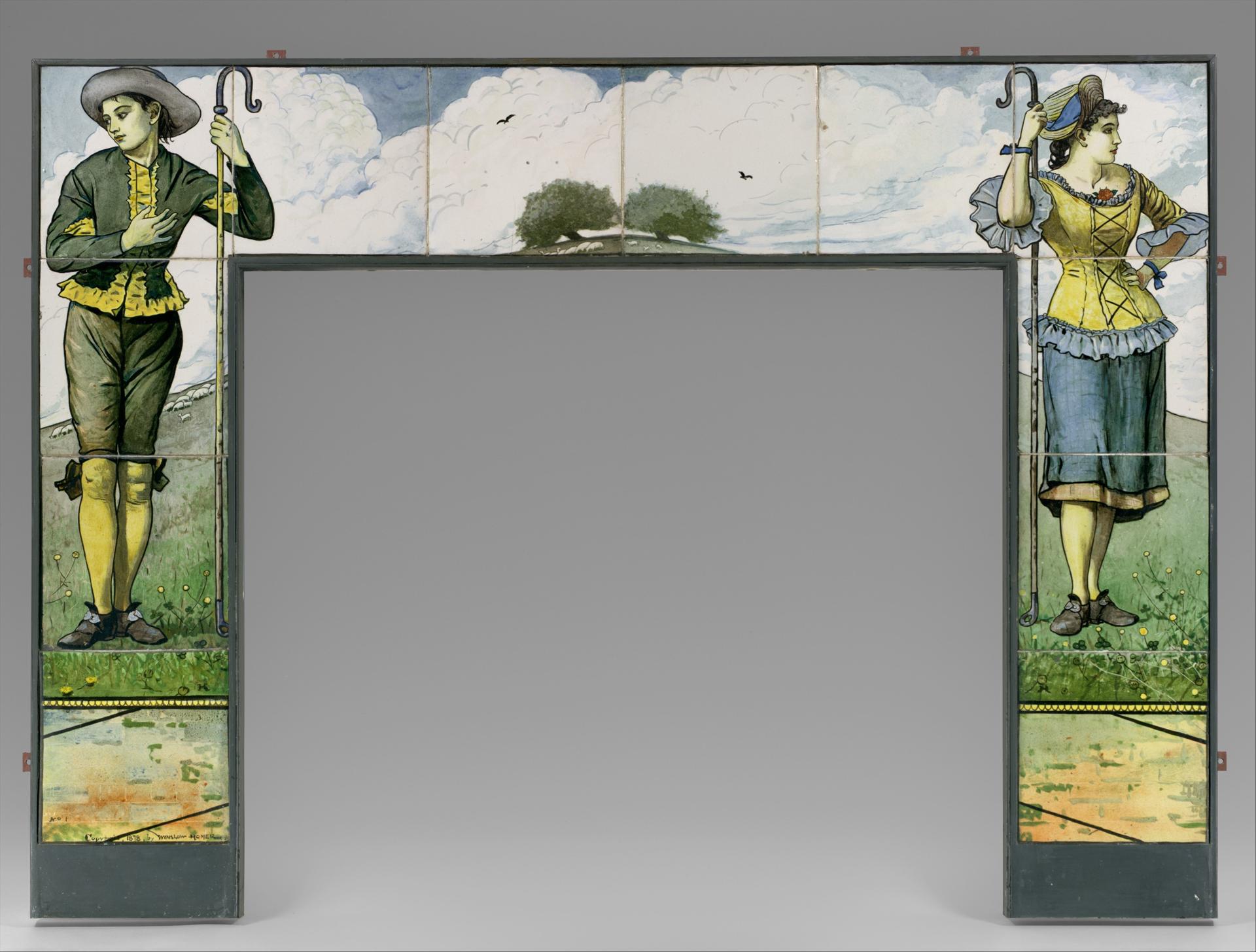
Shepherd and Shepherdess
Original title: Shepherd and Shepherdess
kurzbeschreibung
Dating from 1878, Winslow Homer's "Hirte und Hirtin" is a pair of large-format panels showing a farmer and a farm woman in traditional dress. Made in glazed earthenware with overglaze enamel decoration, each picture is built from tiles of 8 x 8 inches; the overall dimensions are 91.4 x 125.1 centimetres.
Description
A farmer and a farm woman appear in rural costume: the man in a green suit with a yellow waistcoat and a wide-brimmed hat, the woman in a yellow bodice with a blue apron and headscarf. Both carry a stick. Clouds, trees, sky and a few birds fill the space behind them, and a frame encloses the figures. Strong colours and rich detail define the view.
Context
Winslow Homer, known above all as a painter and watercolourist, turned increasingly to rural subjects and the lives of ordinary people around 1878. The execution as glazed ceramic with overglaze enamel decoration points to craft production, possibly in collaboration with a pottery. The pastoral theme of shepherd and shepherdess was widespread in the nineteenth century and offered an idealised view of country life.
Impact
Vivid colour and abundance of detail give the image an immediate narrative presence. The symmetrical arrangement of the two panels produces a calm, balanced layout that invites closer looking. As handcrafted ceramic, the work has a material warmth and a physical character of its own that sets it apart from painted pictures.
Technique
The base is glazed ceramic, with the overglaze enamel decoration applied after the glaze firing and then fired in. The individual tiles of 8 x 8 inches point to a modular process in which the pieces were afterwards joined into a larger picture. This approach allowed precise colouring and a durable surface for decorative purposes.
AI-generated description text
Source: Metropolitan Museum of Art · Public Domain (CC0 1.0)