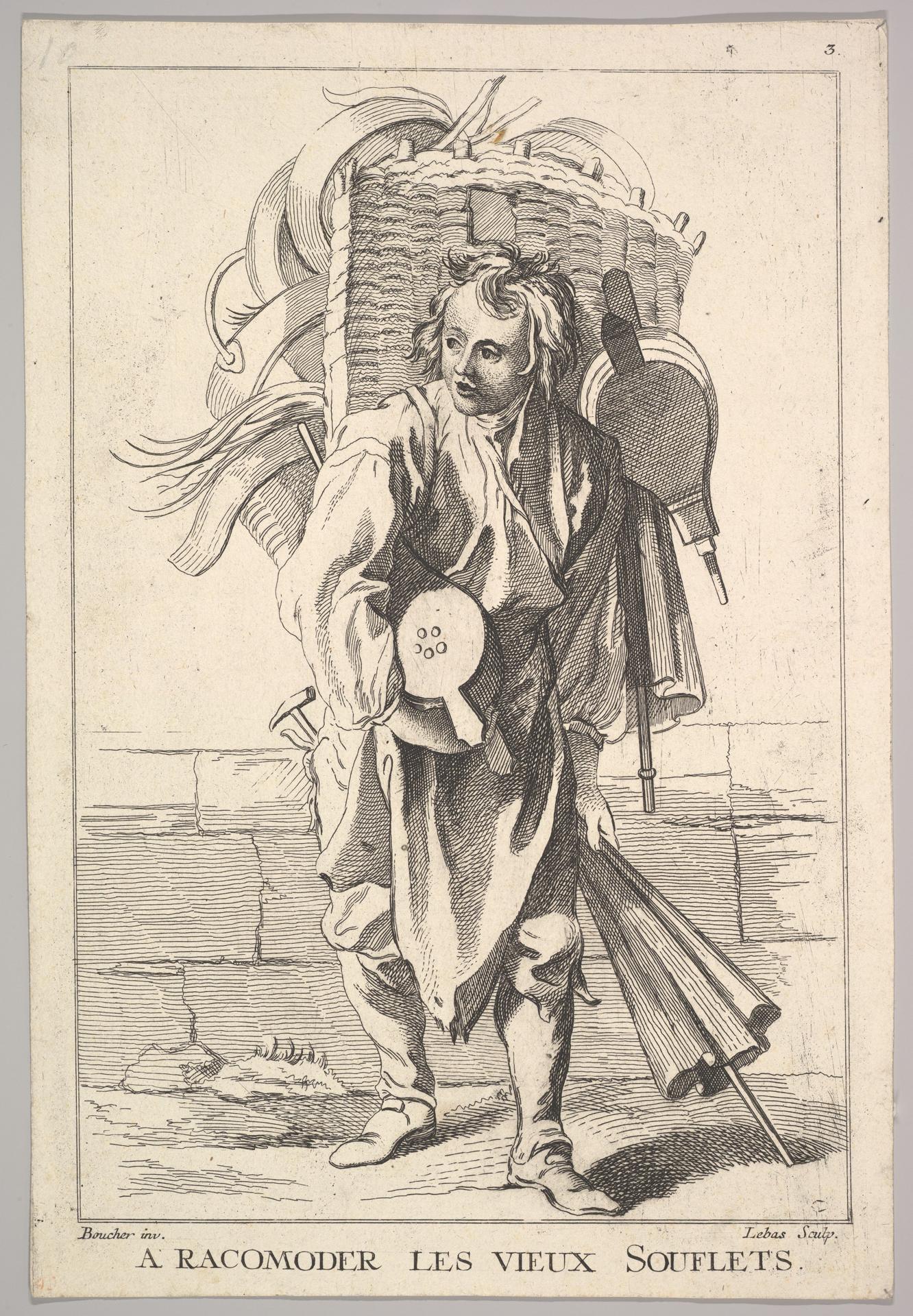
Reverse copy of A Racomoder les Vieux Souflets (Mend the Old Bellows), plate 3 from "Le Cris de Paris" (The Cries of Paris)
Original title: Reverse copy of A Racomoder les Vieux Souflets (Mend the Old Bellows), plate 3 from "Le Cris de Paris" (The Cries of Paris)
kurzbeschreibung
Jacques Philippe Le Bas made this eighteenth-century etching of a street seller mending old bellows. The print is a reversed copy after a design by Jean-Baptiste Greuze and belongs to the series Le Cris de Paris. It was executed in etching and engraving.
Description
A man in plain clothes stands at the front; a cloth around his neck holds his jacket together, and there is a hole in his trousers. He carries a bag over one shoulder, and in his hands he holds a large inflated object that recalls a shepherd's staff, along with a small round item beside it. Stones appear behind him, together with something resembling a drum or musical instrument. Beneath the image runs the inscription 'A RACOMODER LES VIEUX SOULETS'.
Context
Le Cris de Paris recorded the street sellers and craftsmen of the French capital in the eighteenth century. Le Bas produced this reproduction after a design by Jean-Baptiste Greuze, reversing the image left to right. Prints of this kind were sought-after collectibles and carried pictures of urban trades across Europe.
Impact
The craftsman's direct gaze and his emphatically plain clothing give the sheet an immediacy and a popular, down-to-earth character. Thanks to the delicate linework the motif feels rich in detail and brings the everyday life of the eighteenth century vividly forward.
Technique
Etching and additional engraving combine here, making possible fine lines and precise shading. Fabrics, objects and facial features can thus be reproduced in faithful detail. The sheet was printed on paper and trimmed to 27.4 x 18.6 cm.
AI-generated description text
Source: Metropolitan Museum of Art · Public Domain (CC0 1.0)