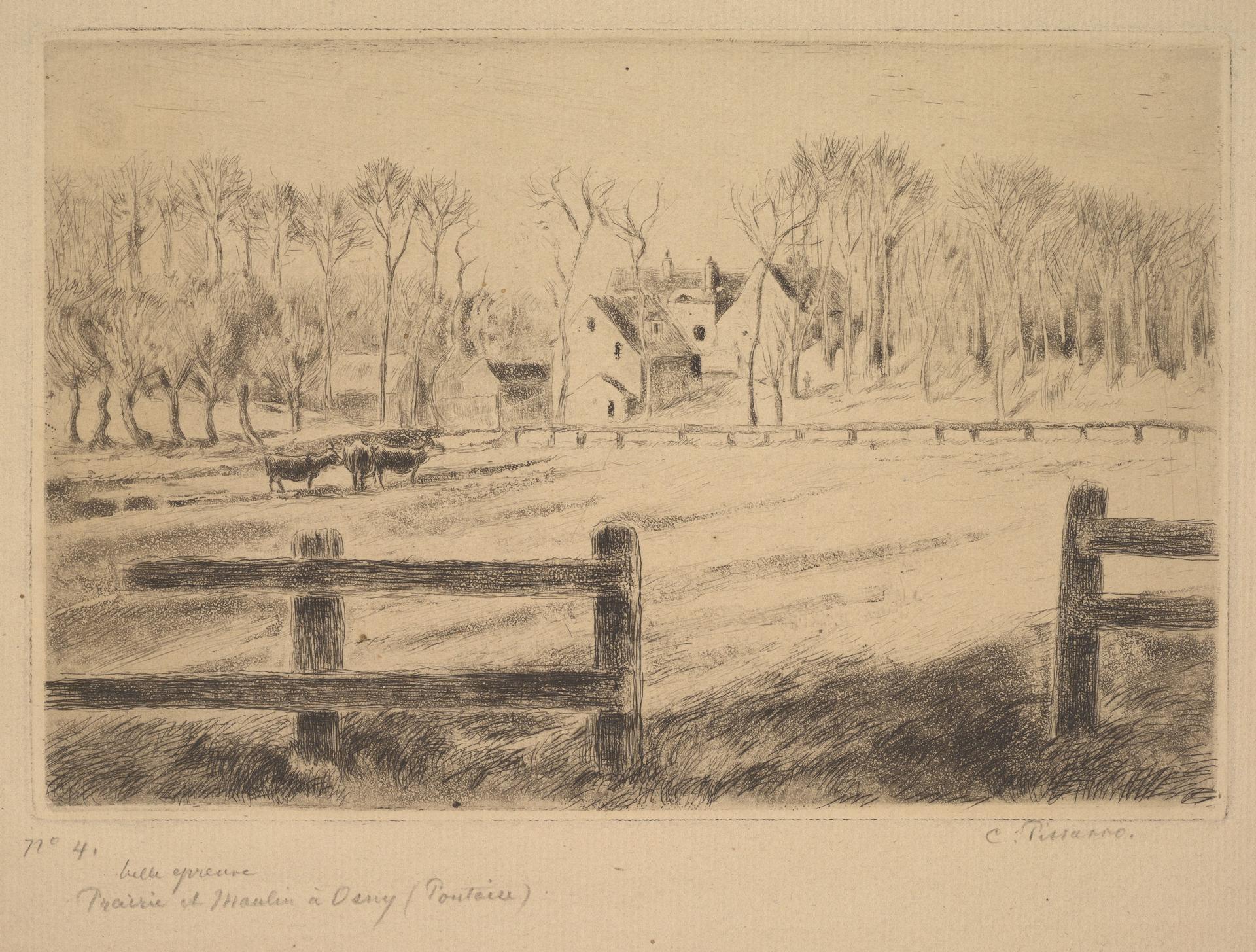
Field and Mill at Osny (Pontoise)
Original title: Field and Mill at Osny (Pontoise), 1885
kurzbeschreibung
In 1885, Camille Pissarro made the etching Feld und Mühle bei Osny (Pontoise). The print is in its sixth and final state, executed as drypoint and aquatint on heavy beige laid paper. It presents a rural view with a field, a mill, and two cows in the foreground.
Description
Two cows amble toward the viewer across a pasture, separated from us by a wooden fence. Beyond them stands a mill building, nestled among trees and other structures of a small village. The layout runs horizontally: the fence closes the bottom, while trees and buildings fill the top. Even light, with no discernible shadows, suggests diffuse illumination. The monochrome tone reinforces the calm, matter-of-fact impression of the subject.
Context
During his stay in Osny, a village near Pontoise, Pissarro created this etching in 1885. There he engaged deeply with the rural surroundings. Six states attest to a careful working process. By then Pissarro was already an established Impressionist, and in printmaking he explored new technical possibilities. The view of field and mill reflects his ongoing interest in peasant life.
Impact
Quiet and contemplation define the sheet, aided by the even distribution of light and the restrained tonality. The calm arrangement directs attention to the simplicity of country life without idealizing it. Drypoint and aquatint, with their fine lines and soft tones, produce a surface that recalls textile structures and feels almost tactile.
Technique
The print was made using a combination of etching, drypoint, and aquatint on heavy beige laid paper. Drypoint leaves bold, slightly raised lines, while aquatint allows delicate tonal gradations. In the sixth state, the final reworking of the plate is visible, in which Pissarro further differentiated the contrasts of light and dark.
AI-generated description text
Source: Metropolitan Museum of Art · Public Domain (CC0 1.0)