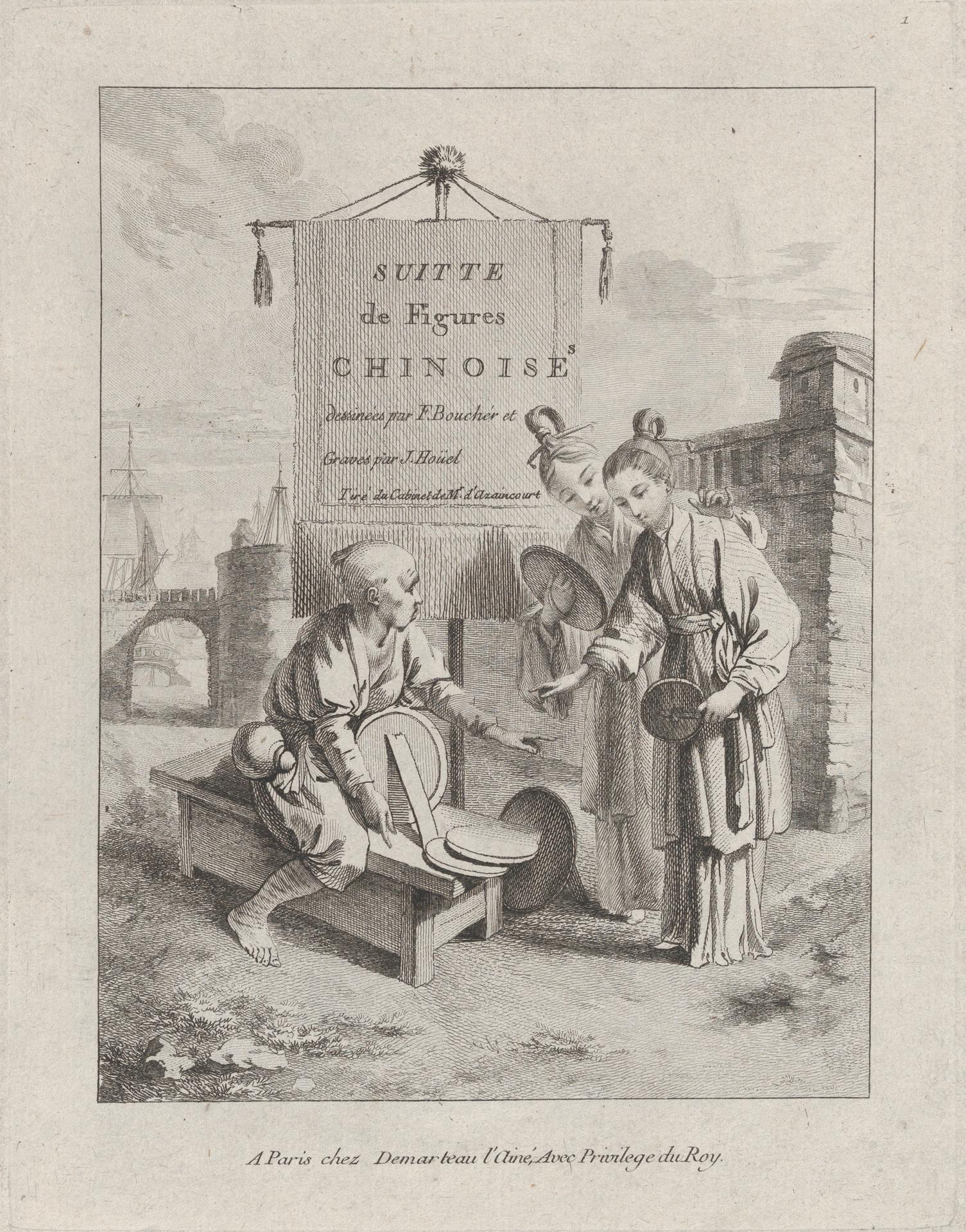
Frontispiece, from Suite de Figures Chinoises. . .Tiré du Cabinet de Mr. d'Azaincourt (Series of Chinoiserie Figures. . .From the Chambers of Mr. d'Azaincourt), plate 1
Original title: Frontispiece, from Suite de Figures Chinoises. . .Tiré du Cabinet de Mr. d'Azaincourt (Series of Chinoiserie Figures. . .From the Chambers of Mr. d'Azaincourt), plate 1
kurzbeschreibung
This title page for the 'Suite de Figures Chinoises' by Jean Pierre Louis Laurent Hoüel was made between 1755 and 1776 as an etching with subsequent engraving. Three figures stand in the foreground, while behind them a city wall with towers rises and a ship sails on the water. The frontispiece opens the series and introduces its theme.
Description
At first glance, three figures in the foreground catch the eye: one sits holding an object, two stand listening, also with objects in their hands. Behind them, a city wall with towers ascends, and on the water beyond lies a ship. A banner inscribed 'SUITE de Figures CHINOISES' and further production details stretches across the scene. Foreground and background are clearly separated, and the light falls evenly without strong shadows or highlights.
Context
Drawings from the collection of the French art collector Mr. d'Azaincourt served as models for the prints. Hoüel executed the sheets between 1755 and 1776, when chinoiserie was widespread in Europe. Such graphic series were coveted collector's items and offered an idealized image of Chinese culture.
Impact
The balanced, almost symmetrical arrangement and calm linework give the sheet a tranquil, decorative feel. The restriction to black and white emphasizes the graphic clarity and ornamental appeal of chinoiserie. The scene conveys an exotic yet harmonious mood, characteristic of the European craze for Chinese style in the eighteenth century.
Technique
The print was produced using a combination of etching and engraving: first the lines were etched, then deepened with a burin to achieve fine details and precise contours. It was printed in black and white on paper; the plate measures 22.3 × 17.5 cm.
AI-generated description text
Source: Metropolitan Museum of Art · Public Domain (CC0 1.0)