Erigone Vanquished
Original title: Erigone Vanquished
kurzbeschreibung
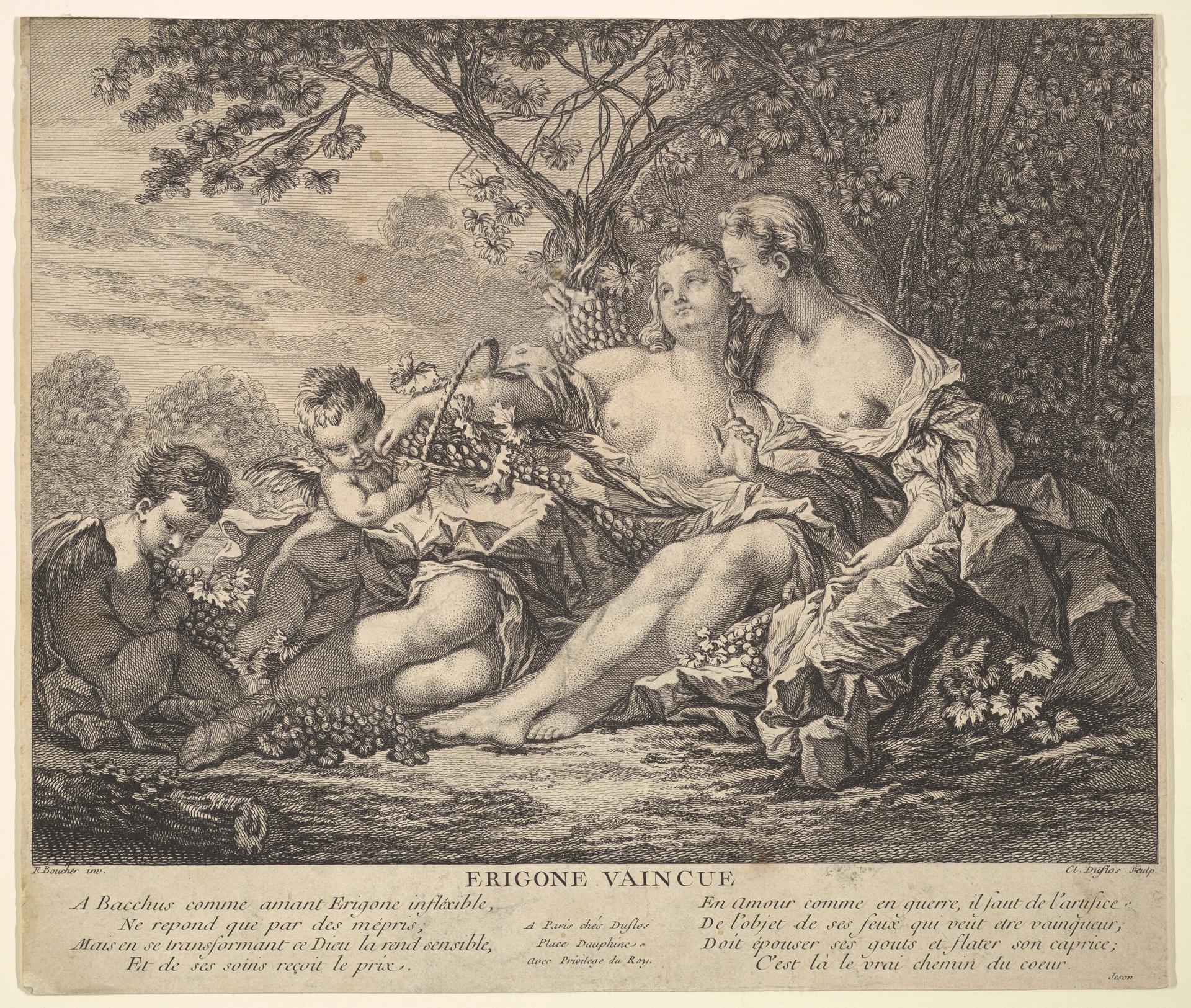
Claude Augustin Duflos le Jeune made this etching around 1745 in the spirit of the Rococo. Two naked women and two putti sit beneath a tree; one woman holds a basket of grapes while the other adds more fruit to it.
Description
Beneath the foliage of a tree, two nude women sit on a bench, wrapped in leaves and branches. One holds a basket of grapes, the other keeps filling it; on the ground two putti have settled, their gaze resting on the fruit. Behind them a landscape of trees opens up under a clouded sky. The sheet stays black and white, as etchings do, yet the graded shading brings out skin and surfaces clearly. Layout and arrangement are balanced, with the figures forming the calm center.
Context
Duflos le Jeune belongs among the French copperplate engravers of the eighteenth century whose reputation rests on very precisely executed reproductions after paintings. The work dates from around 1745, when the Rococo held sway in France and mythological subjects were warmly received in art. Erigone, a figure from Greek legend, appears again and again as a motif in the visual arts of this period.
Impact
Calm emanates from the print: evenly distributed figures and clear linework draw the eye toward the middle and let it rest there. The nudity and the playful putti lend a cheerful, almost pastoral mood typical of the Rococo. With color absent, attention turns entirely to the details of the bodies and the nature around them.
Technique
Etching and additional engraving combine here into very precise linework and nuanced shading. The copperplate method allows finely graded transitions between light and dark, giving skin and foliage a sense of body. The restrained tones come from the black-and-white printing characteristic of engravings of this era.
AI-generated description text
Source: Metropolitan Museum of Art · Public Domain (CC0 1.0)