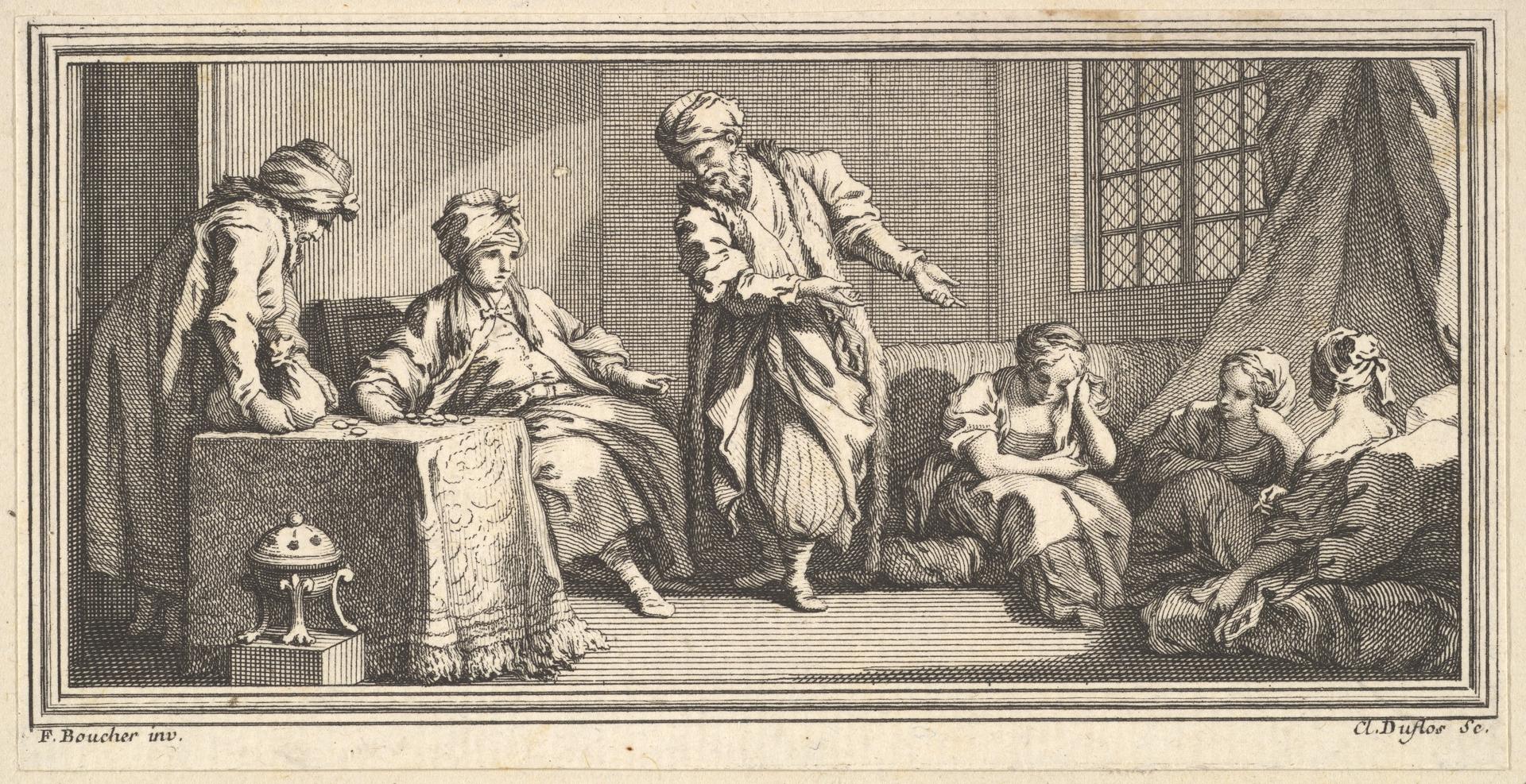
The Slave Merchant
Original title: The Slave Merchant
kurzbeschreibung
Where related prints of the period often reduce the slave trade to an anonymous backdrop, Claude Augustin Duflos le Jeune's etching with engraving of 1746–47 places a specific interior scene at the fore: a presumed slave trader comes into contact with several seated women. The picture is laid out horizontally and divided into narrative sections.
Description
A row of figures stretches across the width of the sheet. A standing man in traditional dress gestures as he turns toward a seated woman wearing a headscarf and a long robe; a second woman dressed much the same has taken a place beside her, while two more crouch on the ground — one resting her forehead in her hand, the other with her head lowered. Coins lie on a table in front of the seated woman, next to which stands a small side table with a bowl; a barred window closes off the back of the room. Curtains and a wooden wall frame the action, which is modelled through line and hatching.
Context
The Frenchman Claude Augustin Duflos le Jeune, an eighteenth-century copperplate engraver, produced mainly reproductions and genre scenes. His etching belongs to an era when the Atlantic slave trade carried great economic weight and was at the same time meeting growing criticism. Within a substantial body of printed work aimed at middle-class collectors, this sheet takes up that subject. Neither the patron nor the original purpose has been recorded.
Impact
The tightly packed arrangement of figures and the even, calm linework create distance and an observing stance. Dramatic gestures are absent; instead the mood is matter-of-fact, almost documentary. Fine hatching gives the image graphic density and draws the eye to details.
Technique
The etching was reworked with a burin, which yields fine lines and precise shading. After the plate was bitten with acid, partial re-engraving followed, differentiating contrasts and textures. The paper has been trimmed, so the original margins and any possible inscriptions are missing.
AI-generated description text
Source: Metropolitan Museum of Art · Public Domain (CC0 1.0)