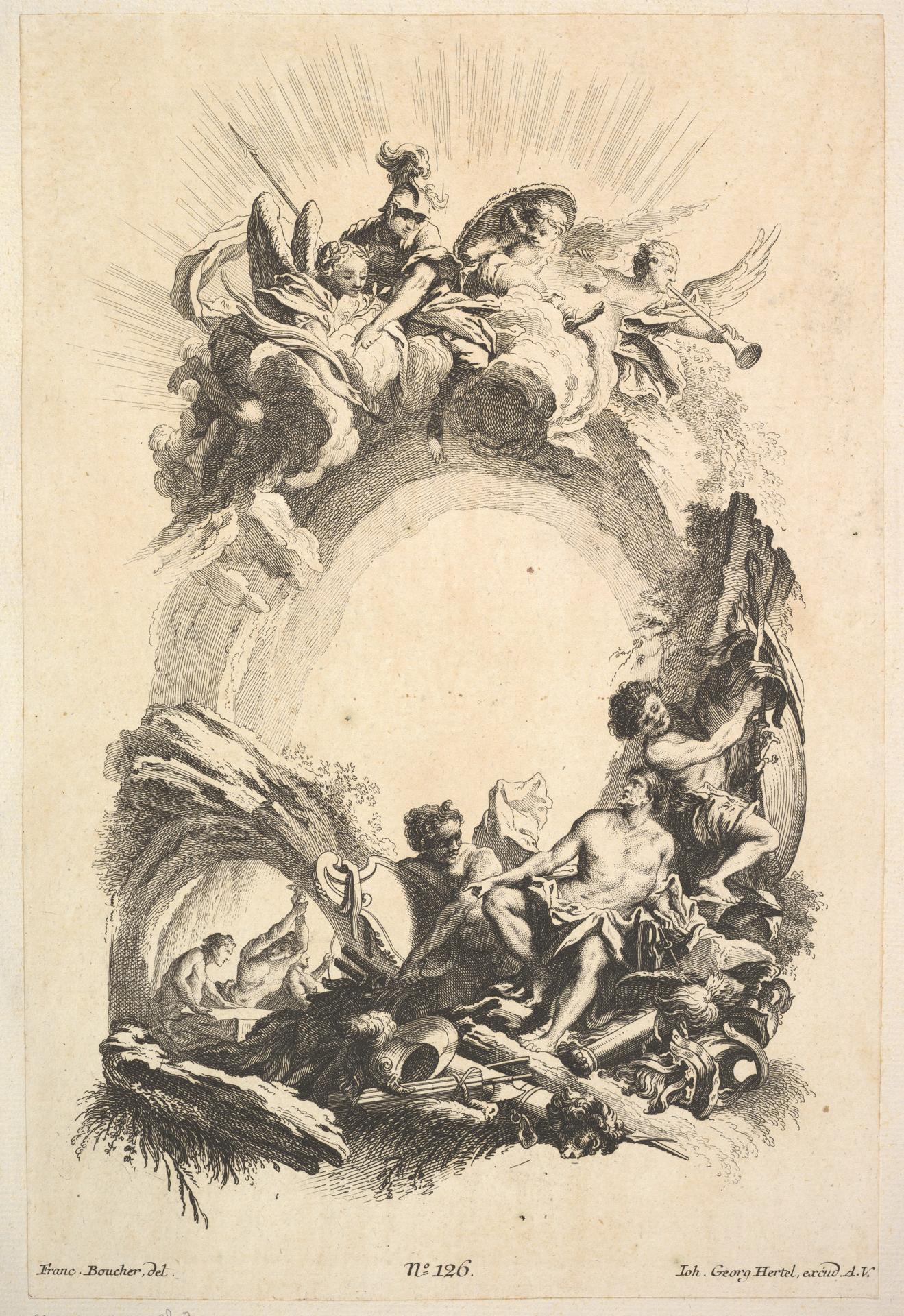
The Forges of Vulcan, from Book of Cartouches
Original title: The Forges of Vulcan, from Book of Cartouches
kurzbeschreibung
Johann Georg Hertel produced this etching and engraving in the mid-18th century. Titled The Forges of Vulcan, it comes from the Book of Cartouches and sets an allegorical hierarchy of angels above a smithy below, all enclosed in an oval frame. The print is a reverse copy after an earlier model.
Description
Angels and other figures float in a luminous upper zone, some bearing a shield or a trumpet. Below, people gather around a table strewn with metal parts and tools — a smithy. Bodies are caught in lively poses, giving the image its energy. A large oval frame dominates the layout and holds the action together. The rendering stays black and white; light emanating from the angels accents the narrative.
Context
The sheet belongs to the Book of Cartouches, an 18th-century collection of ornament prints that served craftsmen as models. Its publisher was Johann Georg Hertel, an Augsburg printmaker and publisher who issued many such pattern books. The subject draws on Vulcan, the Roman god of smithing. That this is a reverse copy points to the period practice of reproducing and circulating designs.
Impact
A tense contrast arises between the heavenly sphere of the angels and the earthly forge. Baroque richness of detail and symmetrical arrangement lend the sheet a ceremonial, almost theatrical air. Rays of light guide the eye to the central action and reinforce the allegory of divine inspiration.
Technique
Etching and engraving are used together: etched and engraved lines yield fine details and precise hatching that model light and shadow. The paper, trimmed to 30 × 19.8 cm, suggests later use or framing.
AI-generated description text
Source: Metropolitan Museum of Art · Public Domain (CC0 1.0)