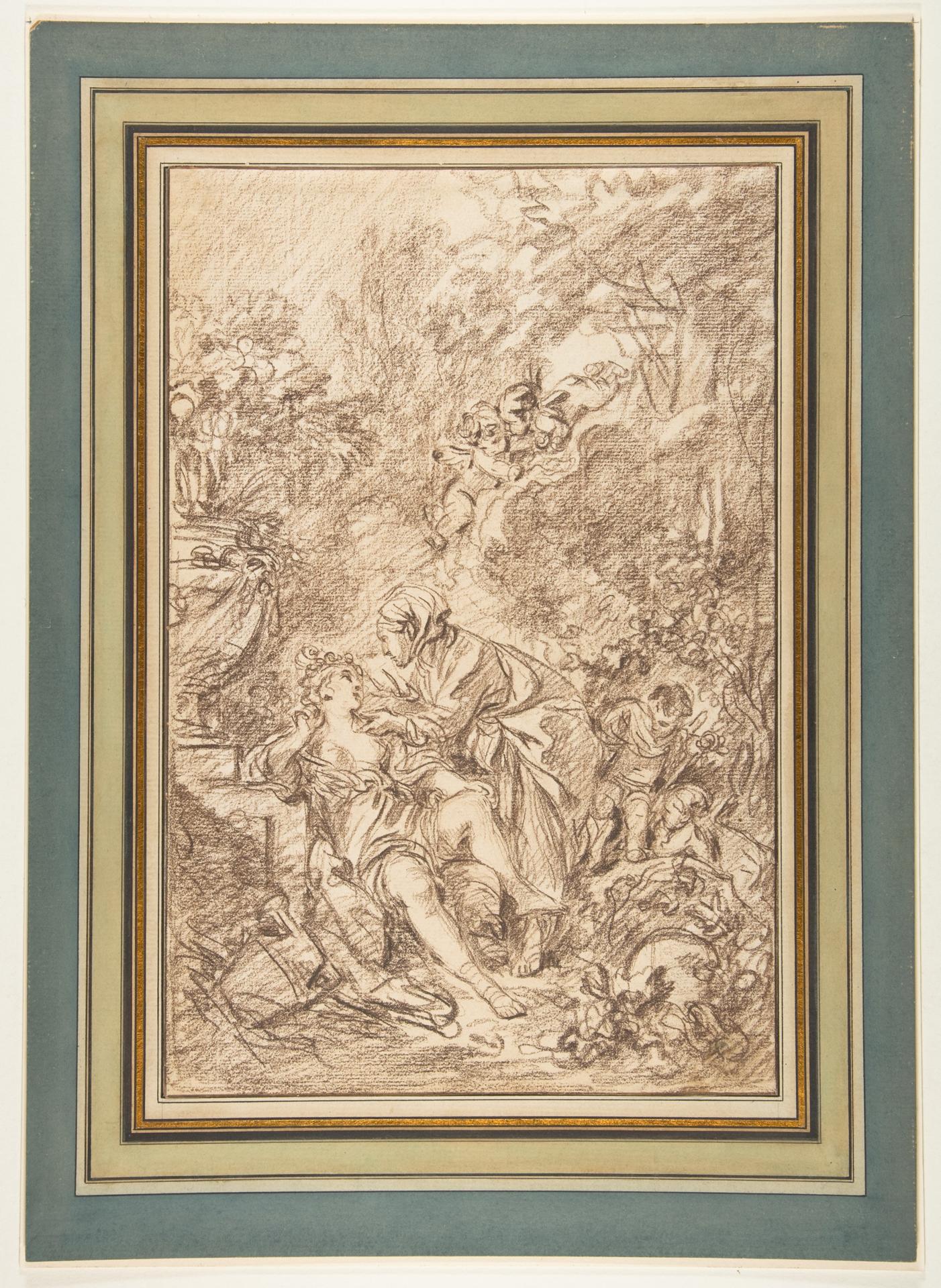
Vertumnus and Pomona (Brown chalk)
Original title: Vertumnus and Pomona
kurzbeschreibung
Two crowned figures seated in a lush landscape meet as François Boucher captured them in brown chalk, likely drawn around the mid-18th century. Several other figures and small putti populate the naturalistic setting around the pair. The encounter of Vertumnus and Pomona, a mythological subject, forms the core of the sheet.
Description
On the left, a robed and crowned figure sits turned toward Pomona on the right, who wears a long dress and a crown as well. Both hold a familiar, mutually facing pose. Trees and plants frame the pair, while behind them further people are only sketchily suggested in the landscape. Small putti enliven the arrangement. Graded light and shadow in the brown chalk give the image spatial depth.
Context
As a leading painter of the French Rococo, François Boucher produced numerous mythological scenes for the court of Louis XV. The story of Vertumnus and Pomona comes from Ovid's Metamorphoses and was widely popular in 18th-century France. The sheet may have served as a preparatory study for a painting or a decoration; no patron is recorded. For developing larger works, Boucher often turned to red or black chalk.
Impact
Elegantly drawn lines and soft modeling of the bodies suit the Rococo taste for grace and sensuality. The close proximity of the two main figures is emphasized by the dense layout and gentle shading. A quiet, poetic mood speaks from the sheet, characteristic of Boucher's mythological works.
Technique
The sheet was executed in brown chalk on paper, which allows finely graduated transitions between light and dark areas. Boucher used the chalk both for clear contours and for soft hatching to gain volume and depth. Several layers of color in a frame surround the drawing, indicating later framing.
AI-generated description text
Source: Metropolitan Museum of Art · Public Domain (CC0 1.0)