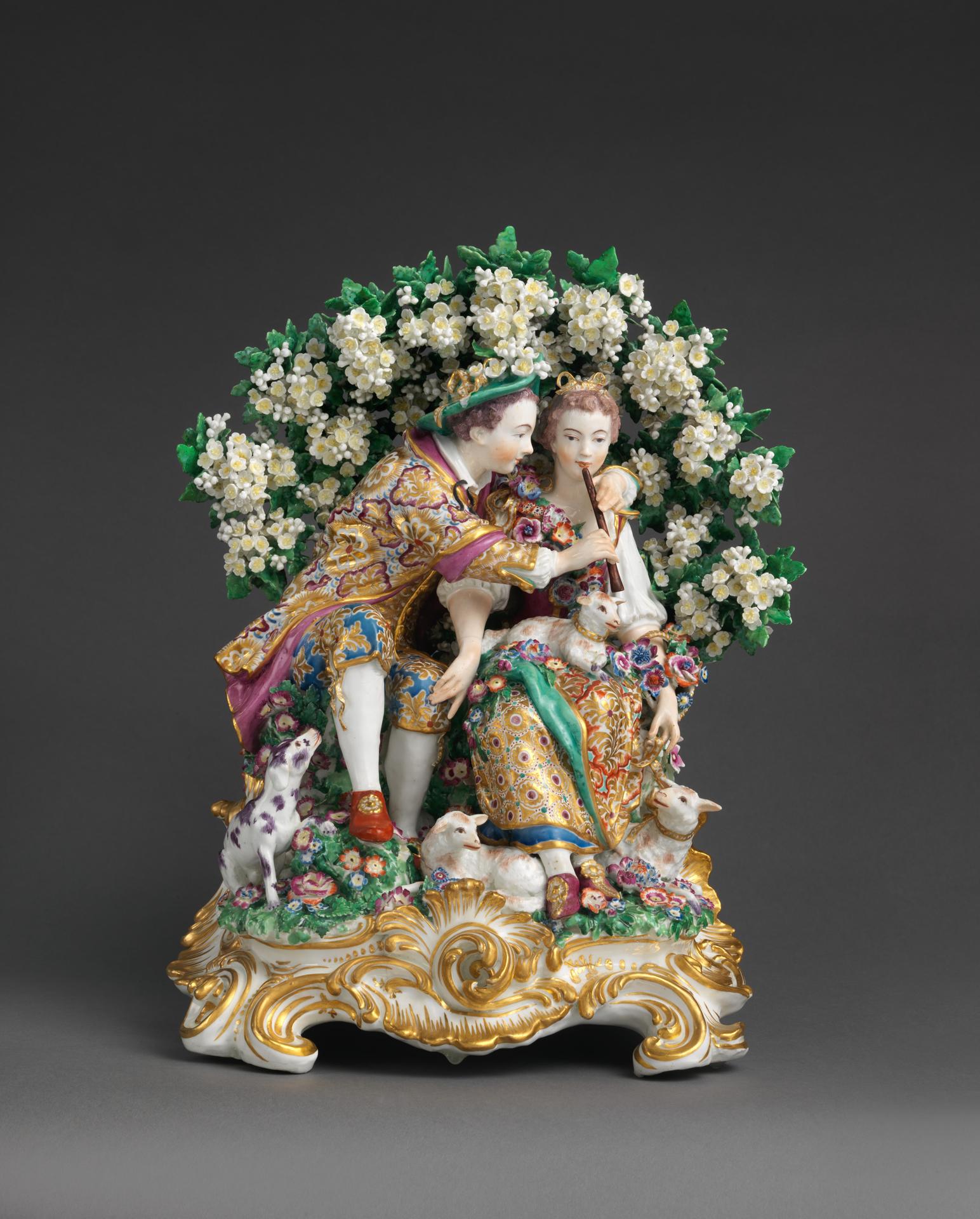
The Music Lesson (ca. 1765)
Original title: The Music Lesson
kurzbeschreibung
What sets Die Musikstunde apart from related porcelain groups of its time is the way it pairs a gallant musical encounter with an unusually rich cast of figures. Made around 1765 at the Chelsea Porcelain Manufactory, the group stands 39.1 cm high on an ornate base. Two figures in costly dress are brought together for a musical meeting, all modelled in soft-paste porcelain.
Description
On a base adorned with flowers and plants and touched with gold, the figure on the right sits on a decorated seat while the one on the left holds out or offers a flute-like instrument. Both wear colourful clothing trimmed with gold. A wreath of white blossoms frames the pair, and along the lower edge several small sheep-like animals lie at rest. The plain dark backdrop makes the colours of the garments stand out.
Context
Chelsea was among England's earliest important porcelain manufactories, founded in 1745. In the 1760s, when this group was made, the factory looked closely to French and German models, above all to Meissen figures. Figurative groups of this kind often served as table centrepieces or room ornaments in well-to-do households. The theme of the music lesson draws on a motif widespread in 18th-century art as an expression of courtly sociability.
Impact
Lively colour and carefully finished garments shape the impression this porcelain group makes. Despite its festive abundance, the arrangement stays graceful and radiates a cheerful, courtly atmosphere. The dark background of the view heightens the luminosity of the colours and gives the figures a strong sense of volume.
Technique
The group was made from soft-paste porcelain, produced at Chelsea with the addition of bone ash and other ingredients. The figures were cast in moulds and then worked by hand; the painting was done manually as well. Overglaze colours were used, supplemented by gilded details that give the object its sumptuous character.
AI-generated description text
Source: Metropolitan Museum of Art · Public Domain (CC0 1.0)