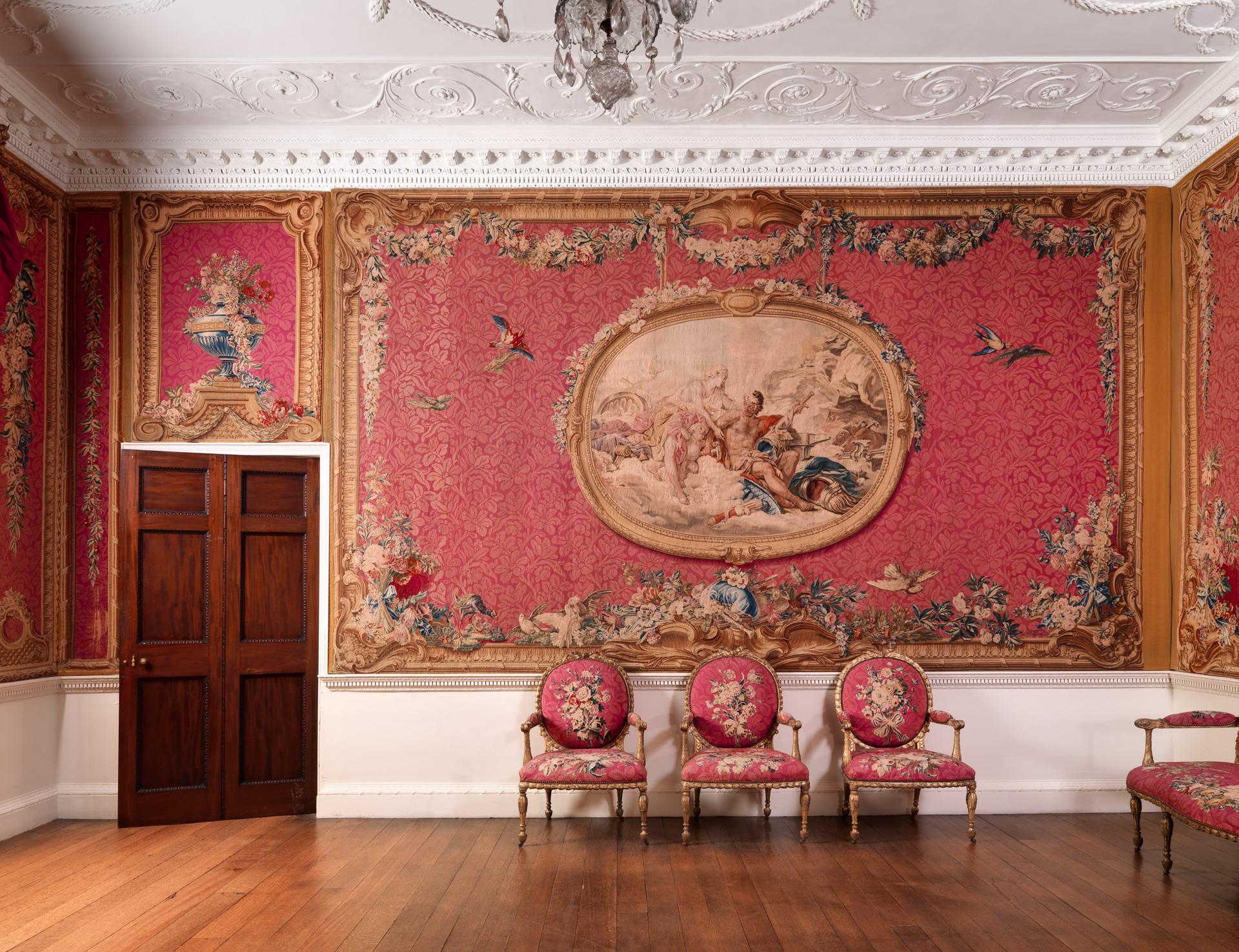
Allegory of Fire (Venus Visiting Vulcan)
Original title: Allegory of Fire (Venus Visiting Vulcan)
kurzbeschreibung
The tapestry Allegory of Fire (Venus Visiting Vulcan) derives from a design by Jacques Germain Soufflot made between 1758 and 1767 and was woven from 1764 to 1771. Made of wool and silk, it has 22–24 warps per inch (9–10 per cm) and measures 10 × 17 feet (304.8 × 518.2 cm). It depicts an allegorical episode: Venus pays a visit to the smith god Vulcan.
Description
Unlike many eighteenth-century mythological tapestries, this one presents an oval picture field set within a rectangular surround. In this scene, several figures appear—a woman, accompanied by a man and other figures—before a landscape with trees and rivers. Flowers and birds form the surrounding border. The room where the tapestry hangs has red walls with floral patterns; in front stand four armchairs with red floral upholstery, and a wooden door on the left. The ceiling is decorated with a complex ornament from which a chandelier hangs; the floor consists of wooden tiles.
Context
Soufflot's design dates between 1758 and 1767, and the weaving followed from 1764 to 1771. The French architect, best known for the Panthéon in Paris, also worked here as a designer of decorative art. The motif of Venus and Vulcan draws on a classical mythological theme prized in eighteenth-century court art. The tapestry was presumably made for a formal room in a noble residence or château.
Impact
The combination of mythological scene and rich floral framing creates a courtly, elegant mood. The oval picture structure within the rectangular tapestry draws the eye to the group of figures and gives the work a theatrical presence.
Technique
The tapestry was produced in high-warp weaving from wool and silk, with a density of 22–24 warps per inch (9–10 per cm). This fine weave allowed detailed reproduction and nuanced color gradations, as was characteristic of high-quality eighteenth-century tapestries.
AI-generated description text
Source: Metropolitan Museum of Art · Public Domain (CC0 1.0)