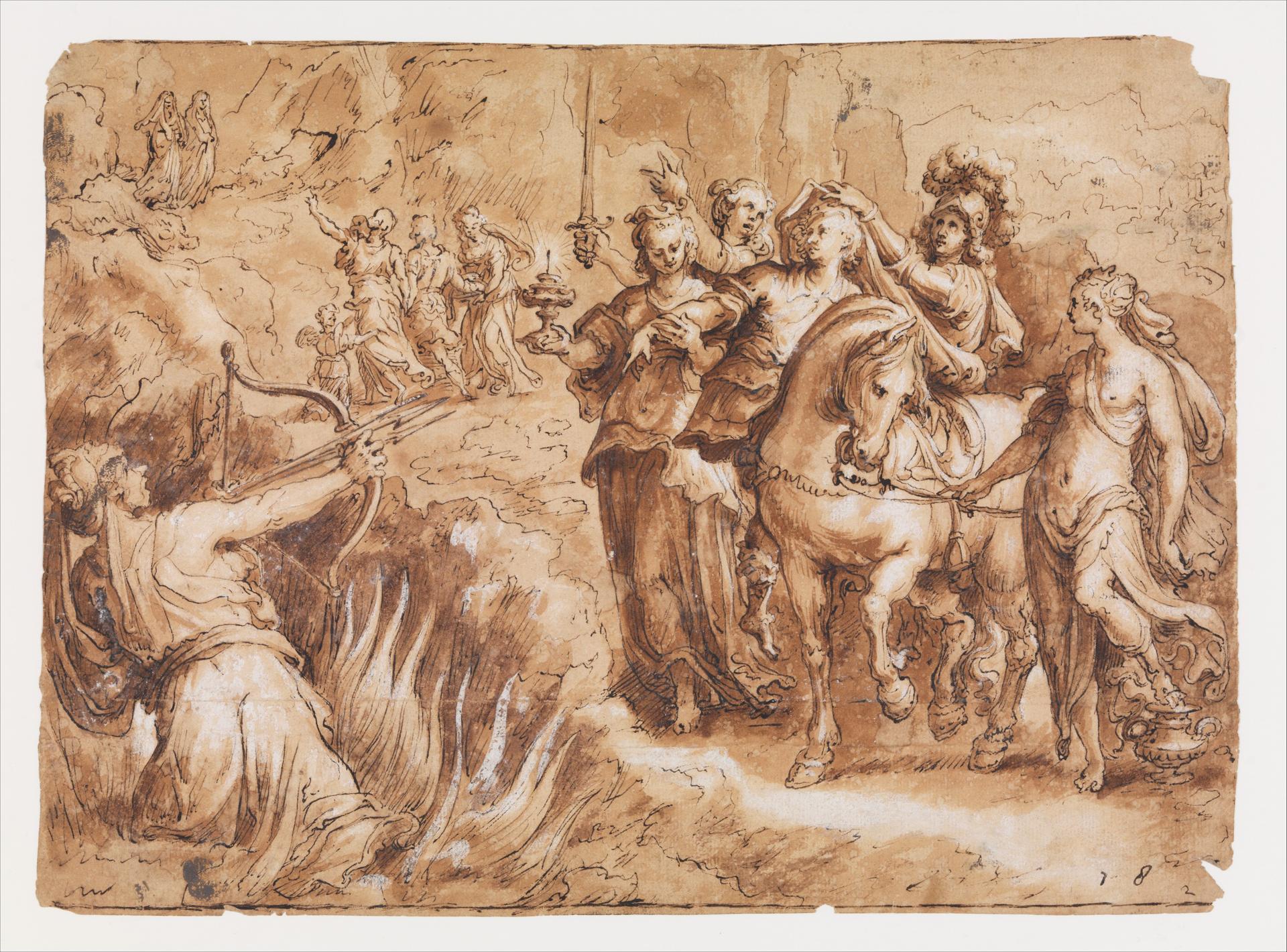
Allegory of the Course of Human Life (Choosing Virtue)
Original title: Allegory of the Course of Human Life (Choosing Virtue)
kurzbeschreibung
Jan van der Straet, known as Stradanus, drew this sheet in 1570 or earlier. Worked in pen and brown ink, with brush and brown wash and opaque white heightening, it addresses the choice of virtue along the path of human life. Several figures are bound into a restless structure that embodies the variety of existence.
Description
A woman on horseback anchors the layout; around her other figures stand and move, among them one with a sword and one with a candle. Floating or wandering figures toward the rear bring unease to the sheet. Brown tones dominate the view, with white heightening standing out in places. Light falling from above gives relief to figures and objects. The lines are carefully drawn and rich in detail, as was customary in the Renaissance.
Context
Stradanus, a Fleming active in Italy, was prized above all for his designs. Allegorical images were popular in his day for making moral and philosophical ideas visible. He worked for the Medici in Florence, among others, and there came into contact with humanist circles. This sheet may have served as a preparatory study for a larger work or been intended as an independent artwork in its own right.
Impact
The eye is drawn by the moving knot of figures and pulled into the allegorical action. Pen drawing and washed areas interlock, creating a lively, almost stage-like mood. Deliberately placed white heightenings give the image plastic depth.
Technique
Pen and brown ink form the basis, supplemented by brush and brown wash and white bodycolor for the heightenings. The framing lines in pen and brown ink are by the artist himself. This method was widespread in the Renaissance for preparatory drawings and cabinet pieces, since it allowed both rapid and precise work.
AI-generated description text
Source: Metropolitan Museum of Art · Public Domain (CC0 1.0)