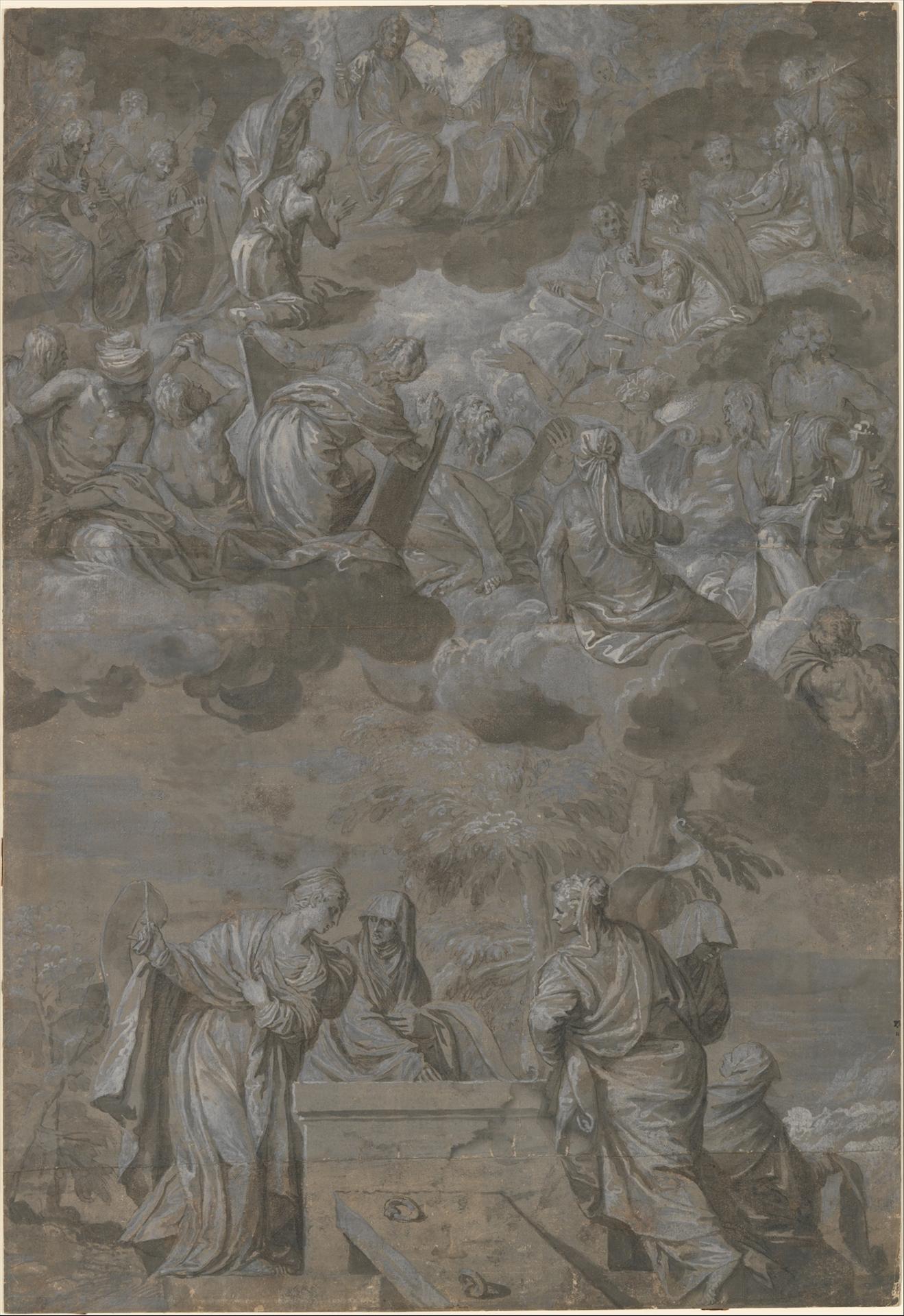
Allegory of the Redemption of the World
Original title: Allegory of the Redemption of the World
kurzbeschreibung
Paolo Veronese (Paolo Caliari) made this drawing between 1528 and 88. It is titled Allegory of the Redemption of the World and is executed in pen and black ink, gray wash, and white gouache heightening on gray washed paper. The sheet presents a religious scene: figures in the foreground and a heavenly assembly in the background.
Description
Several people in traditional garments stand around a table, seemingly absorbed in a ritual or ceremonial act. Behind them, other figures act in a heavenly scene, perhaps angels or saints in a celestial conference or judgment. Clouds surround the event and suggest a supernatural setting. The palette remains largely in grays, with bright accents from white gouache heightening. The layout feels dynamic; the figures appear in various poses and movements.
Context
Veronese ranks among the leading painters of the Venetian Renaissance and is known for large-scale paintings of religious and mythological subjects. The drawing dates from his mature period, when he often made designs for larger compositions. The Allegory of the Redemption of the World belongs to the Counter-Reformation context of Venice, which emphasized religious imagery. Whether the drawing served as a study for a painting or as an independent work is not documented.
Impact
Dramatic staging and lively depiction of movement and emotion characterize the sheet. The interplay of gray wash and white gouache creates a strong light-dark contrast that emphasizes the heavenly sphere. The dynamic arrangement draws the viewer into the narrative and evokes a solemn, sublime mood.
Technique
For the contours Veronese used pen and black ink; brush and gray wash served for shading. He applied white gouache selectively to highlight light accents, which produces a special luminosity on the gray washed paper. The combination of washed drawing and opaque heightening is typical of Venetian Renaissance designs.
AI-generated description text
Source: Metropolitan Museum of Art · Public Domain (CC0 1.0)