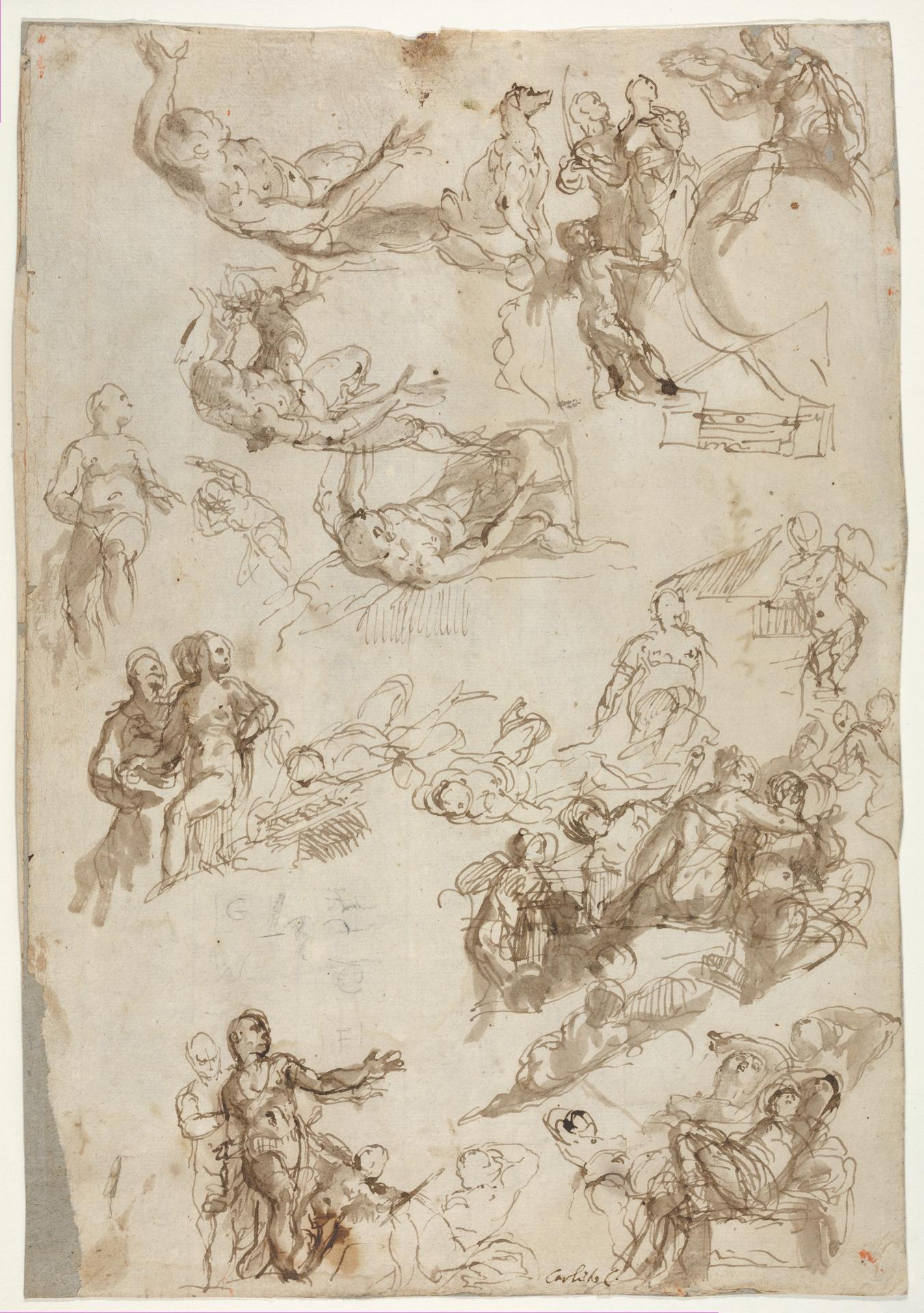
Studies for The Allegories of Love
Original title: Studies for The Allegories of Love
kurzbeschreibung
Around 1570–75, Paolo Veronese (Paolo Caliari) set down a series of figure studies on this sheet, drawn with pen and brown ink and brushed with brown wash. The sketches were probably made as preparatory work for his allegories of Cupid; they show reclining, seated and standing figures in changing poses.
Description
Loosely scattered across the sheet, several figures appear in very different attitudes: some recline, others sit, still others stand upright. The line runs fluidly and with movement, giving the figures liveliness; a few seem caught in dance or wrestling, while others remain calm. Brown tones dominate the whole sheet, a sign of ink and brown brushwash. The groups of figures are placed spontaneously, and shadows or light effects are nowhere to be found.
Context
The studies were made at the height of the Venetian Renaissance, when Veronese was working for churches and Venetian palaces. Allegories of love were highly popular in the decorative painting of those years and often used in frescoes and ceiling paintings. As preparation for larger compositions, the artist tried out the figures in ever-new poses in order to find the most convincing solution.
Impact
The loose, spontaneous line gives the sketch something immediate and alive. The moving figures convey a sensual, expressive quality characteristic of Veronese. Because everything is reduced to brown tones, the eye focuses entirely on the movement and anatomy of the figures, without distraction from color.
Technique
Veronese used pen and brown ink for drawing and a brush with brown wash for modeling the figures. Fine pen lines and soft brush washes interlock, allowing contour and shading to flow into one another. This approach was common in Venetian drawings of the Renaissance and made it possible to capture movement quickly and expressively.
AI-generated description text
Source: Metropolitan Museum of Art · Public Domain (CC0 1.0)