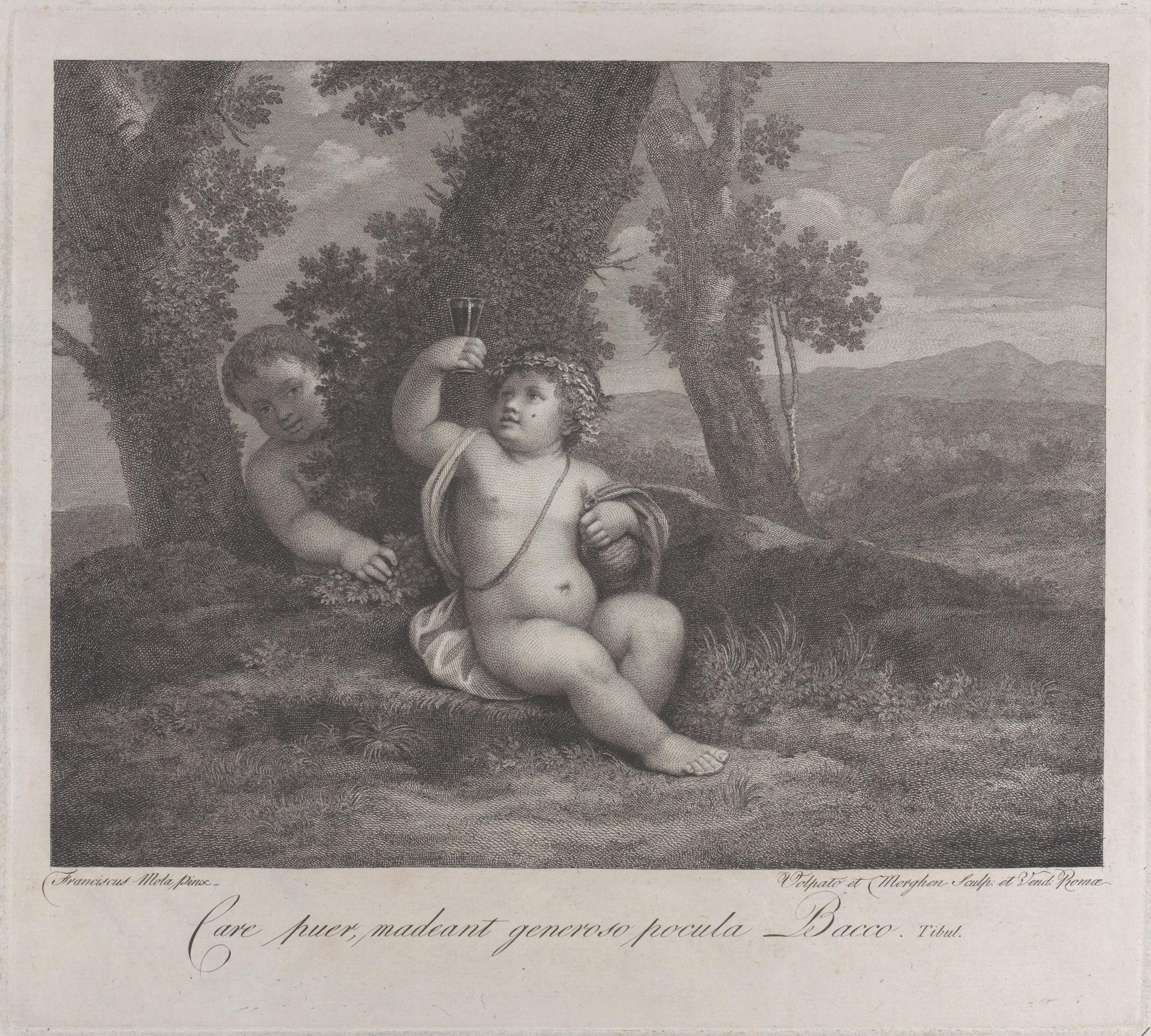
The infant Bacchus seated under a tree, holding up a wine glass, with another infant behind him at left
Original title: The infant Bacchus seated under a tree, holding up a wine glass, with another infant behind him at left
kurzbeschreibung
Raphael Morghen's 1780 engraving presents two children in a peaceful natural setting. A disproportionately large child sits at the center under a tree, raising a wine glass; a second, smaller child stands behind him to the left.
Description
A large child has settled on the ground, holding a glass of wine in his right hand and gazing thoughtfully. To his left, a smaller child leans against a tree and watches. Both are barefoot and dressed in simple, classical-style garments. Trees, hills, and a cloudy sky form the landscape behind them. The layout is balanced: the main figure at the center, the companion to the left.
Context
The engraving was made in 1780, when Neoclassicism was dominant in Europe. Morghen, an Italian engraver, was known for his reproductions after famous paintings. The infant Bacchus draws on a motif from ancient mythology that appeared frequently in late 18th-century art. It may be a reproduction of a painting by another artist—a typical procedure for Morghen.
Impact
The symmetrical arrangement and quiet landscape give the print harmony and balance. The main child's pensive expression introduces a melancholic note that slightly breaks the idyll. The gray tones of the engraving emphasize the precision of the drawing and the Neoclassical formal language.
Technique
Morghen worked in copperplate engraving: the motif is incised into a copper plate and then printed on paper. The lines are fine and exact, as is characteristic of his method. Even light without strong shadows corresponds to the linear engraving technique of the 18th century.
AI-generated description text
Source: Metropolitan Museum of Art · Public Domain (CC0 1.0)