Still-Life with a Watermelon and Pomegranates
Original title: Still-Life with a Watermelon and Pomegranates
kurzbeschreibung
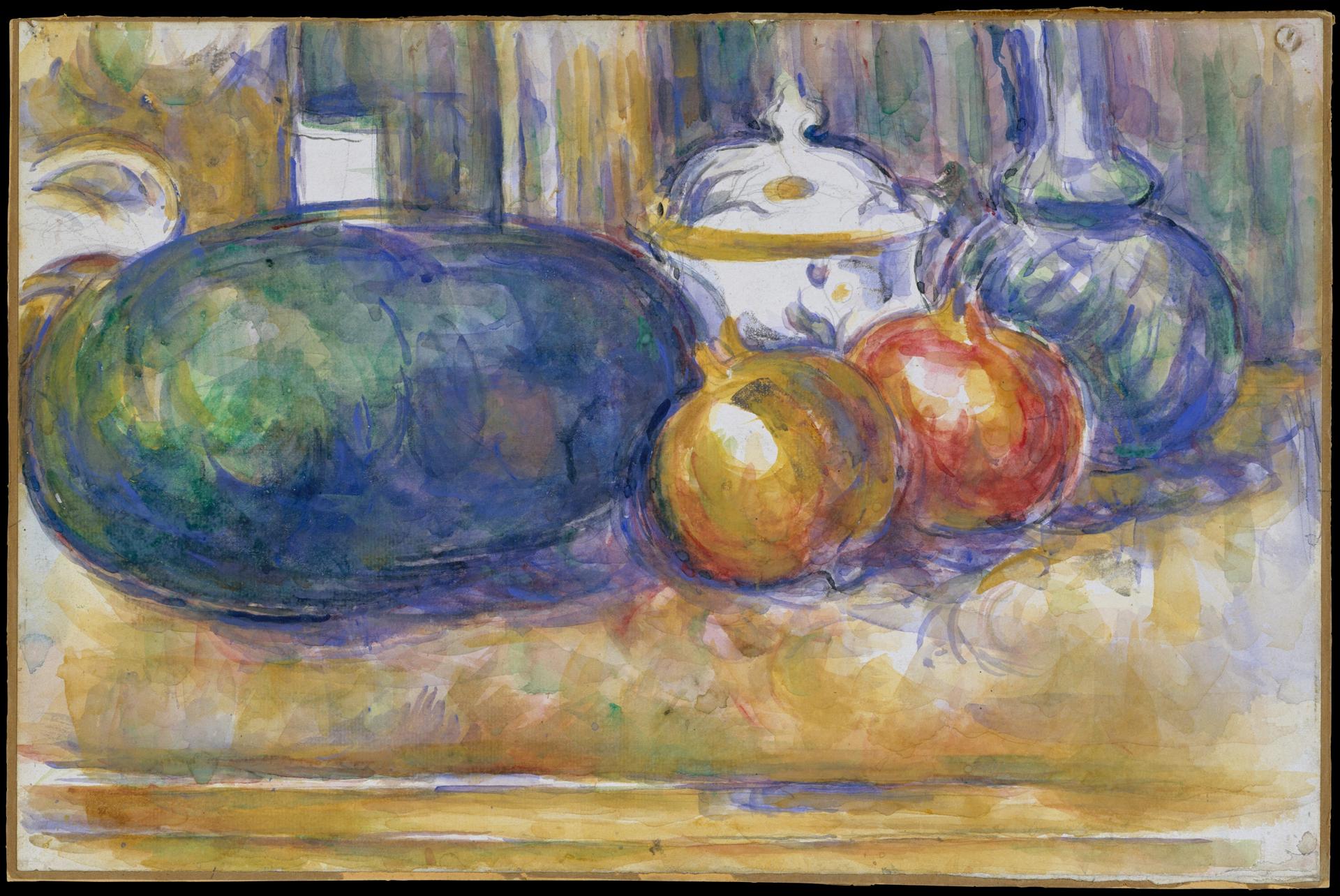
Paul Cézanne made this watercolor between 1900 and 1906. It features a watermelon, two pomegranates, and two blue-green vases. He used watercolor over graphite on laid paper. The arrangement stretches horizontally, with the fruit in front and the vessels behind.
Description
Two pomegranates sit in the foreground, one yellow and the other red, next to a blue-green lidded vase decorated with flowers. Behind them rises a second blue-green vase, this one without a lid; on the left, part of a white vessel with a handle appears. Light enters from the right, highlighting shadows and reflections on the objects. The colors are bright and translucent, and the strokes flow, remaining slightly irregular, as is typical of watercolor. The overall palette feels warm, and the objects are evenly distributed across the surface.
Context
In his late period, Cézanne devoted himself intensely to still life and to the challenge of rendering light and form. He used watercolor to test color and composition, often in parallel with his oil paintings. His choice of fruit and simple vessels reflects his preference for everyday motifs, which he grouped anew again and again. The work was created while Cézanne was working in Aix-en-Provence and increasingly focusing on reduced forms and the harmony of colors.
Impact
The transparent watercolor washes give the still life a lightness and freshness that feels almost sketch-like. The warm palette and the incoming light create a calm, familiar mood that invites close looking at the objects. The simple arrangement appears balanced and harmonious.
Technique
Cézanne applied watercolor over a graphite drawing on laid paper, using the medium's transparency to convey light and shadow. The fluid, sometimes irregular strokes make the brushwork visible and reveal a spontaneous working method. In some places the paper is left unpainted, which enhances the lightness of the construction.
AI-generated description text
Source: Metropolitan Museum of Art · Public Domain (CC0 1.0)