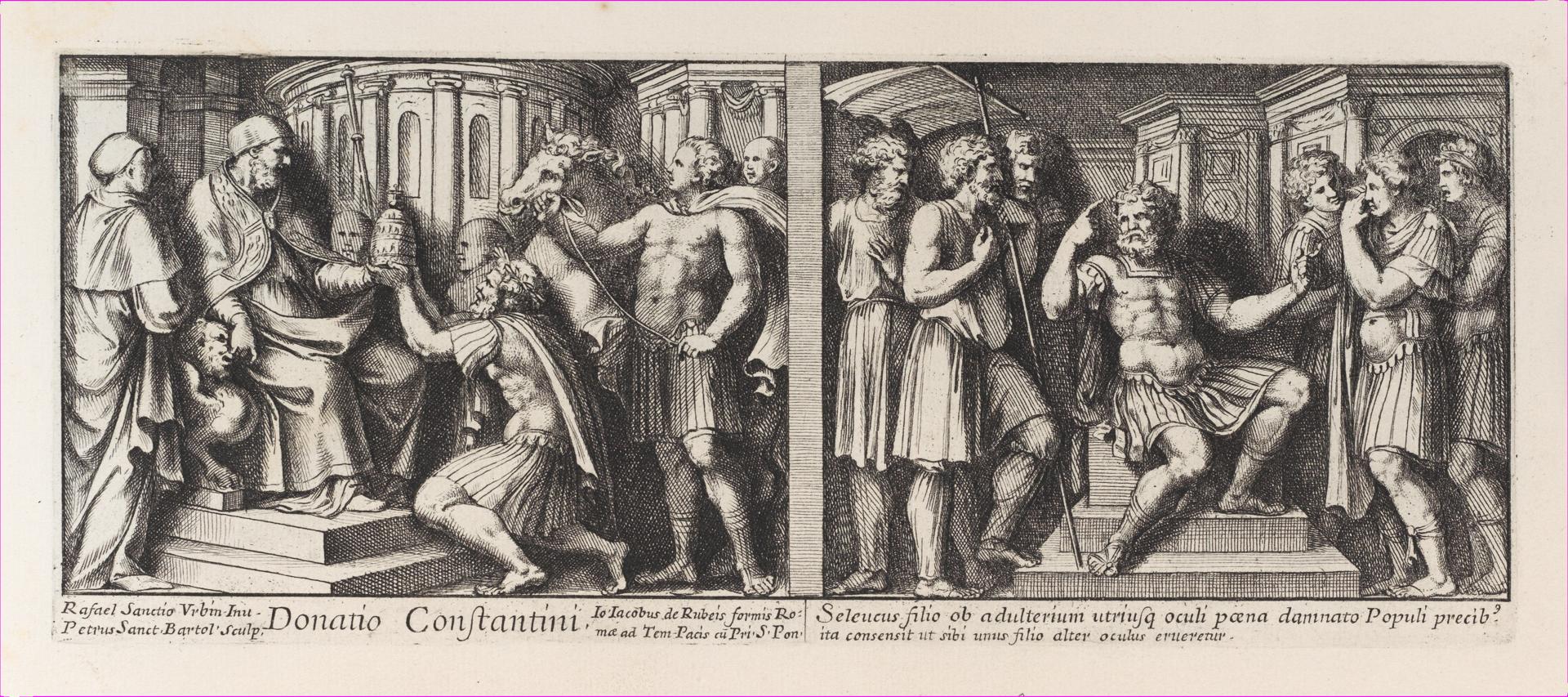
Two Biblical Scenes: Constantine donating the City of Rome to Pope Sylvester at left, after Raphael's Stanza di Eliodoro and The Judgement of Seleucids at right, after Raphael's Stanza della Segnatura
Original title: Two Biblical Scenes: Constantine donating the City of Rome to Pope Sylvester at left, after Raphael's Stanza di Eliodoro and The Judgement of Seleucids at right, after Raphael's Stanza della Segnatura, from a series of 15 plates depicting Raphael's works for the Vatican stanze and the Sistine Chapel tapestries
kurzbeschreibung
Between 1650 and 1670, Pietro Santi Bartoli etched two scenes after designs by Raphael. On the left half, Emperor Constantine hands the city of Rome to Pope Sylvester I; on the right, the Judgment of the Seleucids appears. The sheet belongs to a series of 15 etchings reproducing Raphael's frescoes in the Vatican Stanze and the Sistine Chapel.
Description
A kneeling ruler offers a model of the city to a pope enthroned—this is how the left half of the horizontal sheet begins. Around the two main figures stand others in antique dress. On the right, figures cluster around an elevated judge pronouncing sentence. The drawing uses uniformly fine lines that bring out the contours and shading of the garments clearly. Monochrome and without color accents, the distribution of light remains even across the entire surface.
Context
Bartoli, an Italian engraver of the Baroque, specialized in reproducing ancient and modern art. The series was commissioned by Pope Alexander VII, who promoted prints after Raphael's frescoes in the Stanze. Such sheets made Raphael's inventions known throughout Europe and served artists and collectors as study material. The two scenes take up historical and biblical events that Raphael had designed in the Vatican frescoes.
Impact
Despite its small format, the sheet has a monumental presence reminiscent of Raphael's large frescoes. The precise rendering of the multi-figure groups and the clear narrative structure shape the impression. Balanced arrangement and fine linework allow Raphael's compositional art to be recognized even in the etching.
Technique
For the etching, the drawing was scratched into a copper plate coated with wax and then etched. Bartoli worked with fine, precisely guided lines to capture details of the figures and garments. The even depth of the etched lines and the sharp contours demonstrate his skill in handling 17th-century printmaking.
AI-generated description text
Source: Metropolitan Museum of Art · Public Domain (CC0 1.0)