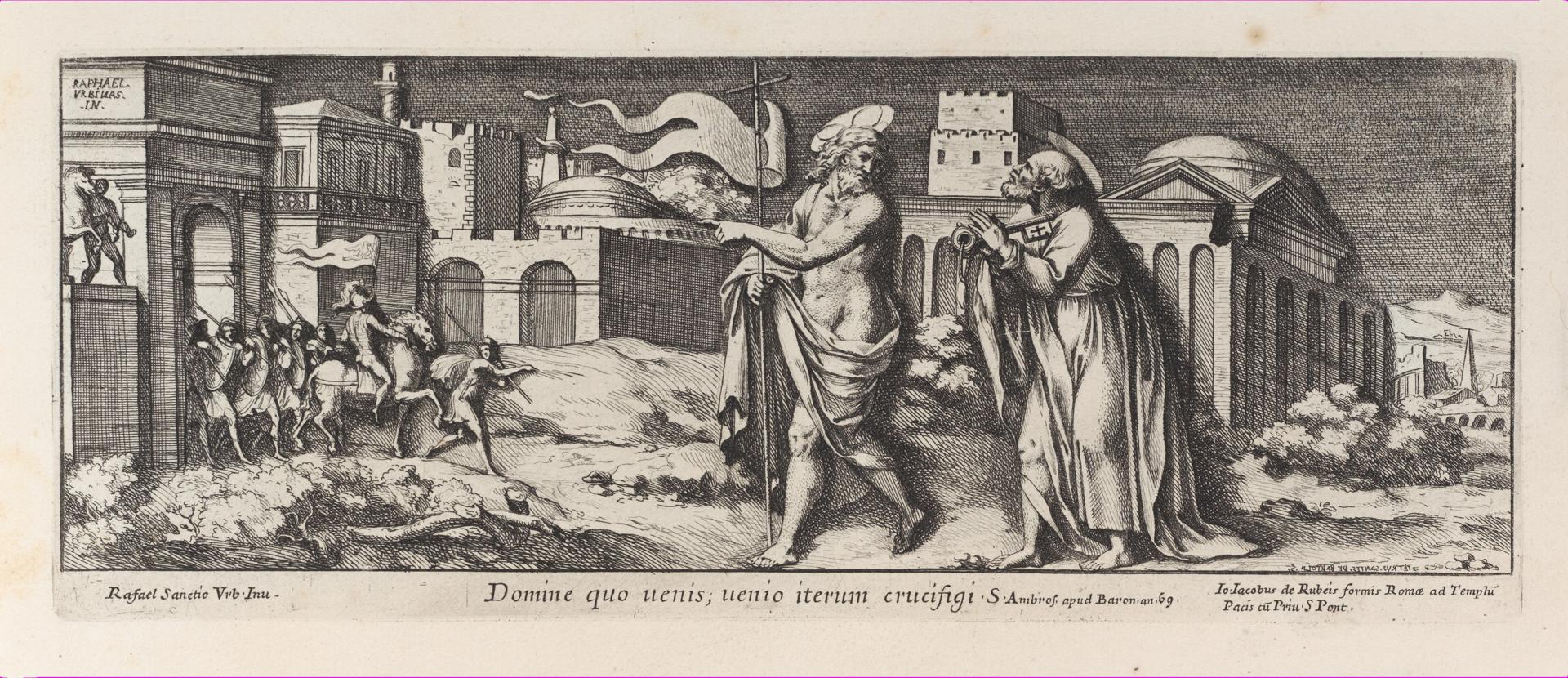
Christ appearing to Saint Peter after the Resurrection (Domine Quo Vadis), from a series of 15 plates, depicting Raphael's works for the Vatican stanze and the Sistine Chapel tapestries
Original title: Christ appearing to Saint Peter after the Resurrection (Domine Quo Vadis), after Raphael's Stanza dell'incendio del Borgo, from a series of 15 plates, depicting Raphael's works for the Vatican stanze and the Sistine Chapel tapestries
kurzbeschreibung
Pietro Santi Bartoli's etching from 1650 to 1670 brings to life the legendary encounter between the risen Christ and the apostle Peter. The print belongs to a series of 15 engravings in which Bartoli reproduced famous works by Raphael from the Vatican Stanze and the Sistine Chapel. For this scene, Raphael's fresco in the Stanza dell'incendio del Borgo served as the model.
Description
Christ, wearing only a loincloth and barefoot, stands face to face with the apostle Peter; he holds a cross and fixes his gaze on Peter, who is wrapped in voluminous robes and whose posture wavers between surprise and concern. Behind the two figures rise ancient buildings and a city wall, before which a crowd watches the event. On the right stands a columned temple, while from the left horsemen approach the scene. The etching technique, with its precise lines and graduated shading, gives the architectural setting depth and structure.
Context
In the seventeenth century, Raphael's Vatican frescoes became known to a wider audience through print reproductions. Pietro Santi Bartoli, an Italian engraver, specialized in reproducing ancient and Renaissance art. The 15-part series to which this print belongs was distributed by Roman publishers. The episode 'Domine Quo Vadis' comes from a legend that Raphael depicted in the Stanza dell'incendio del Borgo.
Impact
Clear lines and strong contrasts of shadow create a mood that is both calm and dramatic. The confrontation between Christ and Peter in the foreground, set against the monumental architecture, feels solemn and recalls the grandeur of the original.
Technique
For this etching, the lines were bitten into a metal plate and then printed on paper. Fine parallel hatching and nuanced tonal values demonstrate Bartoli's typical working method, which aims at a precise translation of the painted model.
AI-generated description text
Source: Metropolitan Museum of Art · Public Domain (CC0 1.0)