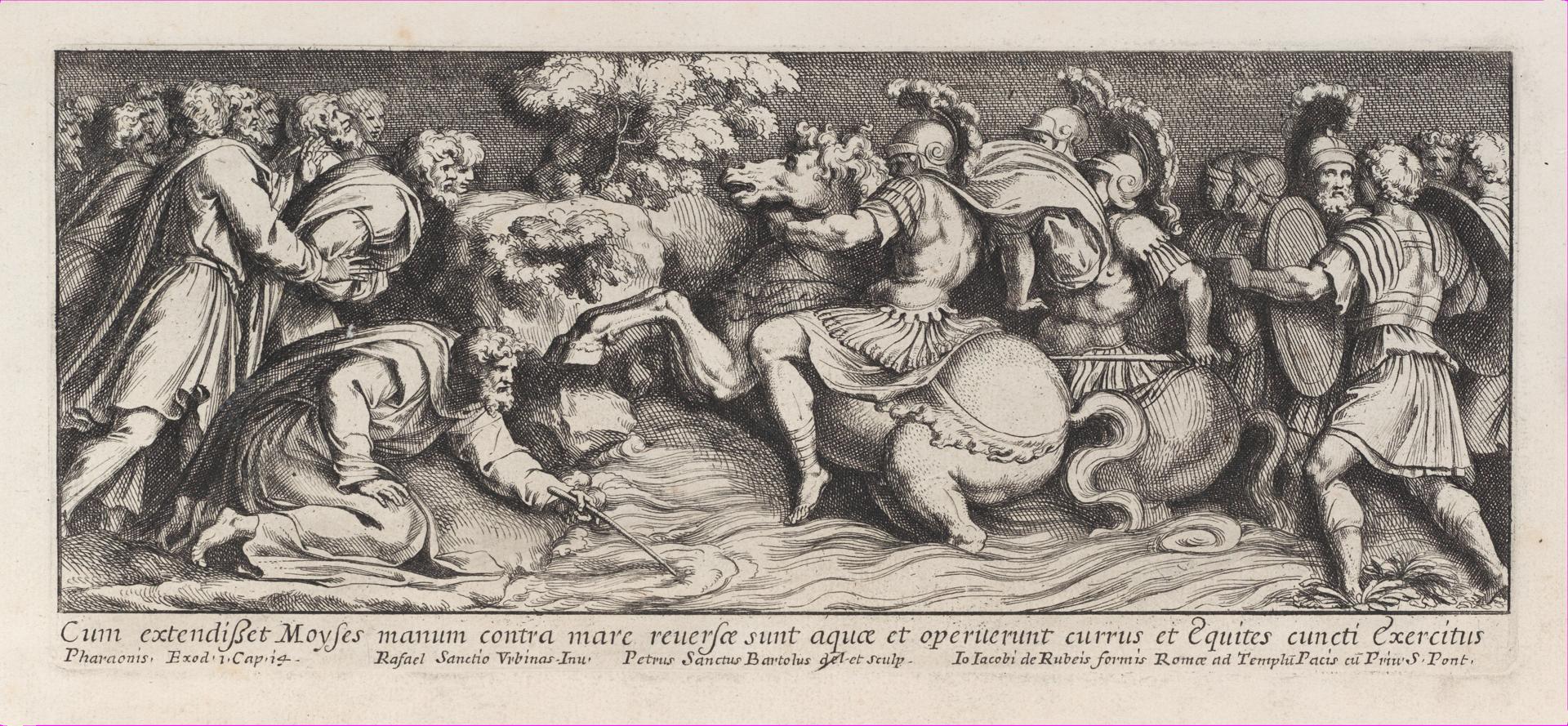
Moses parting the Red Sea as the Pharoah's army drowns, after Raphael's Stanza di Eliodoro, from a series of 15 plates, depicting Raphael's works for the Vatican stanze and the Sistine Chapel tapestries
Original title: Moses parting the Red Sea as the Pharoah's army drowns, after Raphael's Stanza di Eliodoro, from a series of 15 plates, depicting Raphael's works for the Vatican stanze and the Sistine Chapel tapestries
kurzbeschreibung
Between 1650 and 1670, Pietro Santi Bartoli etched the scene of Moses parting the Red Sea while the army of Pharaoh perishes in it. His model was a fresco by Raphael in the Vatican's Stanza di Eliodoro. The sheet belongs to a cycle of 15 etchings in which Bartoli reproduces Raphael's works for the Vatican Stanze and the tapestries of the Sistine Chapel.
Description
At the front right, Moses with raised arm parts the waters, upright and wholly focused on his action. To his left, several figures emerge from the sea—the Israelites. On the other side, soldiers of Pharaoh go under, their faces betraying horror and panic. Trees and rocks frame the setting. The layout draws the eye toward Moses's gesture, while light falls evenly across the surface, held in monochrome tones.
Context
During these years Bartoli was active in Rome and had devoted himself to reproducing ancient and modern art. The etching is part of a cycle of 15 sheets that copy Raphael's frescoes in the Vatican Stanze and the cartoons for the Sistine Chapel tapestries. Such series made Raphael's work known beyond Italy and found favor with collectors and art lovers. Bartoli often worked after designs by other artists, thereby helping to spread Roman art.
Impact
From the contrast between Moses's majesty and the mortal fear of the sinking soldiers, from the dynamic arrangement and harsh contrasts, a tense drama arises. The careful execution and sharp contours give the print a baroque immediacy that brings the biblical narrative directly before the eyes.
Technique
For the etching, the drawing was worked into a copper plate, which was then bitten by acid. This allowed fine lines and hatching to be obtained, with which water, rocks, and bodies could be captured precisely in their surfaces. Monochrome and even light distribution correspond to what characterizes prints of this period.
AI-generated description text
Source: Metropolitan Museum of Art · Public Domain (CC0 1.0)