Marguerite De Gas, the Artist's Sister
Original title: Marguerite De Gas, the Artist's Sister
kurzbeschreibung
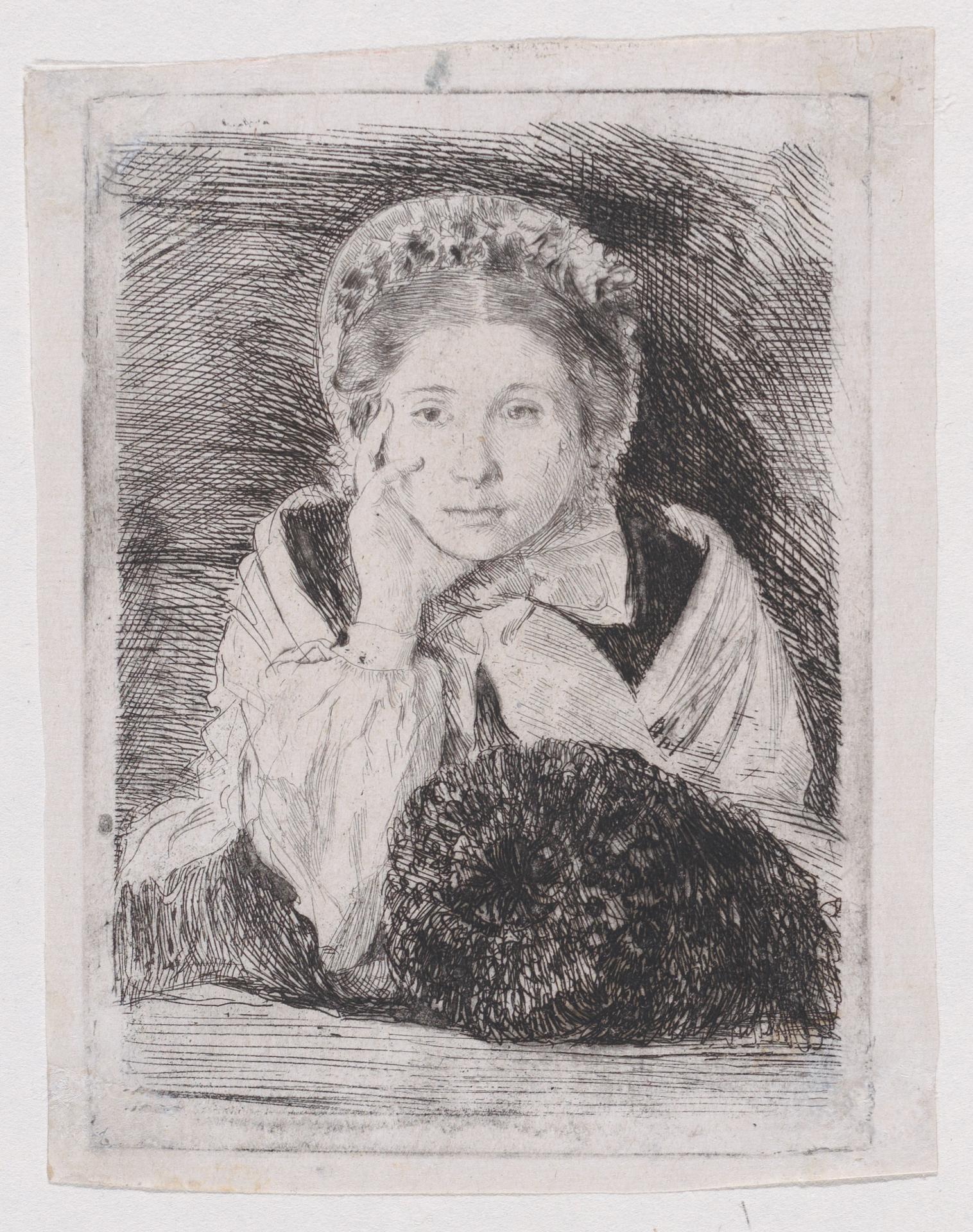
Unlike many family portraits of its time, this etching by Edgar Degas of his sister Marguerite stays fixed on a single moment of pause. Made in 1860–62, it is an etching with drypoint, and of the second of six states only this one impression exists. The small plate measures 11.6 × 8.8 cm and is entirely in black and white.
Description
Marguerite brings her right hand up to her face—a gesture that could signal tenderness or thought. Her headdress is richly decorated with floral patterns, and the garment shows folds and ruffles. A dark, non-representational background makes the figure stand out. The lines are drawn with precision, bringing out textures as well as expression.
Context
This print belongs to an early phase of Degas's career, before he turned to Impressionism. It followed a trip to Italy, where he learned etching. The portrait of his sister reveals the influence of the old masters, especially Renaissance portraiture. Among his prints from that time, it is a rare work.
Impact
The familiar hand movement and the exact rendering of the headdress create a quiet, almost fragile mood. Because the format is so small, the viewer moves closer to the person, which strengthens the intimacy of the image.
Technique
Etching and drypoint are used together, with drypoint leaving fine, burred lines. The black tones and confident stroke demonstrate great technical skill. That only a single impression of the second state survives points to an experimental working process.
AI-generated description text
Source: Metropolitan Museum of Art · Public Domain (CC0 1.0)