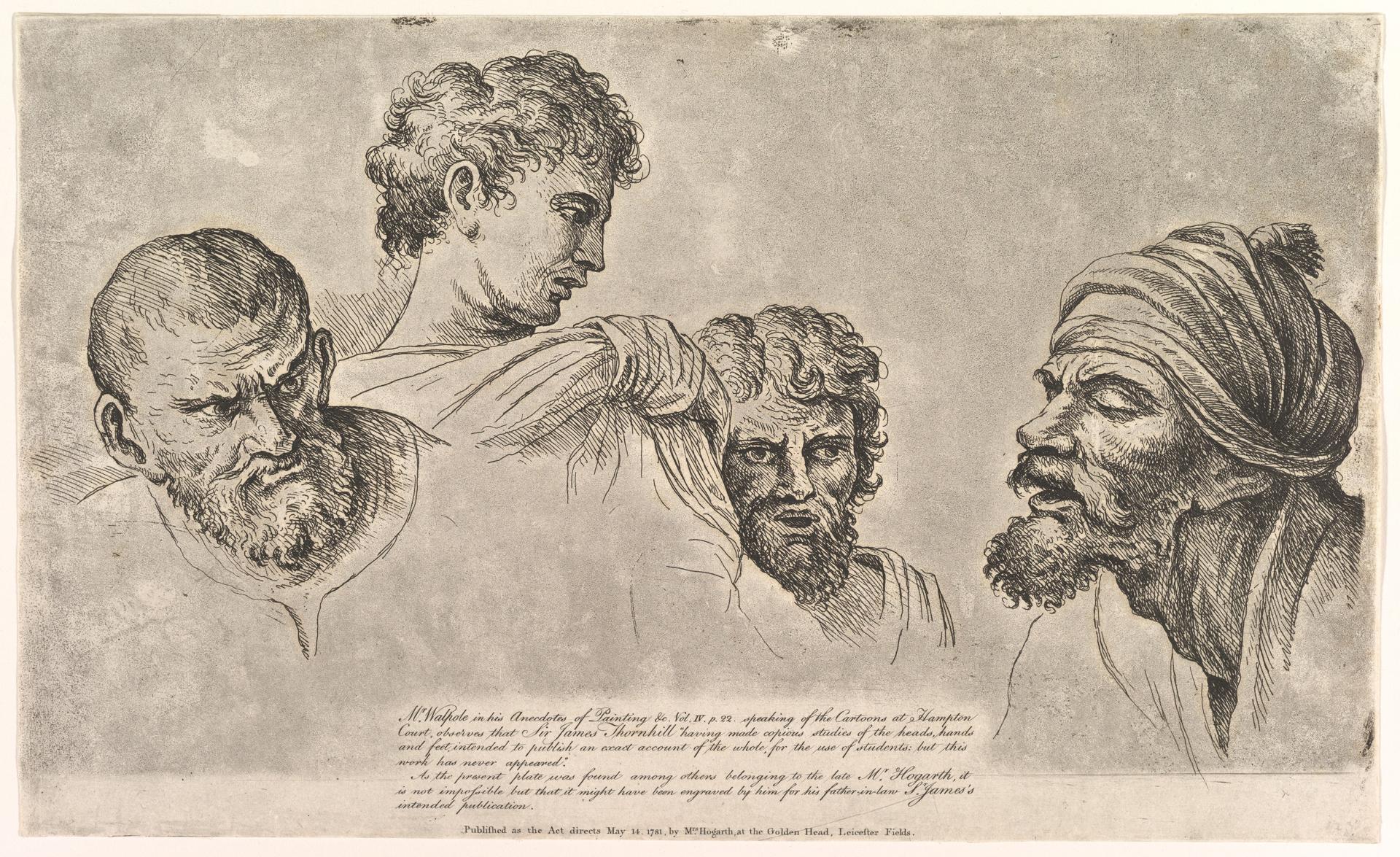
Four Heads From the Raphael Cartoons at Hampton Court (May 14, 1781, Met-Objekt 5936)
Original title: Four Heads From the Raphael Cartoons at Hampton Court
kurzbeschreibung
On 14 May 1781, William Hogarth etched four male heads derived from Raphael's cartoons at Hampton Court. The print is in the second state of two and combines etching with aquatint. The portraits appear in classical dress and follow Raphael's famous designs.
Description
Four male heads line up in a row, each seen from a different angle. Classical garments drape the figures, pointing to antique art. The background stays bare, pushing the faces forward. Aquatint creates a monochrome palette of varied greys. Even light falls on the forms without harsh shadows, while the realistic style renders skin and fabric in detail.
Context
The print dates from 1781, the year Hogarth died, and takes Raphael's cartoons at Hampton Court as its starting point. Hogarth, usually known for satirical work, here engages unusually seriously with high art. The cartoons were widely known in England through engravings and served artists as study material. The work belongs to a series with which Hogarth sought to position himself as an artist and theorist in the tradition of history painting.
Impact
The calm, symmetrical row of heads gives the print a dignified, classical air reminiscent of ancient portrait galleries. Subtle greys and precise facial features lend the work an intimate, almost sculptural quality. The view feels factual and focused, without the moralizing undertone that marks many other works by Hogarth.
Technique
Etching and aquatint were used together, with aquatint supplying the tonal greys. Etching allows fine lines for the facial features, while aquatint provides soft gradations and textures. The second state likely shows strengthening or corrections compared to the first, which is typical of Hogarth's working method.
AI-generated description text
Source: Metropolitan Museum of Art · Public Domain (CC0 1.0)