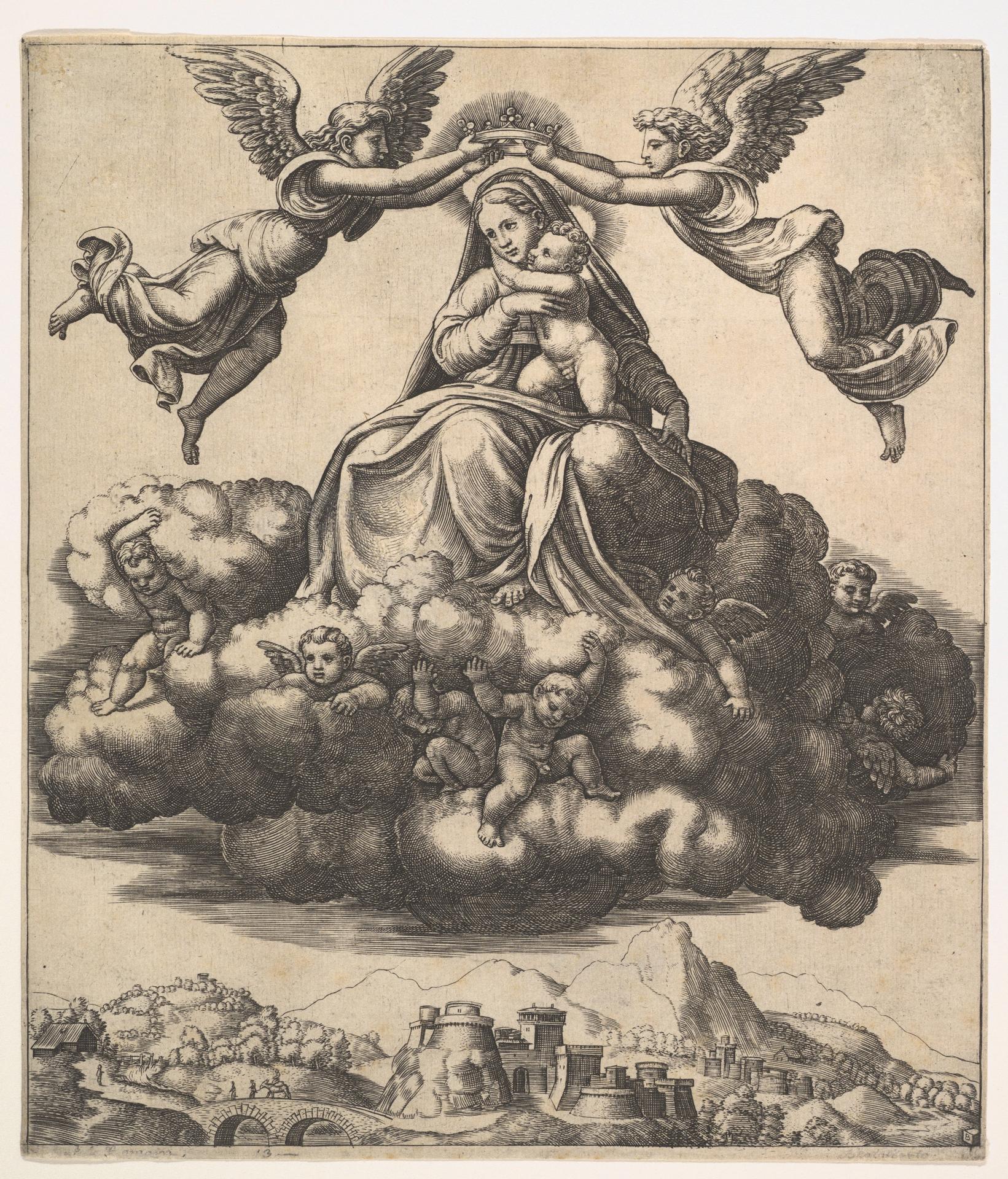
The Virgin seated on clouds being crowned by angels
Original title: The Virgin seated on clouds being crowned by angels
kurzbeschreibung
This engraving by the Master of the Die, made between 1530 and 1560, presents Mary with the Christ Child resting on a cloud. Above the Mother of God two angels hover, bearing a crown. The sheet belongs to Renaissance printmaking and pairs a symmetrical layout with a richly articulated landscape behind the figures.
Description
Mary and the Child sit exactly on the central axis of the sheet, while several putti are scattered across the clouds to either side. Two angels hold the crown over the Virgin's head. Behind the group a landscape opens out with mountains, trees, a village and a castle, their forms defined by delicate lines. Grey and white tones alternate, and the light falls evenly across the whole view, as was usual for engravings of this period.
Context
The Master of the Die was an engraver active in Italy whose name comes from a die shown in his signature; his career falls in the first half of the sixteenth century. Many of his prints reproduce designs by artists such as Raphael, helping such images circulate throughout Europe. The crowned Queen of Heaven was a common subject of Catholic iconography, given fresh impetus in the Renaissance by intensified devotion to Mary.
Impact
The calm, even structure and symmetrical arrangement give the print a solemn, devotional tone. Figures and landscape are clearly separated and cleanly drawn in outline, producing a balanced harmony that invites the viewer to linger.
Technique
The sheet was produced as an engraving: lines were cut into a copper plate and then printed. The stepped grey and white tones show how precisely the engraver worked. The paper measures roughly 23 × 20 cm, and the detailed execution matches Renaissance printmaking.
AI-generated description text
Source: Metropolitan Museum of Art · Public Domain (CC0 1.0)