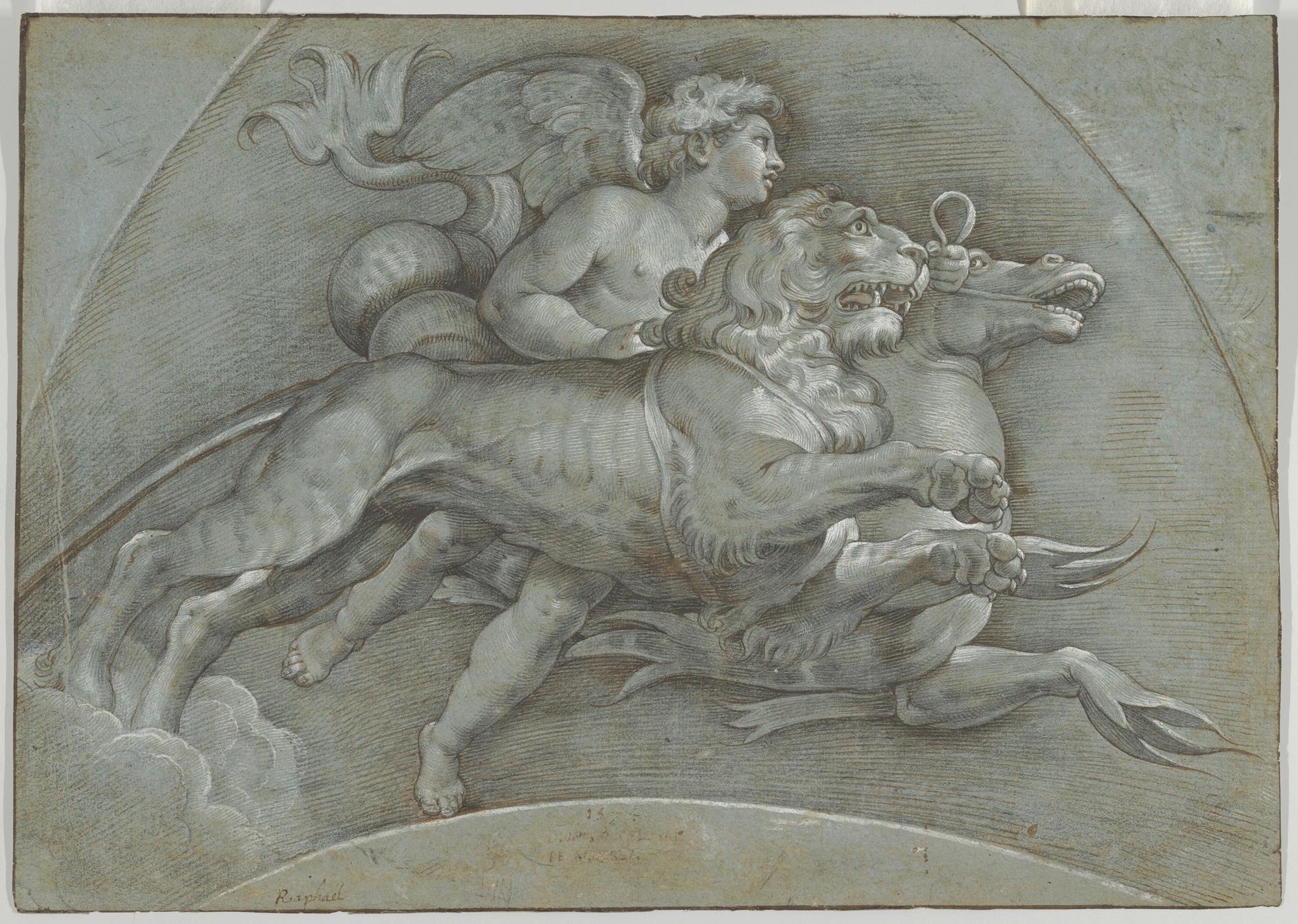
A Winged Putto Riding a Sea Horse and a Lion (recto); The Three Graces (verso)
Original title: A Winged Putto Riding a Sea Horse and a Lion (recto); The Three Graces (verso)
kurzbeschreibung
This double-sided sheet from 1574 pairs a winged putto riding a sea creature on the recto with the Three Graces on the verso. The drawing is executed in pen and brown ink over black chalk on blue paper, with white highlights on the front.
Description
A young, muscular putto with wings sits astride a sea lion whose mouth is open and teeth visible. A rein loops around the animal's neck as it moves forward. Faint clouds suggest a heavenly setting. Mostly black and white, red and white accents pick out certain areas; precise strokes define the anatomy and movement of the figures.
Context
Calvaert, a Fleming who worked in Bologna and ran an influential workshop there, turned to classical and mythological subjects in 1574. The putto and sea lion on one side, the Graces on the other, reflect the period's widespread engagement with antique motifs. Such sheets served as preparatory studies for paintings or as workshop models.
Impact
The layout feels dynamic, and the figures are rendered with movement. The delicate putto and the powerful sea creature are set against each other, creating tension. Fine lines and targeted color accents give the sheet a precious, almost sculptural presence.
Technique
On the recto, pen and brown ink over black chalk, supplemented with white gouache highlights and red chalk accents on blue paper; the verso uses only pen and brown ink over black chalk. Blue paper was prized in the Renaissance as a support because it lends drawings depth and luminosity. Chalk, ink, and gouache together allow subtle transitions from light to shadow.
AI-generated description text
Source: Metropolitan Museum of Art · Public Domain (CC0 1.0)