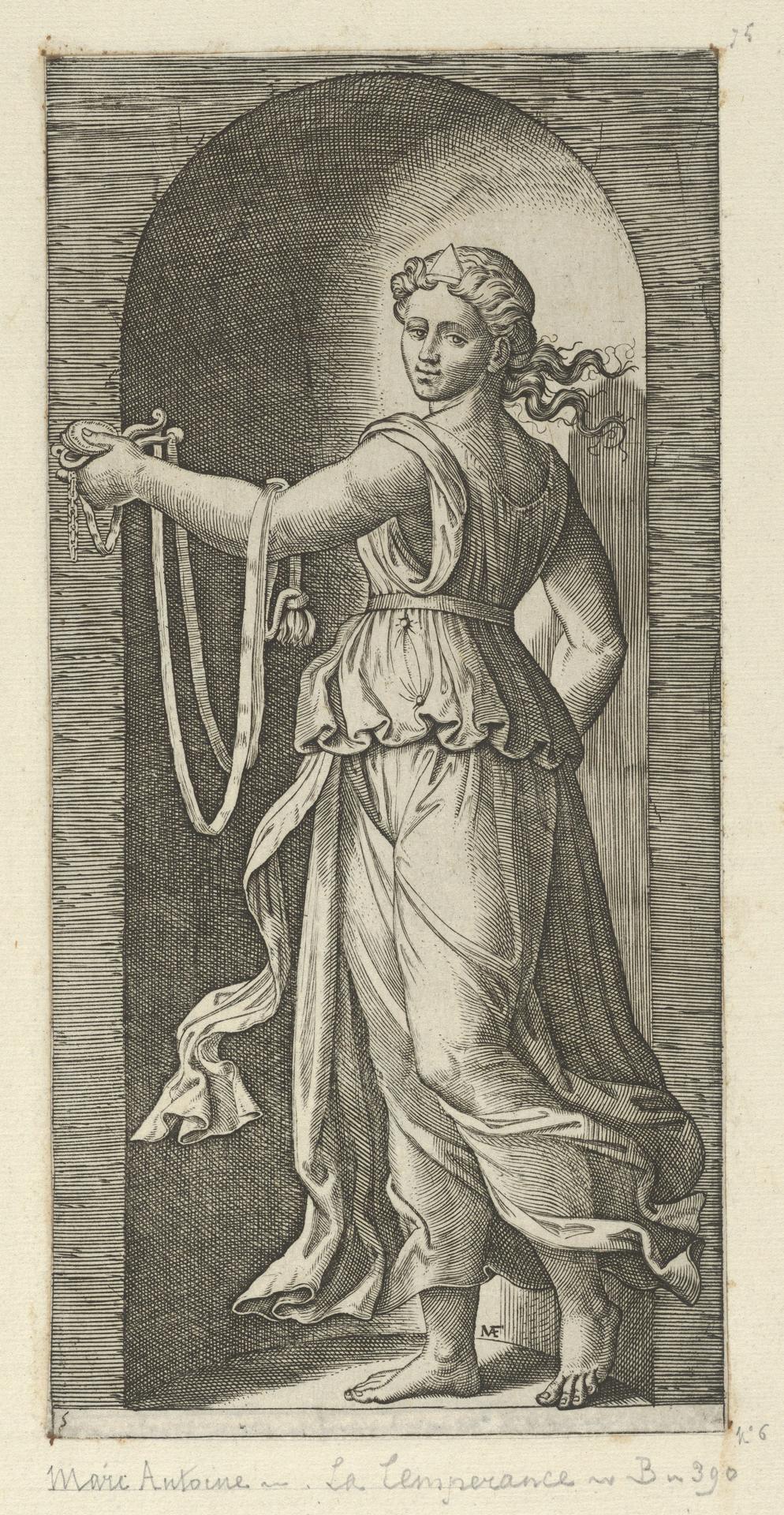
Temperance personified by a woman standing in a niche holding a bit, from "The Virtues"
Original title: Temperance personfied by a woman standing in a niche holding a bit, from "The Virtues"
kurzbeschreibung
A woman stands in a niche holding a horse's bit — this is Temperance, or Mäßigung, as Marcantonio Raimondi engraved her around 1515–25 for his series The Virtues. The print is a fine engraving with clear linework and a figure ideal trained on classical models.
Description
Frontally placed, the woman occupies a shallow round-arched niche whose architecture frames the space symmetrically. A heavy, floor-length robe with many folds emphasizes the contours of her body; her feet are bare. Her hair is tied in a knot, and her gaze is calm and lowered. In her right hand she holds a horse's bit — the attribute of Temperance. Light falling from above models the folds of cloth and the curve of the niche with fine hatching.
Context
Raimondi is regarded as the leading engraver of the Italian Renaissance, known above all for his reproductions after designs by Raphael. The series The Virtues was made in Rome, where Raimondi worked between 1510 and 1520. Single depictions of virtues were highly popular in printmaking of the time — they served artists as models and humanists as collectibles. The dating around 1515–25 suggests a stylistic proximity to Raphael's workshop.
Impact
Quiet symmetry and the clear niche architecture give the print a balanced, monumental bearing. Thanks to precise linework and subtle lighting, the figure looks almost like a sculpture. The bit as an attribute conveys the idea of self-control without any heavy moralizing.
Technique
For this engraving, the lines were cut into the copper plate with a burin. Varying densities and directions of hatching create sculptural shadows and textures. The sheet was printed in black ink on paper, producing a monochrome image with fine gradations of gray.
AI-generated description text
Source: Metropolitan Museum of Art · Public Domain (CC0 1.0)