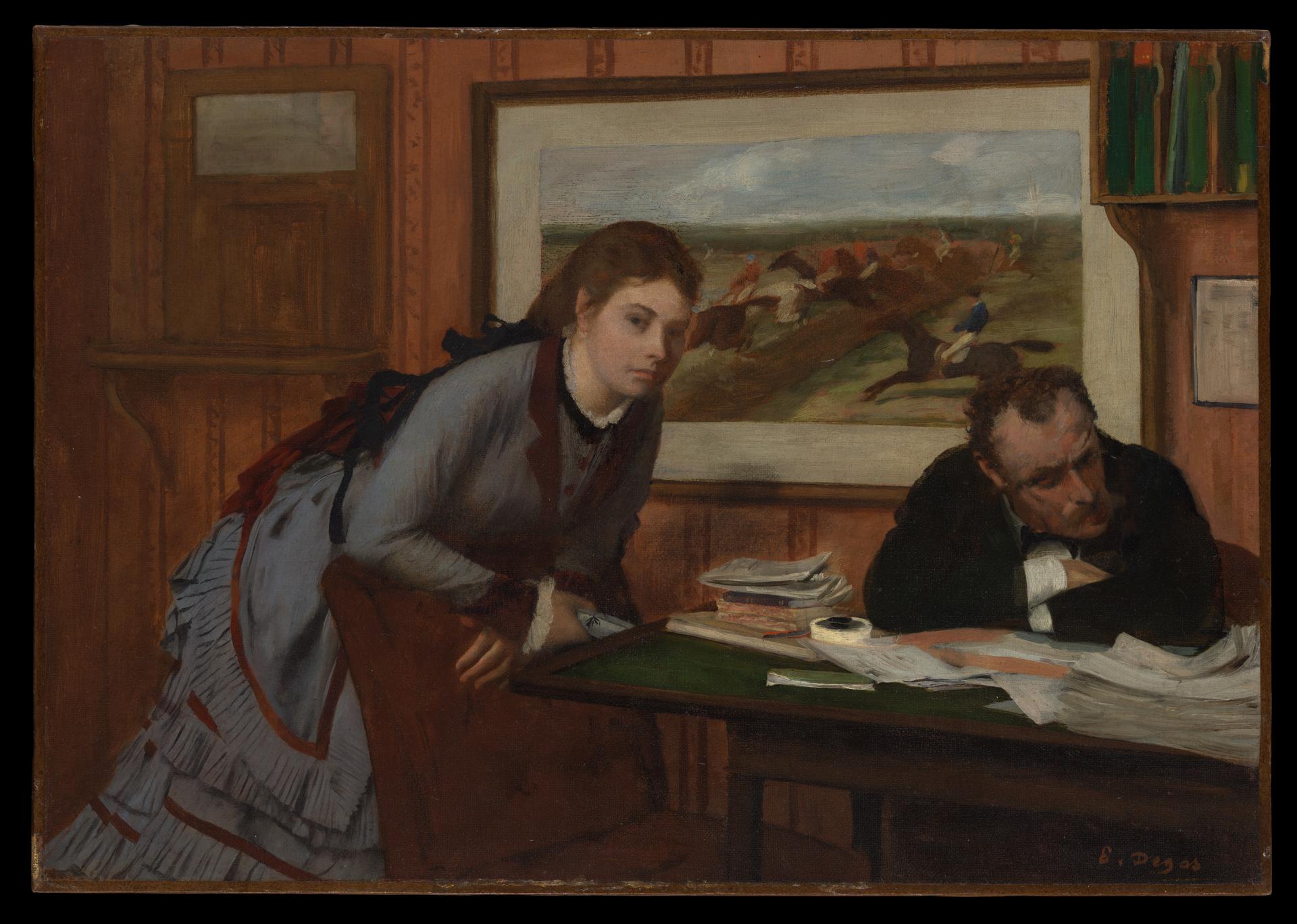
Sulking
Original title: Sulking
kurzbeschreibung
In Edgar Degas's "Schmollen" (c. 1870), a man and a woman share an interior, yet remain apart. She leans across a table while he buries himself in a newspaper. The artist blends close observation of everyday life with touches of impressionism.
Description
Your eye drifts first over the wide, low arrangement, where the two figures sit at the center. The woman, in a gray dress with red undertones, bends over the tabletop; the man in a dark suit reads, perched on the table's edge. Newspapers, a book, and an inkwell-like vessel rest on the table. A wall painting of horses and riders decorates the room; a door opens on the left, and on the right stands a bookcase with a sheet of paper. Muted browns and grays dominate the palette, and light falls softly from the front.
Context
The picture dates from a period when Degas turned increasingly to scenes of daily life and moments of inner feeling. The painter Éva Gonzalès, a friend of the artist, is thought to have modeled for the woman. Though Degas belonged to the impressionist movement, he developed an independent, rigorously considered visual language that set him apart from his colleagues' open-air painting.
Impact
Restrained colors and a calm structure give the picture an intimate, pensive mood. The woman's posture and the man's dismissive gesture create a subtle tension that makes the viewer linger. One senses the quiet distance between the figures.
Technique
Oil on canvas, the painting measures 32.4 × 46.4 centimeters. Degas used fine brushstrokes to bring out the surfaces of fabrics and furniture in detail, and employed a realistic palette with gentle transitions of light.
AI-generated description text
Source: Metropolitan Museum of Art · Public Domain (CC0 1.0)