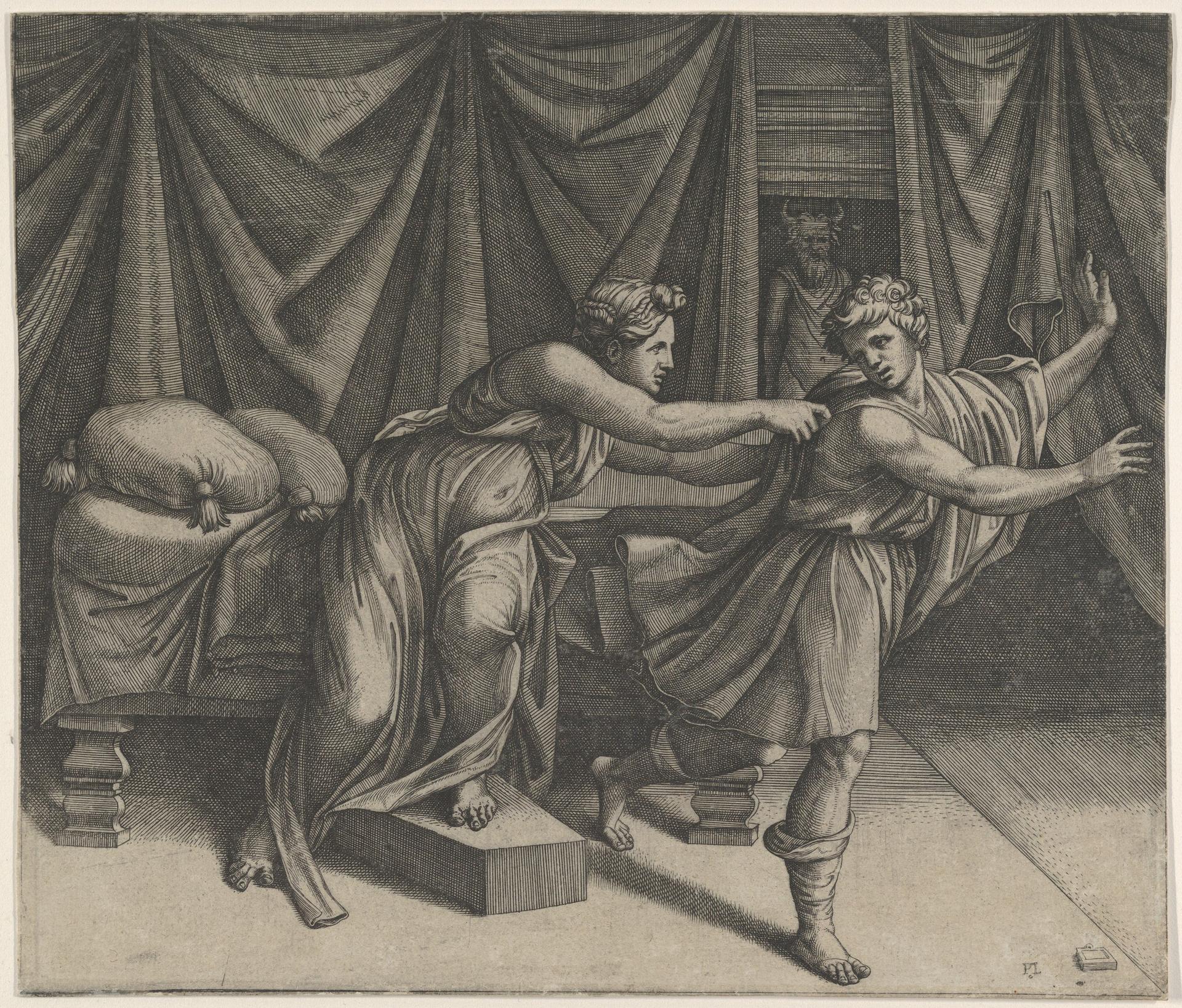
Joseph fleeing from Potiphar's wife
Original title: Joseph fleeing from Potiphar's wife
kurzbeschreibung
A man turns sharply away while a hand on his shoulder tries to hold him back—this moment from the story of Joseph and Potiphar's wife is captured in Marcantonio Raimondi's engraving, made around 1515–25. Two main figures in classical-style dress dominate the image, while a third remains partly hidden behind curtains. The print is executed in the technique of engraving.
Description
In the foreground, a man twists violently, wrenching himself free, yet a second male figure places a hand on his shoulder as if to restrain him. Both wear garments in the antique manner, their folds emphasizing the movement. An elaborate curtain arrangement frames the space, giving the scene a theatrical quality. A third figure appears only partially, obscured by the hangings, deepening the spatial structure. The view remains monochrome; light and shadow are created through delicate lines and hatching.
Context
Raimondi, an Italian engraver of the Renaissance, became known above all for reproductive prints after works by Raphael and other masters. The motif of Joseph and Potiphar's wife enjoyed great popularity in this era and stood for chastity and moral steadfastness. The sheet was made during Raimondi's Roman years, when antique models and Raphael's inventions influenced him. It belongs to a series of biblical scenes aimed at collectors and art lovers.
Impact
The violent twist of Joseph's fleeing body and the restraining gesture of his companion create palpable tension. Delicate lines and the decorative curtains lend the image a theatrical yet elegant mood. Without intrusive effects, the viewer is drawn into the biblical narrative.
Technique
In this engraving, the motif is incised into a copper plate and then printed. Raimondi worked with fine, precisely placed lines and cross-hatching to achieve shadow and depth. The monochrome print highlights the graphic quality and the detailed precision of the reproduction.
AI-generated description text
Source: Metropolitan Museum of Art · Public Domain (CC0 1.0)