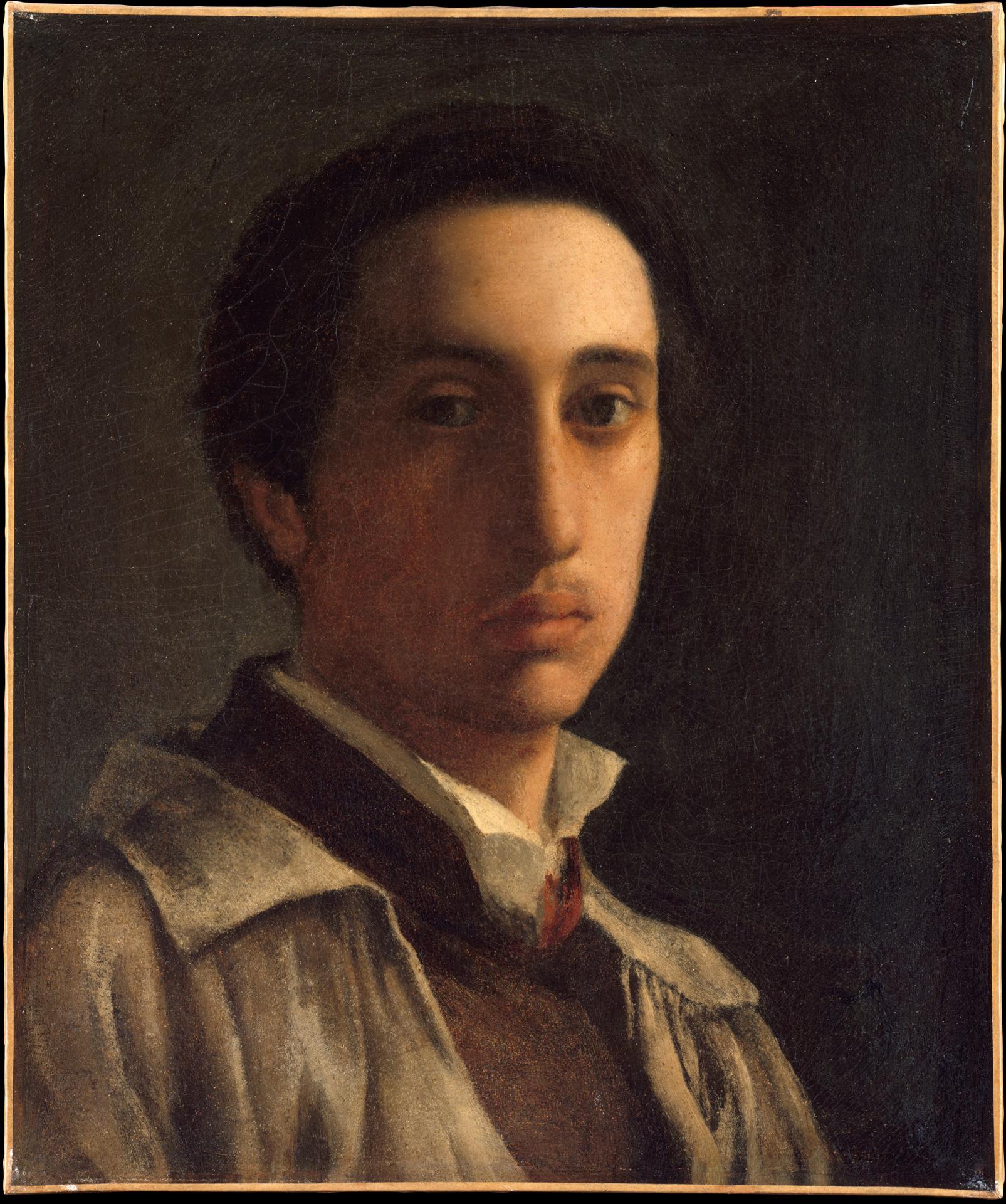
Self-Portrait (ca. 1855–56)
Original title: Self-Portrait
kurzbeschreibung
Around 1855–56, Edgar Degas painted himself: a young man captured in oil on paper, later mounted on canvas. The image brings the face close, the expression stays serious, the background dark.
Description
A plain collared shirt with a red bow at the neck — that's how the sitter appears. Dark, wavy hair frames a face that looks directly and thoughtfully at the viewer. Behind him lies nothing but an indefinite dark ground, which makes the head stand out all the more. The colors feel muted and true to life; sepia tones recall an older manner of painting. The layout and arrangement remain simple and clear, with no other figures or objects.
Context
The picture was made in 1855–56, when Degas was in Paris and schooling himself in the classical tradition. It belongs to his early self-portraits, painted in a phase when he was deeply engaged with portraiture — long before he turned to Impressionism. Later he became known above all for his pastels and oil paintings.
Impact
The direct gaze and serious cast make the portrait a quiet, inward-looking image. The dark, spare surroundings heighten the young man's presence and give the whole something timeless, almost melancholy.
Technique
Oil paint was applied to paper, which was then mounted on canvas — a common procedure at the time to stabilize the fragile support. The execution is fine and precise, facial features and clothing rendered true to life. The sepia tones reveal a deliberately chosen palette that gives the sheet an antique effect.
AI-generated description text
Source: Metropolitan Museum of Art · Public Domain (CC0 1.0)