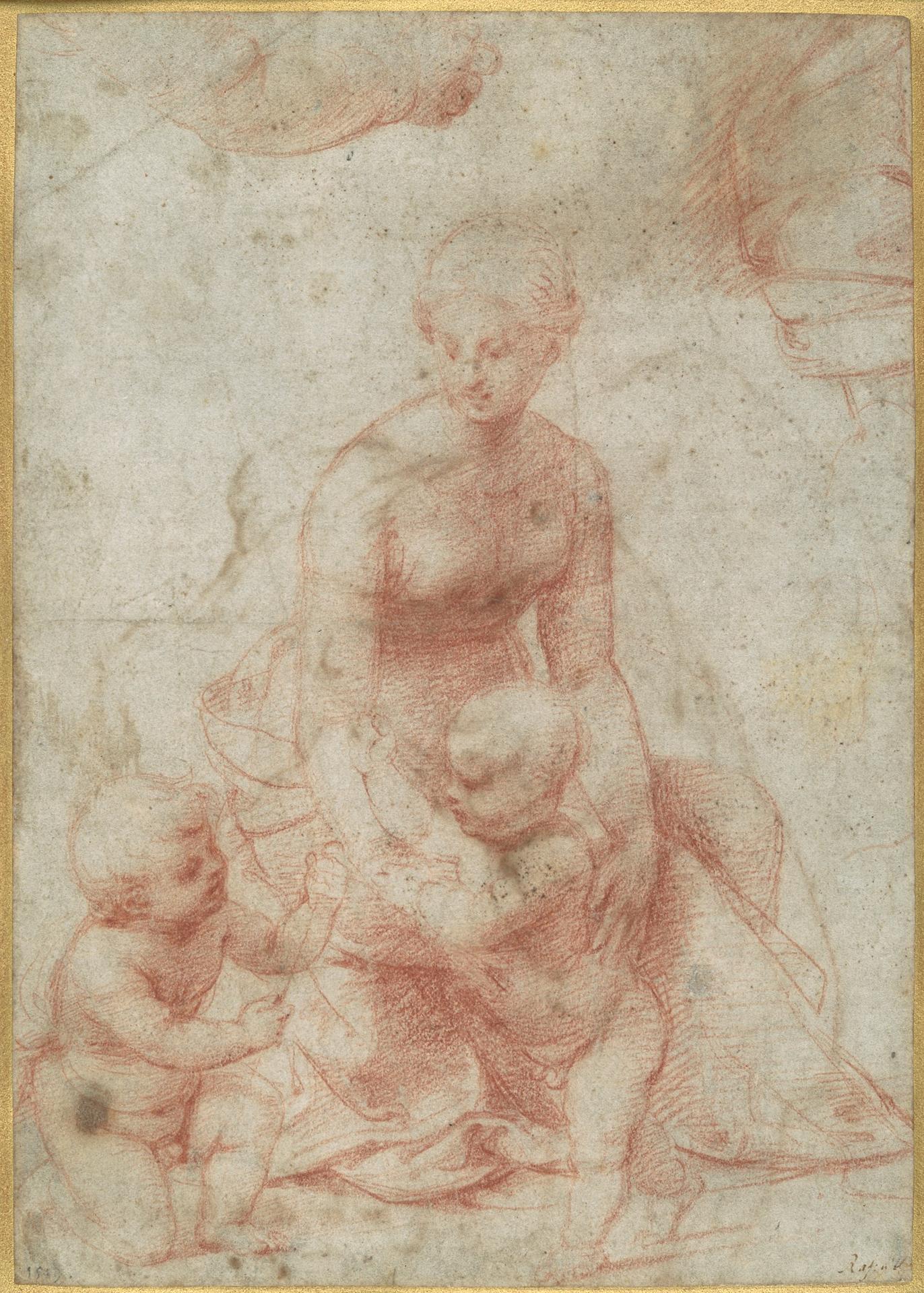
Madonna and Child with the Infant Saint John the Baptist; upper left, Study for the Right Arm of the Infant Saint John; upper right, Study for Drapery (recto); Study of a Nude Male Figure (verso)
Original title: Madonna and Child with the Infant Saint John the Baptist; upper left, Study for the Right Arm of the Infant Saint John; upper right, Study for Drapery (recto); Study of a Nude Male Figure (verso)
kurzbeschreibung
This sheet by Raphael (Raffaello Sanzio or Santi), dating from around 1506–07, carries on its recto a Madonna with the Christ Child and the infant John the Baptist, along with two smaller studies at the top. The verso holds a study of a nude male body. The work is executed in red chalk (recto) and pen and brown ink (verso).
Description
Unlike many Madonna studies of the period, this sheet combines a fully worked figure group with two separate detail studies above. A seated woman appears with a child on her lap; beside her sits another child who holds something out to her. The bodies are rendered with precise anatomical structure. At upper left is a study for the child's right arm, and at upper right a drapery study. The overall tonality is predominantly gray, though the red chalk stands out clearly and a few brown lines are visible.
Context
The sheet belongs to Raphael's Florentine years (about 1504–1508), when he engaged closely with works by Leonardo da Vinci and Michelangelo. Madonna compositions accompanied by additional studies reflect his working method at the time, preparing figures and details for larger paintings. The study of a nude male on the reverse belongs to his anatomical investigations, which were important for his pictorial inventions.
Impact
What first catches the eye here is the union of a calm, maternal scene with the working process laid bare. The linework is precise and restrained; the figures feel approachable. Having the main motif and detail studies on a single sheet lends the view something of the workshop and lets one follow the artist's steps.
Technique
The recto uses red chalk, a common material for studies that allows soft tonal values and fine hatching. On the verso, pen with brown ink is employed, which permits more precise placement of lines. The paper measures 22.4 x 15.8 cm, a compact format for a study that was used more than once.
AI-generated description text
Source: Metropolitan Museum of Art · Public Domain (CC0 1.0)