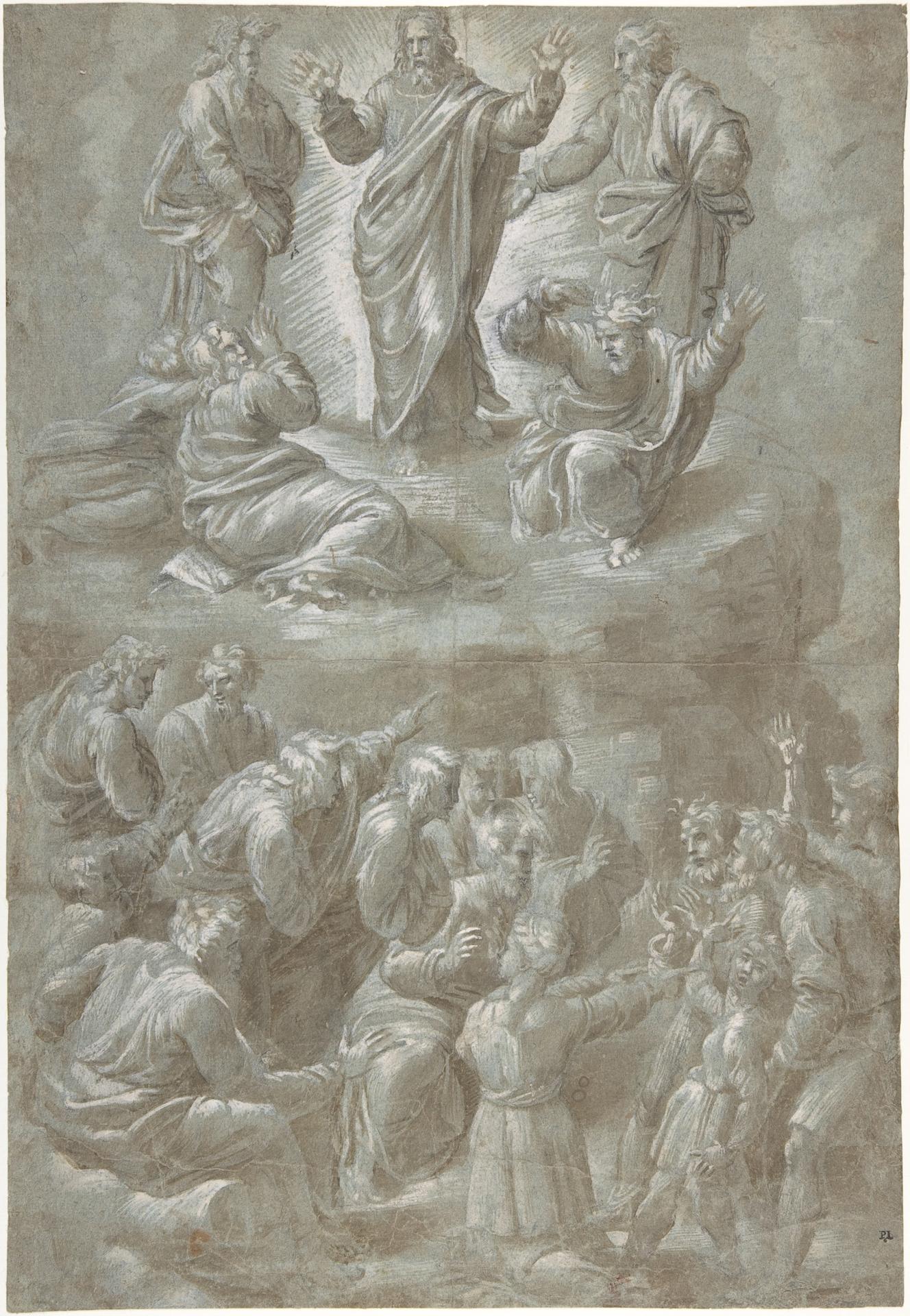
The Transfiguration, after Raphael
Original title: The Transfiguration, after Raphael
kurzbeschreibung
Biagio Pupini made this drawing after Raphael's painting of the Transfiguration of Christ between 1511 and 1551. The sheet is executed in brush and brown wash, with white gouache heightening over traces of charcoal on blue paper. It shows Jesus on a platform, surrounded by figures, with other people below.
Description
Jesus Christ stands raised on a platform, arms lifted, surrounded by figures in various poses—kneeling, sitting, standing. The draperies are rendered convincingly, and light from behind falls on Jesus, underscoring his sacred radiance. Brown tones dominate the structure, while white accents emphasize the brightness of the rays. Below, a group has gathered, seemingly deep in conversation. Faint charcoal traces remain visible in the background.
Context
Biagio Pupini, active around 1511–1551, was an Italian draftsman of the Renaissance in Bologna and its surroundings. His sheet copies Raphael's famous painting 'The Transfiguration', created 1516–1520, now in the Vatican Museums. Such reproductions often served as studies or models for one's own work. Blue paper was widespread in Venetian and northern Italian drawing.
Impact
The clear layout and dramatic lighting put Christ at the center. Brown washed areas and white heightening give the sheet plasticity and stress the sublimity of the scene. A calm, solemn mood emanates from it and emphasizes the religious content of the subject.
Technique
Brush and brown wash determined the execution, with white gouache heightening added on blue paper. First the arrangement was sketched with charcoal traces, then modeled with wash. The white accents serve to bring out light effects and the aura of Christ, while the charcoal lines in the background reveal the design stage.
AI-generated description text
Source: Metropolitan Museum of Art · Public Domain (CC0 1.0)