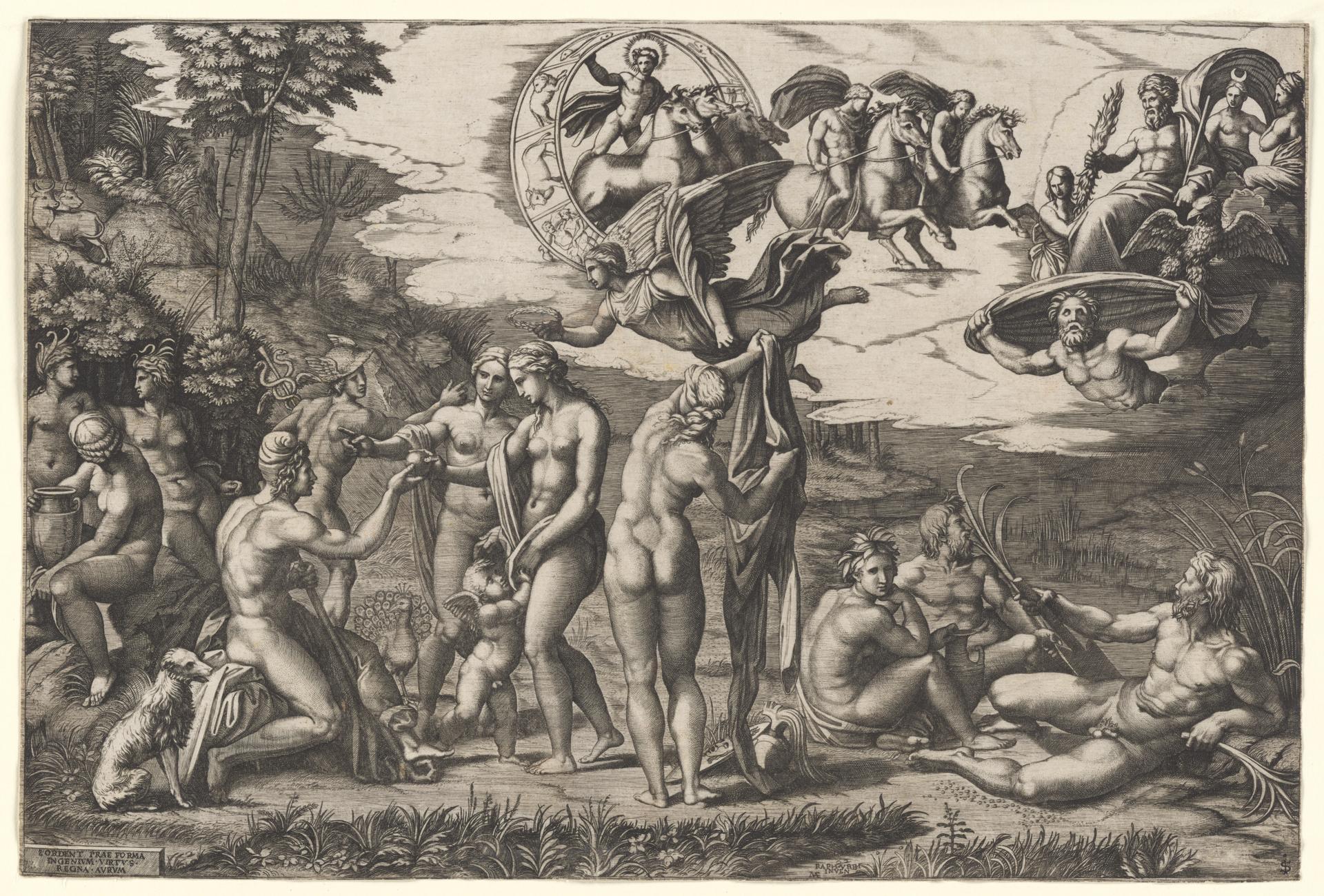
The Judgment of Paris (ca. 1510–20)
Original title: The Judgment of Paris: he is sitting at left with Venus, Juno and Pallas Athena, a winged victory above. In the upper section the Sun in his chariot preceeded by Castor and Pollux on horseback, at lower right two river gods and a naiad above whom Jupiter, an eagle, Ganymede, Diana and another goddess
kurzbeschreibung
Marcantonio Raimondi’s engraving The Judgment of Paris was made around 1510–20. It presents the ancient myth in which Paris chooses among Venus, Juno, and Pallas Athena, surrounded by other deities and figures from the legend. The print is regarded as a carefully worked example of Renaissance printmaking.
Description
Paris sits in the left foreground, with Venus, Juno, and Pallas Athena standing around him; above the group hovers a winged goddess of victory. The upper part of the image is filled by the sun chariot with Castor and Pollux on horses. In the lower right, two river gods and a naiad recline, while above them appear Jupiter with an eagle, Ganymede, Diana, and another goddess. Bushes and trees embed the figures in a natural landscape; the layout is symmetrical and clearly separates the groups. The view remains monochrome, with evenly distributed light that brings out the contours of the figures.
Context
Raimondi, an Italian engraver of the Renaissance, is known above all for his reproductions after works by Raphael. The engraving was made in an era when printmaking was gaining importance and mythological subjects were flourishing in art. The Judgment of Paris goes back to ancient sources and was often taken up in the Renaissance. Raimondi worked in Rome and belonged to Raphael’s circle, which shaped the style and arrangement of this print.
Impact
The viewer’s eye is first drawn by the even brightness spread across the whole surface, which makes the figures stand out clearly. The detailed, symmetrical arrangement gives the mythological material a clear structure; fine lines and calm lighting create a balanced aesthetic. Despite the many figures, the scene feels ordered and harmonious, and the eye is led calmly and understandably through the image.
Technique
For this print, the design was engraved into a copper plate and then printed on paper—a process known as engraving. Raimondi used fine lines and hatching to create shadow and depth. The monochrome execution matches the printmaking of the Renaissance.
AI-generated description text
Source: Metropolitan Museum of Art · Public Domain (CC0 1.0)