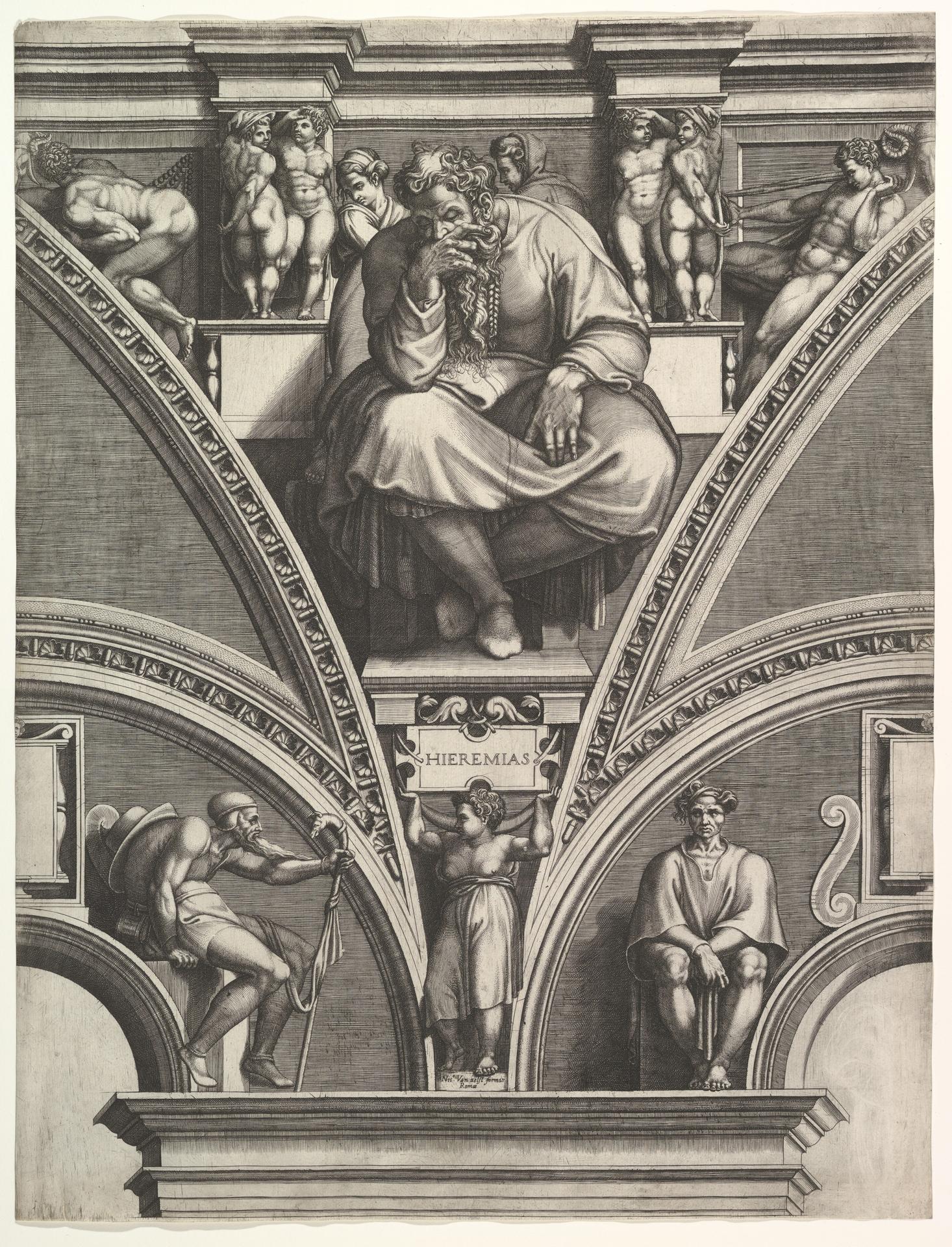
The Prophet Jeremiah, from the series of Prophets and Sibyls in the Sistine Chapel
Original title: The Prophet Jeremiah, from the series of Prophets and Sibyls in the Sistine Chapel
kurzbeschreibung
Giorgio Ghisi made this engraving between 1570 and 1575. It presents the prophet Jeremiah in a pensive pose and belongs to a series reproducing the prophets and sibyls of the Sistine Chapel. The margins have been trimmed; the sheet measures 56.5 × 43.2 cm.
Description
An old man in a long robe sits at the center of the image, one hand raised to his face in a gesture of brooding or sorrow. Behind him, on a pedestal, stand several nude male figures recalling the sibyls of the chapel. Further figures appear along the lower edge, among them a man with a shield and a seated figure. Architectural framing elements evoke the chapel wall. The Latin inscription 'Hieremias' is set near the middle of the print.
Context
The Italian engraver Giorgio Ghisi, active in the sixteenth century, became known for reproductive prints after Michelangelo. The series of prophets and sibyls draws on the frescoes of the Sistine Chapel, painted by Michelangelo between 1508 and 1512. Through Ghisi's engravings these monumental inventions spread widely across Europe. Four states of this print are known; this is the third.
Impact
Carefully guided lines give the image a quiet, contemplative mood that matches the prophet's thoughtful bearing. Despite the crowded arrangement, the view stays clear and balanced, which lends the figure its dignity.
Technique
In this technique, lines are cut into a copper plate: engraving. Ghisi worked with precise, parallel hatching to build up shadow and volume. The print is in black and white and shows the detailed execution characteristic of the artist.
AI-generated description text
Source: Metropolitan Museum of Art · Public Domain (CC0 1.0)