Design for the Tomb of Pope Julius II della Rovere
Original title: Design for the Tomb of Pope Julius II della Rovere
kurzbeschreibung
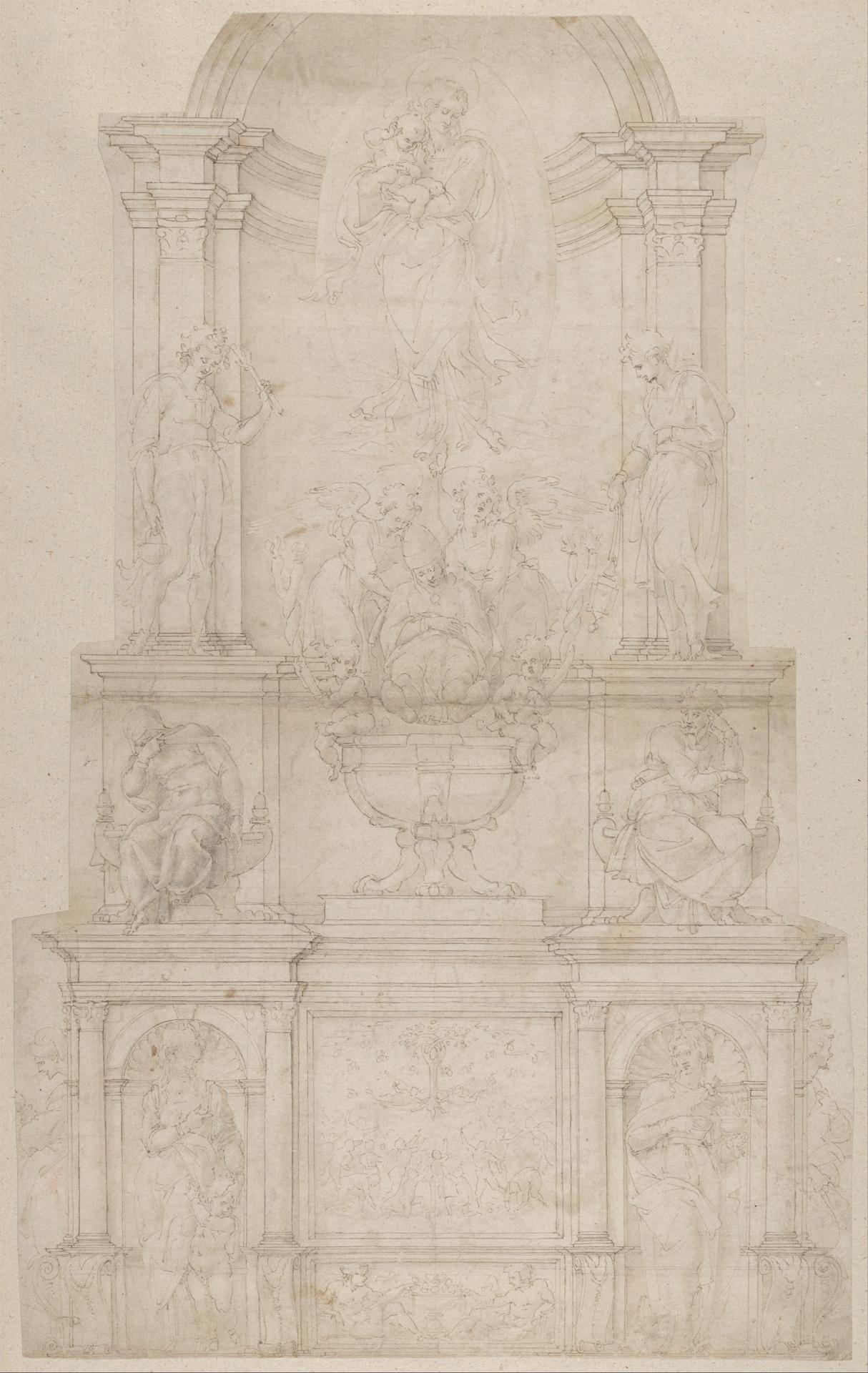
Pen and brown ink, with brush and brown wash over stylus ruling and leadpoint: Michelangelo Buonarroti used these means in 1505–1506 to record the planned structure of the monumental tomb for Pope Julius II della Rovere. The sheet is among the early documents of that multi-part complex, in which sculpture and architecture were to form a whole.
Description
The design rises in symmetrical tiers. At the top sits a Madonna and Child, flanked by two standing figures that may be read as saints. Below, a relief shows a seated figure, with another standing beside it in a niche. The lowest zone is filled by a scene with figures between arcades and columns. Greys and browns dominate, with thin strokes and soft washes bringing out the architectural details.
Context
Few of Michelangelo's projects were as far-reaching as the tomb of Julius II, originally intended for St. Peter's in Rome. The commission came in 1505; work continued over many years, with repeated redesigns, and was finally completed in 1545 in a reduced version. This sheet belongs to the early designs for the free-standing structure crowded with sculptures and is part of a group of drawings held by the Metropolitan Museum of Art.
Impact
The clear articulation and calmly drawn line convey Michelangelo's conception of grandeur. Architectural rigor and animated figures balance each other, producing a solemn, almost dramatic tension. The ambition to create a work of epochal importance is palpable in every zone of the sheet.
Technique
Fine details such as soft shading arise from the interplay of pen and brown ink with brush and brown wash, applied over a preliminary drawing in stylus and leadpoint. The wash creates tonal values, while precise linework holds the contours; together they demonstrate the artist's assured command of his drawing media.
AI-generated description text
Source: Metropolitan Museum of Art · Public Domain (CC0 1.0)