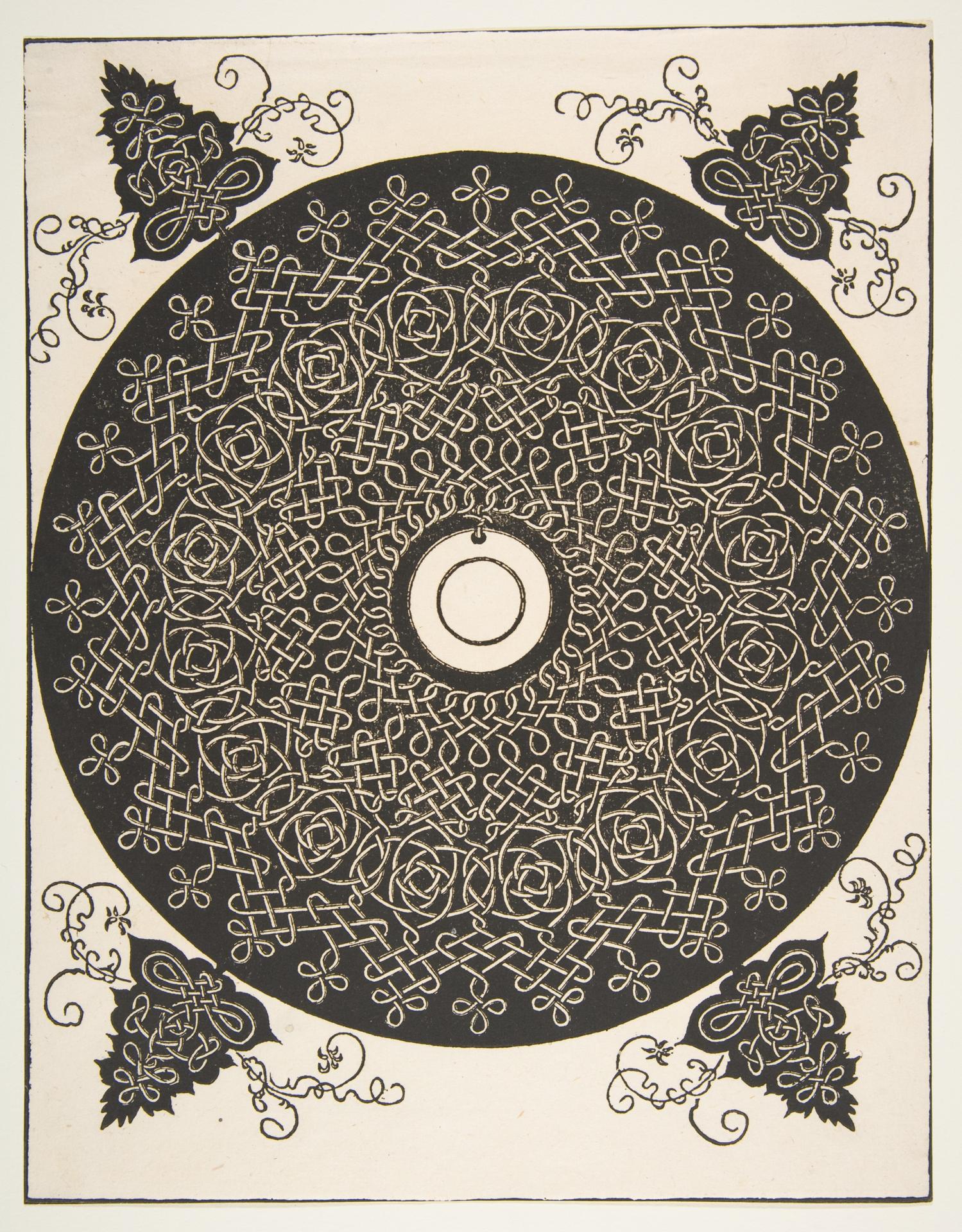
The Fourth Knot
Original title: “The Fourth Knot”. Interlaced Roundel with a Round Medallion in its Center
kurzbeschreibung
The Fourth Knot is a woodcut by Albrecht Dürer, created before 1521. It depicts an interlaced roundel with a central medallion, featuring intricate geometric and ornamental patterns. The print is executed in black and white, typical of Dürer's graphic works.
Description
The composition is centered around a round medallion, with complex interwoven patterns radiating outward in spirals and rosette forms. Four symmetrical, stylized leaf motifs surround the medallion, all formed from the same interlacing lines. The background is solid black, while the central medallion and decorations are rendered in white, creating a striking contrast. The design is balanced and geometric, with no shading or lighting effects, emphasizing the purity of the linework.
Context
Dürer created a series of six knot prints, known as the 'Knoten', which were inspired by oriental carpet designs and Islamic geometric patterns. These works were made during a period when Dürer was exploring mathematical and ornamental forms, reflecting the Renaissance interest in geometry. The woodcuts were likely intended as decorative patterns for craftsmen and artists, demonstrating Dürer's mastery of line and design.
Impact
The stark contrast between the black background and white interlacing lines gives the print a bold, graphic impact. The intricate, symmetrical patterns draw the viewer's eye inward, creating a sense of harmony and order. The work exudes a timeless, meditative quality, typical of ornamental prints from the early modern period.
Technique
This is a woodcut, a relief printing technique where the design is carved into a wooden block, inked, and pressed onto paper. Dürer's precise carving allows for fine, continuous lines that create the illusion of interlacing ribbons. The use of black ink on white paper is standard for woodcuts, and the lack of tonal variation emphasizes the linear clarity of the design.
AI-generated description text
Source: Metropolitan Museum of Art · Public domain (CC0)