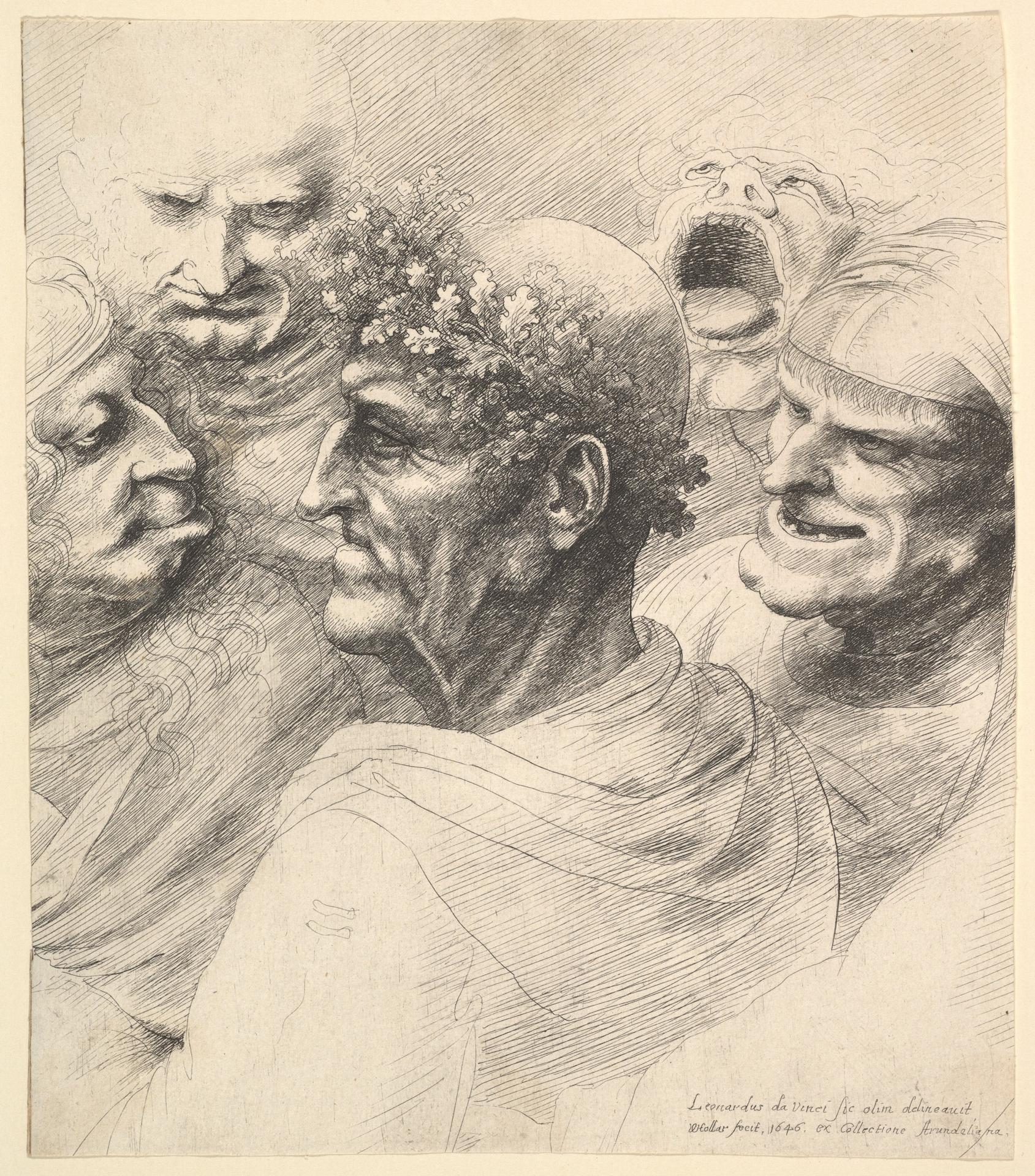
Five grotesque heads, including an elderly man with an oak leaf wreath (1646, Met-Objekt 5490)
Original title: Five grotesque heads, including an elderly man with an oak leaf wreath
kurzbeschreibung
Five exaggerated faces crowd onto a single sheet in Wenceslaus Hollar's etching of 1646. The print measures 18.9 × 16.2 cm and survives as a single impression. It belongs among the studies in which the artist grappled with grotesque physiognomies.
Description
An older man wearing an oak wreath anchors the group, while four further heads in profile gather around him. Their expressions run from a smile to features contorted by pain and despair. Fine, precise lines and careful shading model the faces. Along the lower edge runs a Latin text with the artist's name and the year.
Context
Hollar made this etching in 1646 in Antwerp, where he worked for various publishers. The sheet belongs to a series of grotesque head studies that traces back to Leonardo da Vinci's caricatures. Such expression studies were much sought after as collector's items in the seventeenth century. Hollar's precise technique and versatility earned him commissions from collectors such as Thomas Howard, Earl of Arundel.
Impact
What draws the eye first is the sheer range of expression, swinging between comedy and something more unsettling. The differing faces build a tension that feels almost like a stage. Realistic attention to detail and grotesque exaggeration join in a compelling way. The black-and-white technique turns attention to the drawn line and to the nuances of each face.
Technique
For this etching the drawing was incised into a metal plate and then bitten with acid. Hollar used fine parallel hatching and cross-hatching to bring out shadow and volume. The impression was taken on paper; the sheet is trimmed within the platemark and the image.
AI-generated description text
Source: Metropolitan Museum of Art · Public Domain (CC0 1.0)