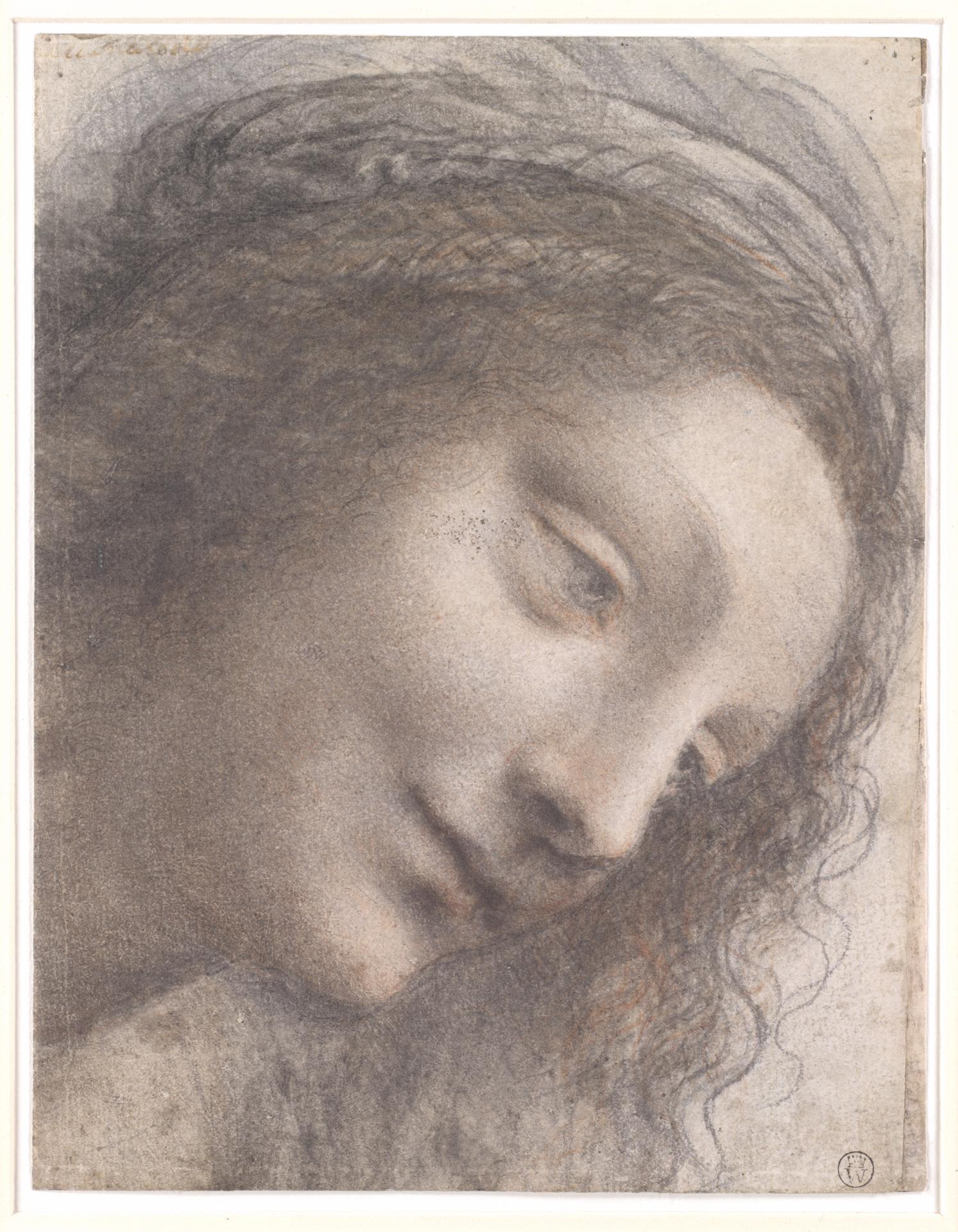
The Head of the Virgin in Three-Quarter View Facing Right
Original title: The Head of the Virgin in Three-Quarter View Facing Right
kurzbeschreibung
Leonardo da Vinci made this drawing around 1510 to 1513, and it shows the head of the Virgin Mary turned to the right in three-quarter profile. The study is executed in black chalk, charcoal, and red chalk, with traces of white chalk. The sheet measures 20.3 x 15.6 cm and belongs to the collection of the Metropolitan Museum of Art.
Description
A woman appears in half-profile, her face directed to the right. Long, wavy hair falls over her shoulder; her expression remains still and absorbed, her eyelids closed, her head slightly inclined. Black, gray, and red tones reveal charcoal and red chalk, with traces of white among them. Delicate, richly differentiated contours stand out, the background remains empty, and a framing line hints at the sheet's original size.
Context
In his late career Leonardo devoted himself increasingly to the expression of emotion and to an idealized image of beauty. The motif is likely connected with his studies for the Virgin Mary, which later fed into paintings such as the 'Virgin of the Rocks' or the 'Virgin and Child with Saint Anne'. Using black and red chalk together was common in the Italian Renaissance for such designs, because it allowed soft transitions and lively skin tones. This sheet shows how confidently Leonardo mastered drawing technique and used it in preparing his paintings.
Impact
The closed eyes and the gentle tilt of the head give the sheet something inward-looking and at the same time very tender. Because the chalk blends softly, an almost painterly effect arises that draws the viewer into the figure's quiet devotion. That only the head is shown and the background remains empty focuses attention entirely on the expression and the linework.
Technique
Leonardo combined black chalk, charcoal, and red chalk and also used traces of white chalk. These means allowed him fine gradations of shading and soft contours, as are characteristic of his late works. The framing lines in pen and brown ink are not by Leonardo; they were added later.
AI-generated description text
Source: Metropolitan Museum of Art · Public Domain (CC0 1.0)