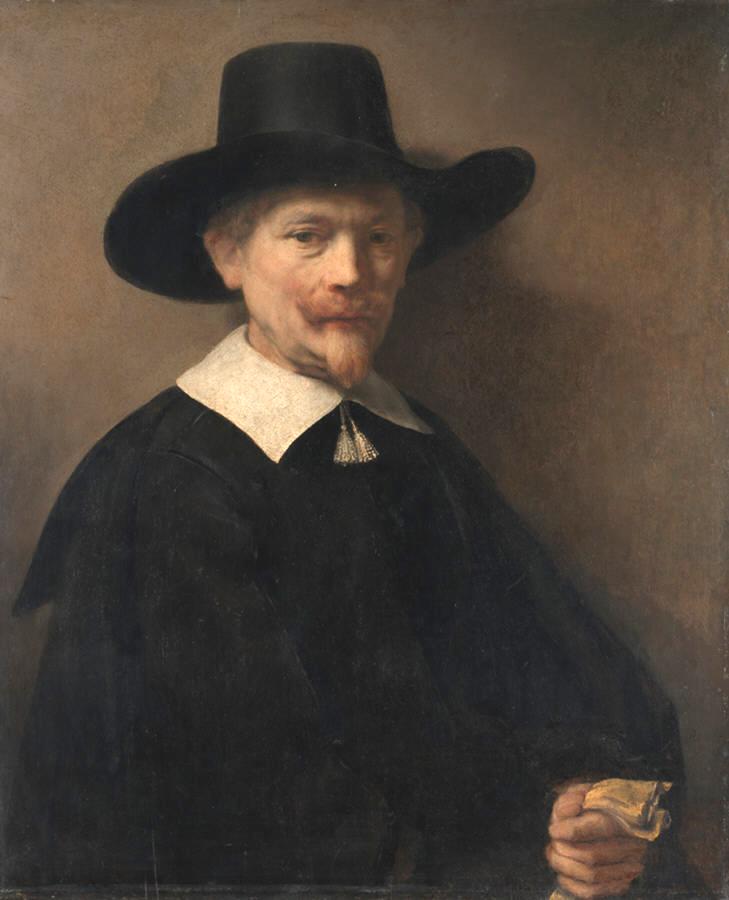
Portrait of a Man Holding Gloves
Original title: Portrait of a Man Holding Gloves
kurzbeschreibung
Rembrandt van Rijn painted this portrait in 1648 in oil on wood. It shows an unidentified man in dark clothing with a white collar, and the panel measures 80.6 by 67.3 cm. In his right hand the sitter holds a pair of gloves, a common sign of rank and prosperity in seventeenth-century bourgeois portraiture.
Description
A broad black triangular hat rests on the man's head, and beneath it a black gown and a white collar stand out, the collar trimmed with a small hanging ornament. His right hand closes around a golden object or something similar, which may be the gloves. A plain dark background recedes and draws the eye to the face. The expression stays neutral, the colours are restrained, and the light falls softly.
Context
The portrait was made in Amsterdam in 1648, when Rembrandt was increasingly working for bourgeois patrons. Who the sitter was has never been established, something that happens fairly often with Rembrandt's portraits of those years. The plain dark dress and the neutral expression follow the Protestant ideal of restraint cultivated among the Dutch middle class. Gloves appear frequently as an attribute signalling wealth and social standing.
Impact
The muted, dark palette and the soft light create a quiet, thoughtful atmosphere. The man's gaze meets the viewer directly and establishes an immediate connection. Details such as the collar and the ornament reveal Rembrandt's care in execution.
Technique
Oil on wood forms the support, a usual practice for seventeenth-century Dutch portraits. Rembrandt used fine brushstrokes for the facial features, while the texture of the gown is built with thicker, pastose touches of paint. A dark underpainting and layered glazes produce the soft transition between light and shadow.
AI-generated description text
Source: Metropolitan Museum of Art · Public Domain (CC0 1.0)