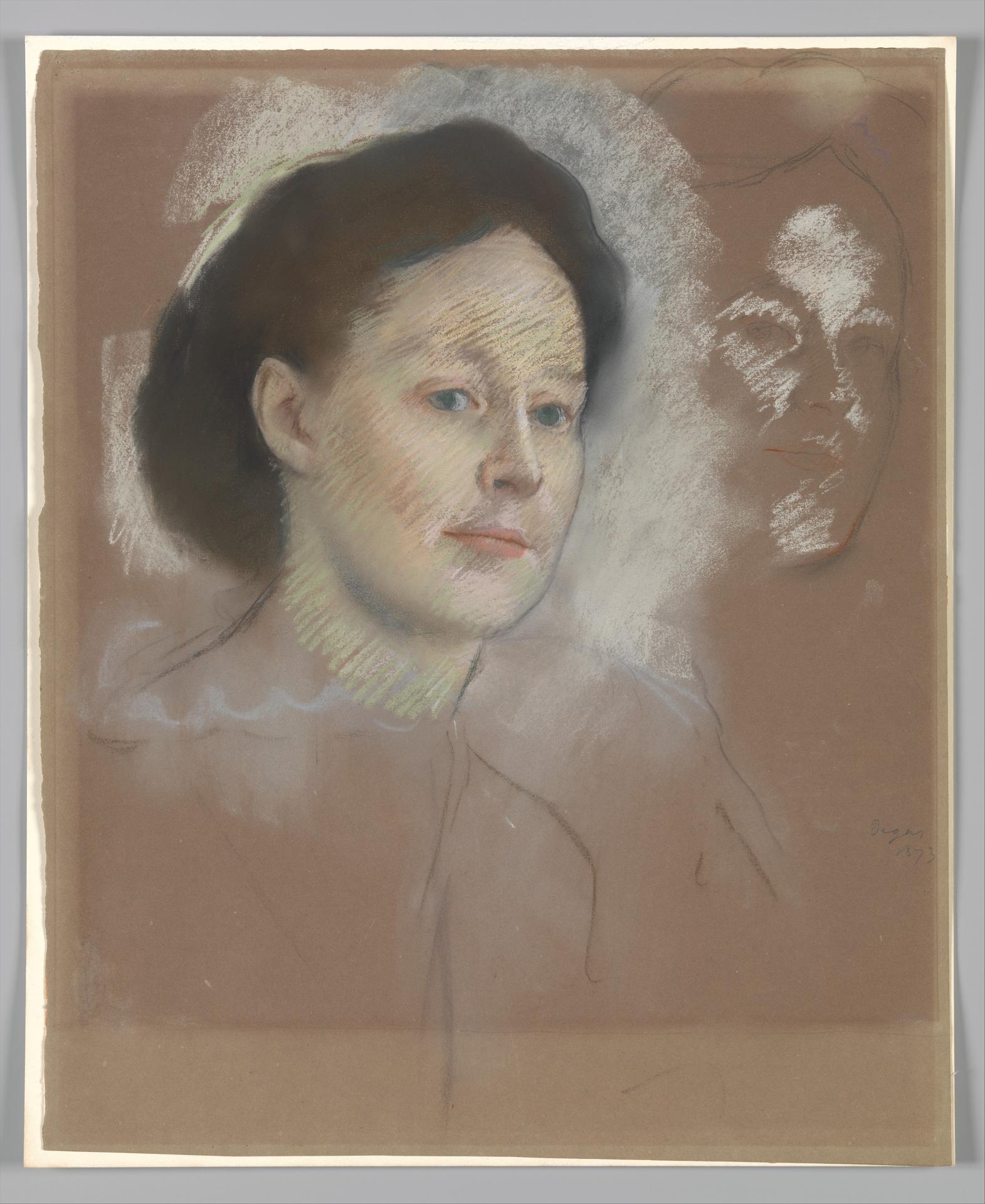
The Artist's Cousin, Probably Mrs. William Bell (Mathilde Musson, 1841–1878)
Original title: The Artist's Cousin, Probably Mrs. William Bell (Mathilde Musson, 1841–1878)
kurzbeschreibung
Edgar Degas made this pastel portrait in 1873 on green wove paper, showing a woman in half profile, most likely his cousin Mathilde Musson. Over time the paper has darkened to brown. The sheet belongs among Degas's early, lesser-known portrait studies, and its private character gives it an approachable feel.
Description
The woman is seen in half profile, her head tilted slightly to the left, with a ponytail falling along the right side of her face. A striking scalloped lace trim sits at the collar of her dress. The background dissolves into blurred, nearly abstract browns, while a faint, transparent shadow or a second portrait remains visible beside her. The palette is mostly pastel, with greys and browns behind her and a soft, diffuse light throughout.
Context
The picture dates from 1873, a period when Degas often drew family members and friends. Mathilde Musson, his cousin, later married William Bell. The work falls around the time of Degas's stays in New Orleans, where the Musson family lived. Pastel on paper was a medium he frequently chose for such intimate studies.
Impact
Soft, diffuse light and pastel colouring give the portrait a calm, familiar mood. The slightly abstracted background pushes facial features and fabric details forward without idealising the sitter. The impression is spontaneous and immediate, like a fleeting moment caught on paper.
Technique
The sheet is executed in pastel on green wove paper that has since darkened to brown. The pastel chalk is applied carefully to work out the figure's contours and shading, creating fine transitions between light and shadow and a lively surface effect.
AI-generated description text
Source: Metropolitan Museum of Art · Public Domain (CC0 1.0)