Christ and the Woman of Samaria: an Arched Print
Original title: Christ and the Woman of Samaria: an Arched Print
kurzbeschreibung
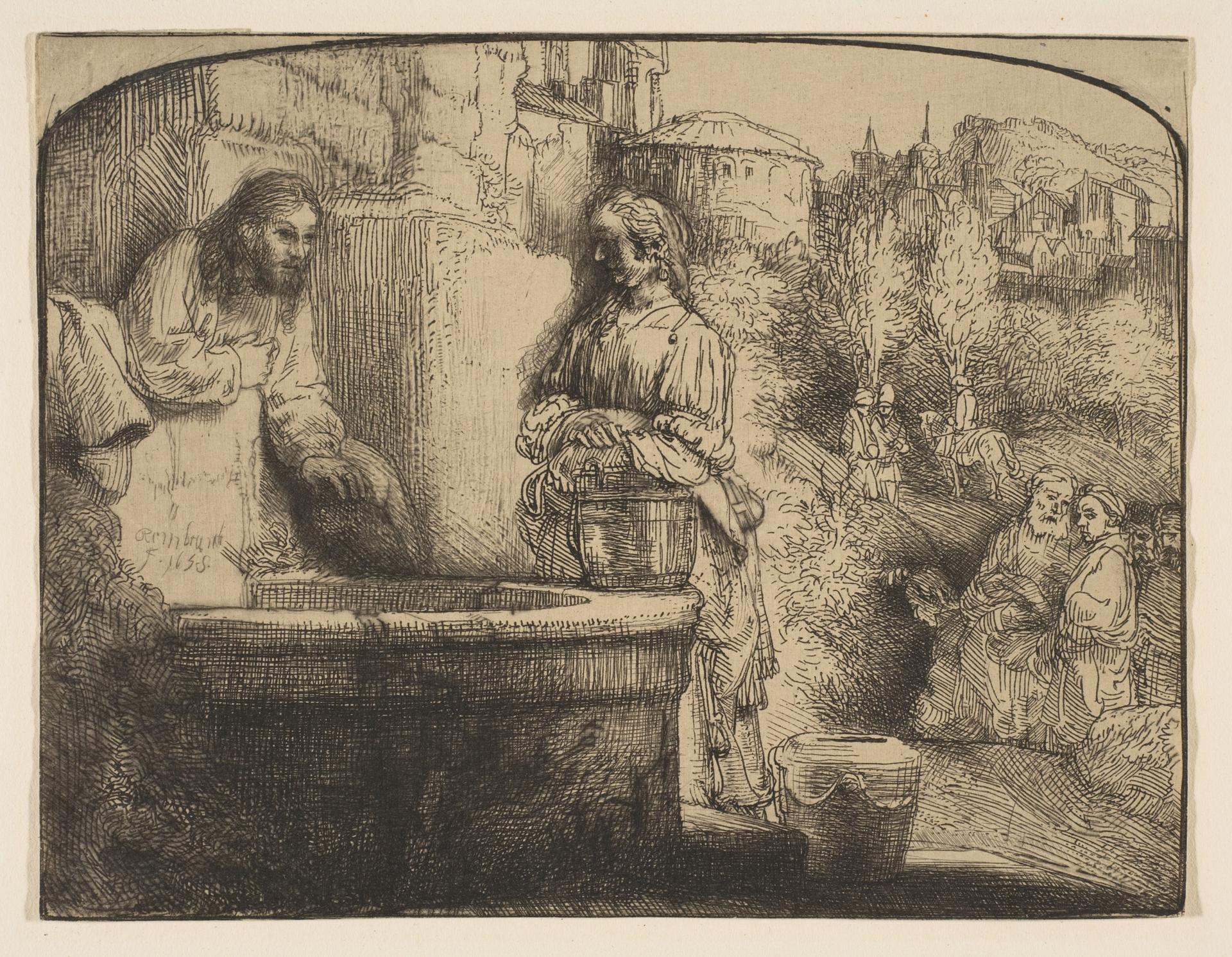
Rembrandt made this etching with drypoint in 1658, capturing the biblical encounter between Jesus and the Samaritan woman at the well of Sychar. The impression measures 12.3 × 15.8 cm and comes from the third of five states. The action unfolds in an urban setting, enlivened by various secondary figures.
Description
On the left, Jesus leans over the well in a long-sleeved tunic, turning toward the Samaritan woman standing on the right, who carries a bucket. Behind the figures, buildings and trees suggest a town. In the street in the foreground, other people converse and watch the event. Fine lines and hatching, characteristic of etching, structure the monochrome image; light is distributed evenly, without harsh contrasts of light and dark.
Context
This print was created in 1658, during a phase when Rembrandt increasingly treated biblical subjects and valued etching as an independent medium. The Samaritan woman at the well refers to the Gospel of John (chapter 4), where Jesus speaks with a woman from Samaria. Rembrandt was known for imbuing biblical narratives with human warmth and everyday relevance. The work was made in Amsterdam, where the artist lived and worked at the time.
Impact
A calm, almost intimate mood pervades the encounter, supported by the delicate linework and even light. The scene feels both ordinary and significant, prompting the viewer to reflect on the conversation. The secondary figures add narrative depth without distracting from the central meeting.
Technique
For this print, Rembrandt combined etching and drypoint, and also used plate tone to differentiate surface textures. The fine lines and hatching were created by etching and by direct scratching into the printing plate. The present impression belongs to the third of five states, indicating careful reworking of the plate.
AI-generated description text
Source: Metropolitan Museum of Art · Public Domain (CC0 1.0)